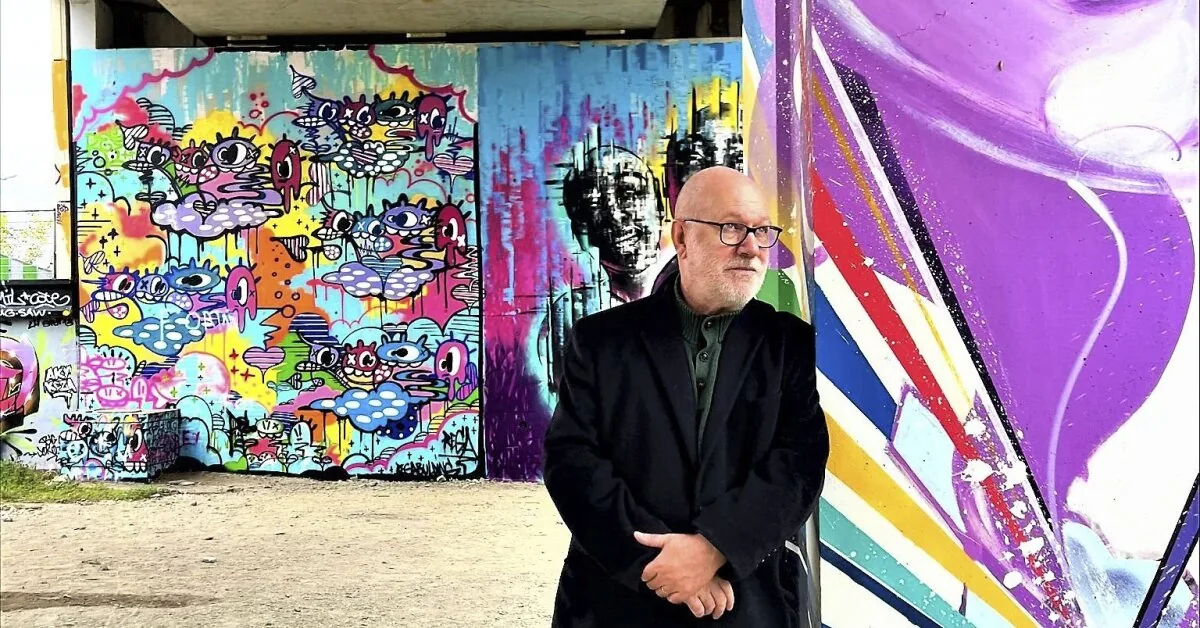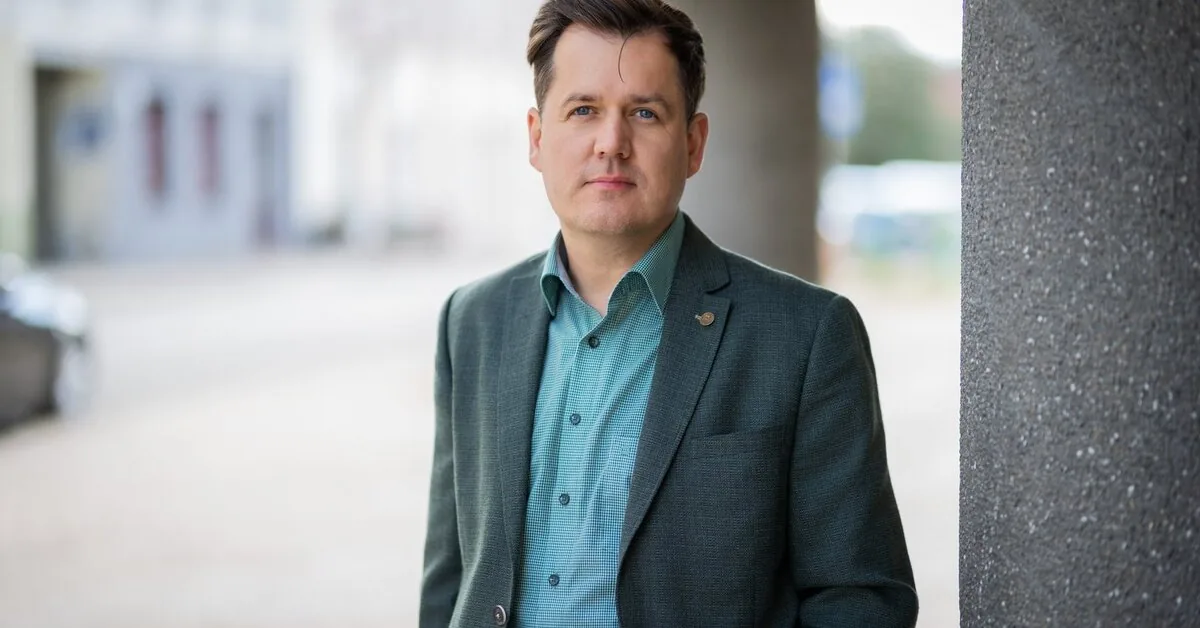
“You tell yourself – as a citizen, an artist, a writer to politicians – I also have to do something,” says M. Gailius, recalling the quickly made decision to run for president at a time when the association, as he says, was facing not only a reputational but also an existential crisis.
Read more After the scandalous statement by Donald Trump – South Korea’s reaction
In an interview with 15min, he talks about the current mood in the association, balancing duties, the vision of an electronic artist identity, the aim to include new members, and the idea of basic income for artists, heard from the Minister of Culture.
– It is likely that many people not active in the cultural field heard about the Artists’ Association for the first time when it came into the spotlight due to the position and statements of the former association president Jonas Staselis while he was serving on the LRT Council. How do you assess that situation? And how much did it motivate you to run for the association president?
– Like you and the new chairman of the Cinematographers’ Union, I was most motivated to change the direction of activity by the Cultural Assembly. You tell yourself – as a citizen, an artist, a writer to politicians – I also have to do something. We were seriously frightened. I’m sure we all went to listen to Čiurlionis’s “Sea.” I thought: I like editing – it’s a great pleasure because you can put unstructured material into one structure, and a writer’s job is also to structure thoughts into a plot. I decided to start making reels about politics and culture. I registered on TikTok. I didn’t want to become an influencer, I wanted to do something.
And then a window appeared. The Artists’ Association council expressed no confidence in Jonas Staselis – which was completely logical. At one event, I met an acquaintance translator. She asked if I knew about the announcement to lead the association. No, I said, I don’t know. Are you going? I’m going, I said. At that very moment, I agreed. I was in the right place at the right time. My life motto is a quote from Milan Kundera’s “The Unbearable Lightness of Being”: “Everyday life is silent, only coincidence is full of spells.” I don’t mystify, there is no magic here. But if there is such a perfect coincidence – that is a spell.
The association members are perceptive people. They did not sit still and most members declared no confidence in the president. That means they wanted to protect what they had.
– How did you see the association itself at that time? Did it seem that it was experiencing not only a reputational but also an existential crisis?
– Yes. As far as I know, members no longer wanted to pay membership fees. And that is already an existential question. And there is probably no need to talk about a reputational crisis. As you say, if many heard about the association at that time because of one person’s role, it means it started from a negative point. But the association members are perceptive people. They did not sit still and most members declared no confidence in the president. That means they wanted to protect what they had.
– “Most” is probably an important keyword. The association unites twelve creative organizations. However, those who followed the discussions that went viral in the media and social networks could notice that there are different positions among the members. What is the mood in the association today? What are the biggest frictions still about?
– I don’t think they still exist.
– Gone because the previous leader is no longer there?
– The former president took a kind of quasi-Don Quixote position. He was a fighter, that cannot be denied. I currently have no one to fight against. I try to listen to everyone. So far, I don’t hear anyone being upset about anything. And I have already directly heard that four members have different expectations.
– Expectations for yourself or for the association?
– About a third of the association members are opposition and probably have a different position on all issues. I don’t yet know what, but I will definitely try to find out. So far, there have been other important matters: e.g., re-registration, meeting with the Minister of Culture.
– Who makes up this opposition?
– I cannot reveal, I don’t know. The head of one union hinted about that group of four. I will try to find out. Probably it can be deduced. But it’s cool that there are different, even somewhat thoughtful people – I don’t see a problem. It is very normal in any democratic format to negotiate and make decisions by voting. As long as statehood is not harmed, as long as there is no talk against Ukraine – until that point is reached.
– Can it be said that this would be your red lines as president?
– Then, as a single management body in the council, I would raise, for example, ethics or no-confidence issues. I cannot demand the union to overthrow the leader, but the issue can be raised in the association council format.
– You are a press representative of the Liberal Movement faction. How did the party and faction react to your new role in the association?
– The party chairwoman Viktorija Čmilytė-Nielsen, who is also the faction leader, reacted. I approached her as a faction employee. She was pleased and wished me strength. It was important to clearly discuss incompatibilities: how public duties conflict or overlap with civil servant duties.
In principle, when we talk about responsible jobs in the state, it is not good to sit on two chairs.
– I want to ask about incompatibilities. It is natural that tensions may arise, considering that the association itself seeks to influence political processes. How do you plan to address this, what safeguards will you put in place?
– First, since the association is a registered influencer, according to the Law on Legislative Foundations, I will have to fill out a form and declare influence activities at the end of the year. Due to the delay in re-registration at the Register Center, I still don’t have access to the bank account, I cannot log into Skaidrio. I will find out how to register each case of influence. Today [August 12] was the first – a meeting with the Minister of Culture.
And second, I apologized to the former Minister of Culture, Member of Parliament Simonas Kairys, that I will not help him anymore. In principle, I recuse myself from cultural policy issues in the Parliament. For example, I will freely write about the budget law, but if politicians, when discussing the budget law, formulate a thesis that cultural funding is insufficient, I would have to recuse myself from that. Because the press releases I prepare are signed with my name.
– Have there been doubts among association members about your role in the political field? Are all members comfortable with it?
– There were no doubts, but there were very practical questions. In principle, when we talk about responsible jobs in the state, it is not good to sit on two chairs. But in this case, the mitigating circumstance is that I am not a person directly executing politics in the Parliament. I just serve them, although with the possibility of influence. This is compatible.
The state can help an independent person by interfering as little as possible. This aligns with liberal ideology in terms of values.
During the association’s election conference, a question arose about dependence, let’s not hide, on the Liberal Movement. I can declare: yes, I have liberal views, with a social perspective, you could say social liberal. I support their policy and I think the life of self-employed artists, free creators is basically also a liberal life. The state can help an independent person by interfering as little as possible. This aligns with liberal ideology in terms of values.
– You mentioned that you had a meeting with the Minister of Culture. What did you discuss during it?
– The deputy minister Tomas Juočys also participated in the meeting. I asked that the Government’s action plan aims not only to make the Culture Council more efficient but also to restore funding to the previous period – 2025 – level and increase it. The minister agreed. We agreed to throw the new draft of the Artists and Artists’ Organizations Act into the trash.
Read more Exhibition of graphic artist Elvyra Kairiūkštytė’s drawings opened in Ukmergė
– Why?
– It lacks reality. The law should be more data-driven. The goals of the law are understandable, but the means are, to put it mildly, questionable. In my understanding, if the ministry undertakes to rewrite the law, it must present a truly new quality document.
There are very interesting ideas in the ministry. Maybe they sound utopian, but why not? One of them is basic income for artists according to the Irish model.
There are very interesting ideas in the ministry. Maybe they sound utopian, but why not? One of them is basic income for artists according to the Irish model, Basic Income for Arts. The minister himself raised this idea. The association will undoubtedly support it. The minister said very well – the state should not only allocate payments for downtime but also provide benefits to artists. This makes a very good impression. There are other, smaller ideas – very democratic, emphasizing that social partners and the community must be heard first.
– Does the current minister’s stated goal regarding next year’s cultural budget – to have at least no less funding than in 2025 – meet the association’s expectations?
– No, it does not. Lukas Alsys is an ambitious person and he cannot go with such a number – he must push for plus ten, plus twenty. How to do that? I am not a politician, that is his job (laughs). But reading the Government’s action plan, we see the strengthening of the Lithuanian Culture Institute’s role – that requires money. The establishment of the Cultural Heritage Fund. Doesn’t that require money? It does. I insisted that the overly cut funding of the Culture Council – the main instrument for artists’ activities – be increased. They say it will be increased. I named only three lines that need to be increased. And what about the lion’s share – cultural workers’ salaries?
– Besides the legislative processes you discussed with the minister, what other issues seem most pressing and important to raise politically for the association?
– Just as the association’s statutes are ten years old, so is the artist’s status no longer meeting modern conditions. Therefore, the draft of the Artists and Artists’ Organizations Status Act is truly needed, but it must be done very professionally.
The association and the ministry itself lack a clear understanding of what an artist is.
Fundamental things need to be fixed. The association and the ministry itself lack a clear understanding of what an artist is. One of the association’s goals for next year is to create a strategy outlining the economic role of the artist. I have a vision of an electronic artist identity. It would not be very difficult to do this, for example, linking it to a business account, an instrument adopted in the previous term. So that with one click you could go to a museum for free because artists can use such privileges, be exempt from taxes, or the state would pay your mandatory health insurance. And at the same time, you would feel a certain prestige.
The second important issue is sustainable cultural funding. How to do that? Basic funding could be one way, but whether it is the best – I am not sure either. It seems to me the best way is the Lithuanian Culture Council and other funds, like the Cinema Center, the Culture Institute’s activities, in which artists also participate. These programs must be increased. These are the most democratic instruments that keep the whole system alive.
Do we want to be an outstretched hand, or can we be like the Danes, Icelanders, where every tenth person is a novelist or poet? Not to mention how much they create in cinema, etc. Lithuania must set a strategic goal: when will the next “Sun and Sea” be? Unfortunately, I do not see that in the Government’s action plan.
– It seems there are fundamental issues that need to be reviewed. Does the association have the resources for that? And are the president’s duties paid?
– They are paid. The association council members decide what salary to allocate to the president according to the project funding from the Culture Council in the strategic funding program. Administrative expenses, i.e., the president’s salary, can be allocated no more than half of the funding received from the Culture Council.
– Because there are no more people in the administrative apparatus?
– No, there is only one employee. So let’s calculate. Currently, the association’s funding is 12,000 euros, so the president can be allocated 6,000 euros – about 500 euros before taxes per month.
– So the question remains: with these financial, administrative, and time resources, while holding other positions, is it realistic to achieve ambitious goals?
– It is realistic. I will write a project for the Culture Council. Currently, I am practically conducting a public procurement for a partner-consultant. That salary is not presidential. But union chairmen care – very cool, knowledgeable, and experienced people who themselves try hard.
– The association has so far carried out other activities more focused on promoting culture and the activities of the association’s members themselves. Will these continue? For example, will the Artists’ Awards remain?
– As a communications bachelor, communication is very important to me. The Artists’ Association is more of a strategic, lobbying organization. We do not bring symbolic weight, except for the LRT issue. However, this does not negate that belonging to your union and the association is power, value, honor, and benefit. At the election conference, one delegate reproached me: why, when running, do you talk not about the beauty of art, Bach’s fugues – here I paraphrase – muses, but about money, influence. I say, you make art. I want to talk about benefit, rating, prestige.
The Artists’ Association is more of a strategic, lobbying organization. We do not bring symbolic weight, except for the LRT issue.
And speaking about previous activities, the awards remain. It is a tradition. International cooperation remains and continues to expand. We will seek to join the Culture Action Europe network. And establish cooperation ties with the Nordic and Baltic countries. This opens new opportunities, e.g., European funds.
– Speaking of cooperation, the association unites different members, but not all artist and cultural operator unions operating in the country. Are there plans to expand the list of members and include those parts of the ecosystem that currently do not operate under the association’s umbrella?
– Besides ongoing legislative work, next year will be very important for clarifying the strategy. The second priority is international cooperation. The third could probably be strengthening the association with new members and regaining former members. For example, interdisciplinary artists, performing arts critics, film critics, designers – I would very much like them to join the association, this is my personal expectation. But I would keep some distance from the creative industries association. It is healthy to have some competition; there is no need to merge.
Read more After the report of a dangerous armed incident – police chase: footage released