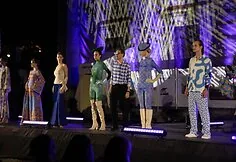
This year’s runway showcased sustainability far beyond just material choice. Designers grew crystals directly on textiles, entrusted dyeing to plants and natural processes, created from materials no longer needed by industry, revived slow handcraft and crafts passed down through generations. Alongside ecological solutions, themes of social sustainability, cultural and historical memory, neurodiversity, and the human relationship with clothing resonated strongly.
Read more Loud purchase: Liverpool officially presented Barcola
“Every year our designers remind us that sustainability has no single recipe. This year, the variety of interpretations was especially broad – from science and experiments with materials to very sensitive personal or historical stories. And probably most importantly, we see sustainability less and less as an additional feature of a collection. For the younger generation of creators, it becomes part of the creative thought itself,” says Indrė Jakaitytė-Gandžumian, head of SUSTAINABLE FASHION WEEK Vilnius.

“Young creators very clearly showed that sustainability for a designer does not necessarily mean limitation. On the contrary – sometimes it is precisely the limited amount of material, an already existing object, an old craft, or the necessity to seek another technological solution that opens a completely new direction of creation. Sustainability does not limit creativity – it provokes it,” says Serge Gandžumian, artistic director of SUSTAINABLE FASHION WEEK Vilnius and designer.
Impressive collections
The show began with Živilė Skurvydaitė and her collection “Village Woman,” rethinking the relationship between woman, nature, and clothing. Once a derogatory image, the “village woman” in the designer’s work becomes a symbol of intuition, strength, and independence. Nature here is not only an inspiration but also a participant in the creative process: fabrics are dyed with plants and natural pigments, using shibori, ice, steam, and pressing techniques, and part of the final result is consciously left to natural processes by the creator.
A personal story was brought to the runway by Rashad Phos (“Phos Incantation”) from the USA with the collection “All I Have.” Born after a difficult life stage, the clothes became a new chapter and a kind of armor against life’s negativity for the creator, where sculptural elements combine with comfort. The reuse of materials is a consistent part of Rashad’s work – he gives new life to worn and “deadstock” fabrics, chooses natural materials, consciously reduces microplastic use, and creates clothes adapted to different bodies.
The youngest participant in the festival’s history, Domas Balaišis, undertook a surprisingly broad creative experiment in the collection “Transferred Natural Assemblage.” He was interested in what happens to natural and other materials when they become unnecessary or no longer meet industrial standards. Collaborating with companies, farms, and breeders, the creator collected feathers, fur remnants, and other unused materials, combining them with recycled fabrics and threads. The collection’s idea was extended by a nonverbal story through dance, inspired by Latin American and African cultural expressions.
Jomilė Uksaitė’s “Tolimė” spoke about the search for privacy, closeness, and genuine connection in a technology-saturated world. Body-enveloping forms became wearable shelters, and the creator consciously returned to slow handcraft, local craft, and leftover materials. The collection was complemented by hand-felted woolen shoes made together with craftswoman Inga Samušienė, created following the “zero-waste” principle.
One of the most intriguing experiments was presented by Mija Mečanecaitė (“MIA MECANEC”) in the collection “Symbiosis.” Inspired by moss growth, crystal formation, and organic structures, the creator grew crystals directly on the fabric, allowing the process itself to shape part of the garment’s surface. Handcraft and slow fashion principles combined with experimentation in the collection, and textile leftovers turned into new decorative elements.
A completely different vision of the future was offered by Motiejus Lazauskas (“Performance”) in the collection “Analogs.” In a post-apocalyptic world, clothing becomes a survival tool and an object carrying its own story, with items chosen not for their original purpose but for what else they could become. The creator sought inspiration in post-apocalyptic cinema and character art, and did not hide scratches, stains, and imperfections of used materials – their previous life became part of a new aesthetic.
Marija Neimantaitė’s “Mistake” looked at sustainability from a social perspective. Dyslexia and neurodiversity here become not a deficiency to hide but a different way of perceiving the world and creating. The designer combined wool and cotton with gifted threads and unexpected everyday objects – beads, pencils, paper clips, or rulers, and hand-crafted surfaces emphasized individuality and the value of different experiences.




The theme of historical memory was very sensitively touched upon by Medeina Biliūtė in the collection “Beyond the Bleached Fields.” Drawing from experiences of exile, family stories, preserved objects, and handicraft traditions, the designer explored a time when creativity often arose from the necessity to make do with what was available. She transferred this principle into her creative process: using natural leather production leftovers and fabrics donated by sewing companies, with their limited quantity dictating constructions, layering, and improvisation.
Evaldas Kašiuba’s “Knitting” became a metaphorical story of liberation from excess. Like a butterfly leaving its cocoon, heavier collection structures gradually gave way to lightness and silk organza. The designer chose natural fibers – wool, nettle fiber, cotton, and silk – and slow felting and nuno felting techniques, contrasting unique handcraft with the culture of short-term consumption.
Read more This island in Poland hides a grim past: underground – a secret city prepared for nuclear war
Marija Bondarenko looked back to even older layers of cultural memory in the collection “GODDESS.” The Old European cultures studied by Marija Gimbutienė, the Great Goddess archetype, and Neolithic symbolism here took on a contemporary form. Themes of natural cycles, feminine creative power, and cultural memory merged with principles of slow fashion, handcraft, small-scale production, and durability.

8 young voices of Italian fashion
Longtime festival partner Rome University of Fine Arts (RUFA) brought a joint collection of eight young designers to Vilnius this year. This presentation alone revealed a very diverse approach to sustainability by the young generation of Italian designers – from hand-dyed and naturally dyed materials, reuse of denim and other textiles to biomaterials, “deadstock” leather and fabrics, repair, and zero-waste principles.
Alongside material experiments, young creators raised social issues – discussing the working conditions of fashion industry employees, fast fashion pollution, and responsibility for how and how much we produce. Some projects complemented the physical creation process with technologies that allow virtual garment modeling and reduce material waste even before production begins.

From production leftovers to sensory fashion
Rasmus Linde from Estonia presented the collection “Along the Line,” which grew from one unexpected material – production leftovers of 100% natural wool felt from Estonian footwear manufacturers OmaKing and Toku. The material, having lost its original purpose, became the basis of the fashion collection in the designer’s hands. However, “Along the Line” speaks not only about material transformation – the collection emphasizes the connection between bodies, the lineage of women, inherited memory, emotions, and relationships.
Olivija Steinsvik transferred the language of painting into fashion in the collection “Fabricated Impasto.” Color, texture, and layering here function like on a painting canvas, and the creator’s developed “painted fabric” technique allows textile leftovers to be combined into completely new fabric surfaces. Experimenting also with bioplastics, the designer adapts the creative process to the already available material instead of producing new ones.
Paulina Vitauskaitė’s “REMAINS” was based on old denim and the Japanese wabi-sabi philosophy, seeking beauty in imperfection and traces left by time. The designer deconstructed and recomposed garments but consciously preserved their pockets, seams, wear, and signs of previous life. The patchwork principle allowed using as much of the available material as possible – even the smallest denim scraps returned to new surfaces.
Grėtė Labanauskaitė (“LÁBA STUDIO”) further expanded the boundaries of social sustainability in the collection “Feeling.” For several years, the designer has consistently raised the question of whether fashion should primarily be experienced visually. In her work, clothing can be recognized through touch, sound, movement, and even smell, so the collection is accessible to people with visual impairments. The creator combined textiles with wood, metal, feathers, everyday objects, and bioplastics, turning fashion into a multisensory experience.
Sacred groves and contemporary “Baltica”
Estonian designer Nataly Järvik’s collection “In the Bosom of the Sacred Grove Tree” brought back to the runway the almost forgotten Estonian tradition of sacred groves. Tree spirits, forest rituals, ancestral stories, and a strong human-nature connection met here with knitting, crocheting, felting, and embroidery – crafts the creator learned from her grandmother. The collection used moss, birch bark, wool, cotton, raw silk, worn and leftover materials from previous works, and sustainability merged with the question of how to preserve not only resources but also vanishing knowledge.
The seventh SUSTAINABLE FASHION WEEK Vilnius runway was concluded by Almantas Kunskas (“House of Kunskas”), participating in the festival for the second time, with the collection “BALTICA.” The designer contemporarily interpreted ethnographic ornaments and symbols of Lithuania, Latvia, Estonia, Finland, and Poland, transferring cultural memory into today’s wardrobe. Recycled cotton and polyester fabrics, digital printing, and a capsule wardrobe designed for longer wear connected cultural heritage preservation with contemporary sustainable fashion principles in the collection.

Four-day fiesta with a grand finale
The final fashion show concluded the four-day festival program, which once again this year showed that SUSTAINABLE FASHION WEEK Vilnius aims to speak not only about the final garment. The festival began with creative sustainable fashion workshops at VILNIUS TECH, and the SUSTAINABLE FASHION SUMMIT Vilnius held at Vilnius Town Hall brought together scientists, designers, lecturers, and fashion professionals from Lithuania and abroad.
The conference discussed artificial intelligence opportunities for more sustainable fashion, new textile technologies, the potential of fiber hemp, biodesign, consumerism, and the future of circular fashion. Insights were shared by Prof. Dr. Eugenijus Skerstonas, ISM lecturer Kristina Maikštėnienė, FTMC scientist Dr. Ingrida Padleckienė, French textile designer Claire Deuffic, fashion engineering master and European Climate Pact ambassador Olesia Les, RUFA representative Guenda Cermel, and other Lithuanian and foreign experts.
Read more Incident at a woodworking company: fire in a high-pressure dryer