


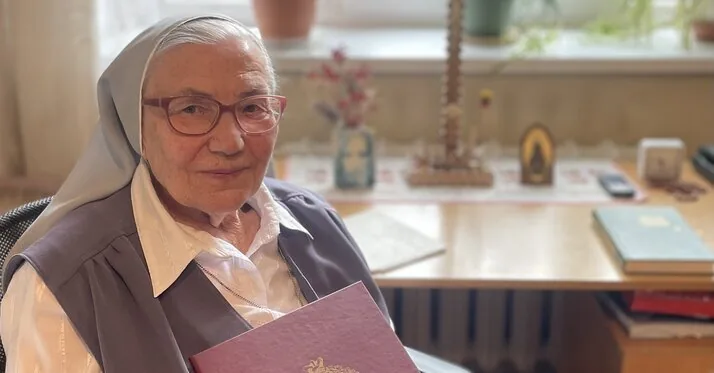
During her studies, she became interested in security because she could not stay silent during lectures when hearing lies or distorted historical facts. After spontaneously joining the 1956 All Saints’ Day student march in Vilnius, supporting the Hungarian uprising, she was expelled from the third year of the Vilnius Pedagogical Institute and became a constant subject of surveillance. Despite the persecution, she continued to hold to her beliefs, engaged in underground activities, and was not afraid of possible consequences because she believed in God’s protection and will.
Read more 2 times boiled megaconflict: why these tankers are attacked
Joined the Hungarian uprising
Elena Šuliauskaitė was born in 1932 in the Prienai district, Stuomenai village, in a peasant family. After graduating from Kazlų Rūda secondary school, she enrolled in the Vilnius State Pedagogical Institute. She chose to study psychology – the same specialty her older sister had completed. However, during the Soviet era, teacher seminaries where her sister worked were abolished, and psychologist training was discontinued, so from the second year she was transferred to Lithuanian language studies.
Troubles in her life began on the evening of All Saints’ Day in 1956, when students in Vilnius organized to support the Hungarian uprising. Sister Gerarda recalls that she joined the march spontaneously: “I saw a group of our people walking. I asked: what’s going on? They said: students are gathering. And I went along.” According to her, at first the students just walked around Rasos Cemetery, but soon she suggested going to the grave of Jonas Basanavičius and singing “Dear Lithuania.” “I thought, for this they definitely won’t do anything to us,” she says.
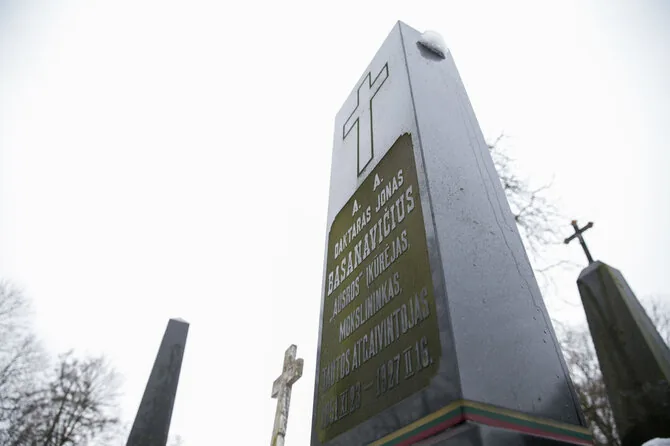
However, the protest soon turned into a political event. The students intended to march to the city center, but they were met by the militia. “They caught students and threw them into trucks like sticks,” recalled sister Gerarda. That time she managed to avoid detention, but interrogations soon began. She had already been on the authorities’ radar before – for a bold statement in a lecture. Once, when a lecturer explained that Lithuania had “joined” Russia, she publicly objected: “It was a division, not a joining.” To this, one activist replied: “Only an enemy of the Soviet Union could say that.”
After long interrogations, the student was informed that she was expelled from the institute. The official wording was formulaic: “Expelled for not justifying the title of Soviet student.” Her parents were not informed, but she rushed to find work, although even the simplest jobs were hard to get. “I went to ask for a job at a press kiosk, and they told me: working at the kiosk is political, so we cannot hire you.”
Dismissed from university for faith
Eventually, she managed to find work. For a while, she worked as a conductor, later as a telegraph operator, secretary, extra, assistant to a doctor-epidemiologist, warehouse manager, and accountant. At the same time, she became increasingly involved in religious life. “I started attending church very actively, got to know the sisters, and joined the Congregation of the Sisters of Christ the King Deacons,” says sister Gerarda. The sisters encouraged her to study because it was mandatory for nuns belonging to that convent to have higher education. “You haven’t finished university – you must enroll,” they urged her. No one wanted to accept her for full-time studies, but she finally managed to enroll in the part-time department of the Faculty of History and Philology at the then Vilnius State V. Kapsukas University (now Vilnius University, VU), where she graduated in 1968 with studies in Lithuanian language and literature.
After graduating, E. Šuliauskaitė began working as a lab assistant at the Faculty of History and Philology at VU, where her classmate also worked. However, Soviet security continued to follow her. Her activities with youth at St. Nicholas Church had a significant impact. Students gathered there, religious programs, processions, and meetings with priests were held. “At one such evening, priest Sigitas Tamkevičius was invited to participate. After Mass, there was a meeting attended by young people, and a newly arrived young altar server was invited to that meeting. As it later turned out, he was a security agent,” the interlocutor says. After this event, several students were expelled from VU, and soon it was her turn.
Sister Gerarda says she thought every day going to work about how long she would have to work there, and she constantly awaited a summons to the rectorate. And she got it: “I knew that one day that call would come. The university party activists gathered for a meeting, and I was told directly: ‘You belong to the Congregation of the Sisters of Christ the King Deacons, so you cannot work with youth.’ The administration suggested writing a request to leave work voluntarily, because otherwise, a note would appear in the work book stating that she was unsuitable for scientific work. Thus, she was forced to leave VU ‘voluntarily.’
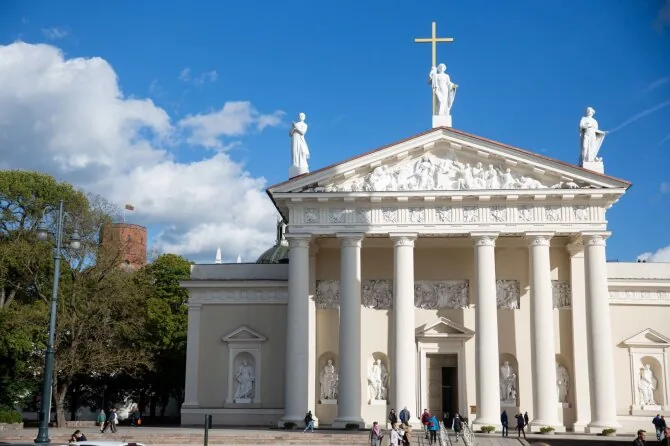
However, sister Gerarda herself did not consider this dismissal a tragedy. At that time, she had already decided to work actively in the Church. Moreover, during the Soviet era, nuns were encouraged to leave state jobs and serve in parishes – working as organists, sacristans, gathering youth, who at that time came to church in large numbers. “The youth were the scariest for them,” recalls sister Gerarda. According to her, the authorities feared most that young people would find community and a spirit of freedom in the church.
Engaged in underground activities
Despite the persecutions, E. Šuliauskaitė soon became involved in underground activities. In 1975, she became one of the main editors of the “Chronicle of the Catholic Church in Lithuania” – one of the most important publications documenting Soviet oppression. She simply recounts the proposal from S. Tamkevičius heard in Simnas to publish the “Chronicle”: “The priest gave me some texts and said: correct the language. Then he added – you will work on the ‘Chronicle’,” the nun smiles.
Before starting work on the “Chronicle,” practical instructions were given. Priest S. Tamkevičius advised dressing modestly and being prepared as if an arrest could happen at any moment: always carry a passport and a small amount of money – about 50 rubles – which was allowed to be taken to prison. But the most important thing was not to lead informers to secret workplaces.
“I remember when I traveled to Kybartai to publish the ‘Chronicle,’ I would change clothes on the train before getting off, take off my glasses (which I always wore), and put on a wig. Once, even a comrade did not recognize me,” laughs sister Gerarda.
The work of publishing the “Chronicle” was done secretly. The publications were typed on typewriters, copied through carbon paper, often in private apartments or remote places. For the first years, she edited the “Chronicle” and printed the first copies alone, then sisters joined her. They would come and work intensively on the “Chronicle” issue for two weeks, and after printing it, they would leave.
Thought she would end her life in prison
During the conversation, sister Gerarda emphasizes that this activity was closely monitored by security structures. Constant searches took place, and people were arrested for distributing or copying the “Chronicle.” Among those affected for copying the “Chronicle” were her close comrades, nuns: sister Ona Vitkauskaitė, Nijolė Sadūnaitė, Genutė Navickaitė, Ona Pranckūnaitė. Priest S. Tamkevičius, Alfonsas Svarinskas, Juozas Zdebskis, and others were imprisoned. She also always thought that sooner or later she would be arrested; this did not scare her but only encouraged her to act and trust God’s will. “I always thought I would end my life in prison; I could not even imagine otherwise. There was no sign of any hope that anything could change with Russia.”
Despite the constant threat, arrests, and persecutions, the “Chronicle” was published regularly – every two months. All work was carried out under strict secrecy and silence conditions: even ordinary conversations often took place in writing because it was believed that there could be eavesdropping.
The “Chronicle,” secretly smuggled abroad, was translated into various languages and spread the message to the world about the true state of faith and freedom of speech in the Soviet Union. This underground work, lasting at least nine years, became one of sister Gerarda’s most important life missions, for which she was awarded the Freedom Prize in 2021.
Still, she herself regrets that those who risked the most – the people who collected and passed information to the publication – are often forgotten in this work. “When you read the ‘Chronicles,’ you saw how many people risked because the published information had to include the name and surname of the person who provided it. Otherwise, it was not considered reliable and did not get into the publication,” says the former editor of the “Chronicles.”
History is not erased
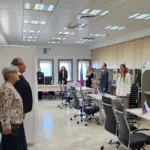
For the historical injustice she experienced – dismissal from university due to religious beliefs – sister Gerarda, a nun of the Congregation of the Eucharistic Jesus Sisters, was honored with a VU memory diploma – a symbolic sign of the university’s apology and recognition of her belonging to the VU community.
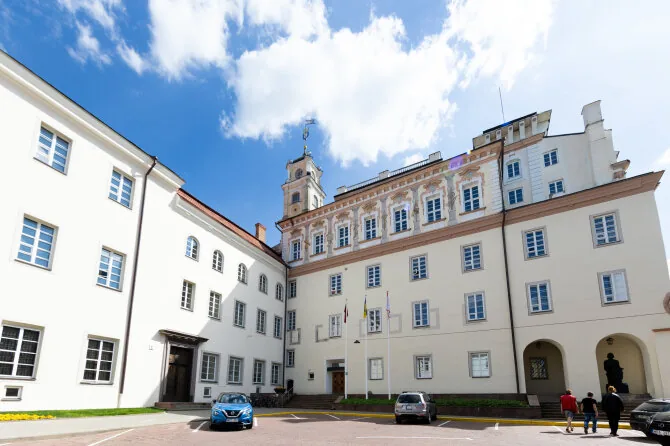
Asked what this means to her today, sister Gerarda is modest and says she does not feel deserving but emphasizes that she has always felt a strong emotional connection with the university environment and its people. She remembers the birch tree and fountain at the Faculty of Philology, where the university graduation photo was taken.
“I have always loved the university very much. For 12 years, both studying and later working there, I was surrounded by very good people – in the administration, the rectorate, and the academic environment. I am very grateful. I think it is very beautiful that history is not erased,” the nominee said while receiving the VU memory diploma.
Despite the difficult history of searching for life and professional paths, she remained a smiling optimist, remembers the university and its people brightly, proudly, and still calls it a “sanctuary of science.”
Read more Tragic scenes from Greece: two firefighter helicopters collided in the air