









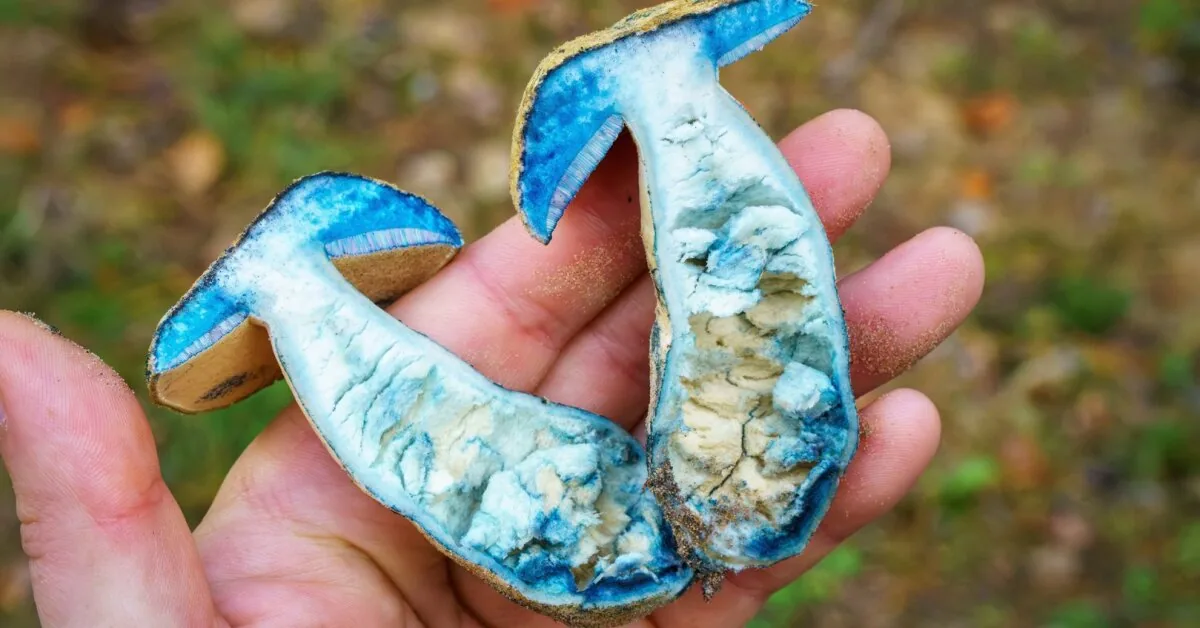
The woman did not expect that the biggest surprise would await her not in the forest, but already at home. After returning with her daughter, they began to clean the collected mushrooms and prepare to cook them.
Read more From the competition organizers – modest prizes for Meilutytė and Navikonis, but zero for Alekna
“When I cut that mushroom, I was even scared. It instantly started turning blue – the longer I looked, the bluer it became. I had never seen a mushroom change like that before,” recalls a 15min portal reader.
At first, the woman didn’t even know what to think – whether such a mushroom is edible at all, or if its bluing indicates that it is poisonous.
“I thought it might be better not to take the risk. After all, you don’t know what kind of mushroom it is. So I just threw it away and kept the saffron milk caps,” she says.
Still, curiosity remained. Irena wanted to find out what she had actually found in the forest and why the cut mushroom turned blue so strongly.
“The most interesting thing was that in the forest it looked completely normal. Only at home, when I cut it, did I see the bluing. I wonder if other mushroom pickers have encountered this?” the woman wonders.
Are these mushrooms really dangerous?
Since Irena herself was not sure what she had brought from the forest, we asked a mushroom expert to look at her story.
Jonas Kasparavičius, a researcher at the Mycology Laboratory of the Botanical Institute of the Nature Research Centre, recognized the mushroom from the woman’s description and explained that it is the blue-staining slippery jack. The mycologist even calls this mushroom the “mushroom picker’s nightmare.”
Why does it turn blue so quickly when cut, whether such a mushroom can be put in the pot, and how to distinguish it from other slippery jacks – J. Kasparavičius explained all this in an interview with 15min.

– Why does the blue-staining slippery jack turn blue when cut or damaged – what happens inside the mushroom at that moment?
– The mushroom’s flesh cells contain a compound called variegatic acid – a natural orange pigment of mushrooms. The name of this substance is related to the fact that it was first isolated from the yellow slippery jack, or Suillus variegatus. When the slippery jack is cut, broken, or pressed, part of its cell structure is disrupted and variegatic acid reacts with atmospheric oxygen. The reaction is not entirely spontaneous; it is catalyzed by specific enzymes in the mushroom – oxidases.
The reaction produces an unstable bright blue substance called quinone methide. Over time, this blue substance can further oxidize, fade, or turn grayish-brown (transforming into other pigments). The original substance (variegatic acid) has strong antioxidant properties and is used by the mushroom not to scare mushroom pickers or animals, but to reduce iron compounds in dead wood. In other words, to break down some compounds of dead wood. It is possible that it also participates in the mushroom’s defensive reactions.
– Does the bright bluing of the mushroom mean it is poisonous, or is this just a misleading belief among people?
– Since this substance is probably present in all boletes, including the true bolete (although in very small amounts, so we don’t see its bluing, even though it does occur), and most of them are good edible mushrooms, it seems that it does not have any significant negative effect on most of our bodies. It may even be the opposite, meaning it could be beneficial.
Read more Special Dakar anniversary for Lithuania: the first Lithuanian started in the desert 30 years ago
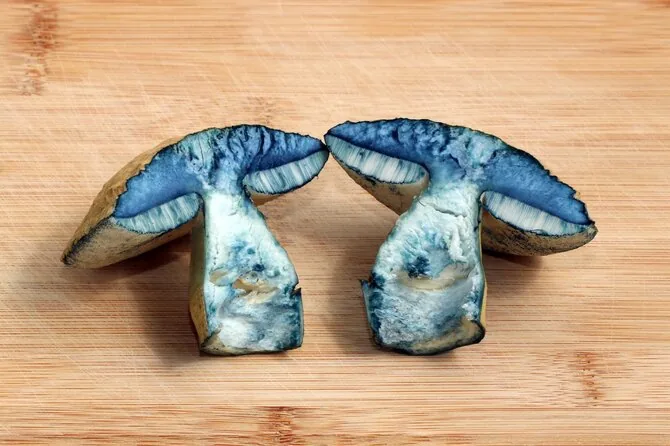
This mushroom is a very good example that we humans do not understand mushrooms or understand them incorrectly. It is common for us that both our skin and various plant-based substances change color when damaged or decomposing. Unfortunately, in the world of mushrooms, it is a bit different, but we evaluate everything based on our understanding and sensations, which in the case of mushrooms mercilessly deceive us.
For this reason, when picking mushrooms, you cannot rely on your feelings or intuitions. The only advisor or helper is knowledge of specific mushroom characteristics, various mushroom atlases and identification apps, or people who know mushrooms. When this mushroom is thermally processed or dried, the blue color completely disappears, and the mushroom flesh becomes white again or takes on a gentle yellowish tint.
– How to distinguish the blue-staining slippery jack from other similar mushrooms – which mushrooms do pickers most often confuse it with?
– Not every mushroom picker collects slippery jacks. Even those who know them. Blue-staining mushrooms simply don’t go down well with people. Usually, from a distance at least, they confuse them with slippery jacks, faded boletes, sharp pine boletes, or light velvet boletes. It has even been mistaken for the devil’s bolete – what else would stain blue like that?
Usually, the slippery jack is unmistakable because of its bluing as soon as you pick it up. Often faint blue “bruises” can also be observed on growing untouched mushrooms. Whether these are the effects of hail, very intense rain, or, conversely, very hot, dry weather – is unclear.
Its cap is whitish, creamy, straw or sand-colored. Its surface is matte, dry, not smooth and coarsely fibrous (it looks like felt or slightly fuzzy). It usually grows from 5 to 15 cm in diameter. The underside of the cap of young mushrooms is whitish, while older ones yellow slightly. The stem is the color of the cap, smooth, without the “netting” characteristic of some boletes, nor other colored spots or small scales, or longitudinally protruding fibrous ridges. It is relatively thick, solid, but the stems of older mushrooms often have cavities, especially in the lower part (this is a characteristic feature of the genus Suillus).
– Is the blue-staining slippery jack a good, edible mushroom? Is the blue-stained part safe to eat?
– From what has already been said, it is clear that this is a good, edible mushroom. If someone took the trouble to crush or cut a fresh slippery jack into the smallest pieces, they could see that it all turns blue. Therefore, dividing it into blue-stained and non-blue-stained parts makes no sense. If it is fresh, not dried, not rotten, and does not smell bad, it can be consumed.
There is no data on the use of the blue-staining slippery jack in folk medicine, but scientific studies show that its fruiting bodies, besides other substances typical for mushrooms, contain a high concentration of biologically active 1,3-1,6-β-D-glucans. According to some studies, these polysaccharides may positively affect overall immunity and also have antioxidant effects. The variegatic acid that gives the blue color is also a strong antioxidant. Those who collect this mushroom consider it nutritious and tasty.
– In which parts of Lithuania and in what kinds of forests can this mushroom most often be found? Could there be more of it than usual this year?
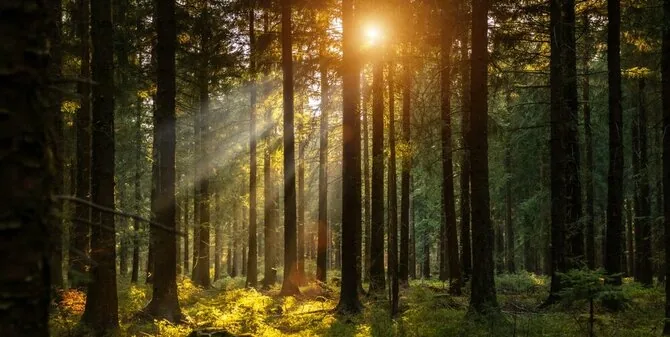
– The blue-staining slippery jack grows throughout Lithuania, it is not rare, but it is hard to call it very common. It likes light, sandy soils. It suits both deciduous and coniferous forests, but it most often grows near pines, with which it is physically associated – forming mycorrhiza with their roots. It prefers more open, bright places.
Since few mushroom pickers collect them, and they do not grow in large groups, usually growing singly, although not very rare, even those who collect them usually never gather many. Their yields, like those of other mushrooms, vary from year to year, but it is difficult to judge their abundance. Due to unstable, changeable weather, there are some doubts about the possibility of a large yield this year.
Read more Virginia Woolf «In Search of a Room of One’s Own» – a literary journey through England


