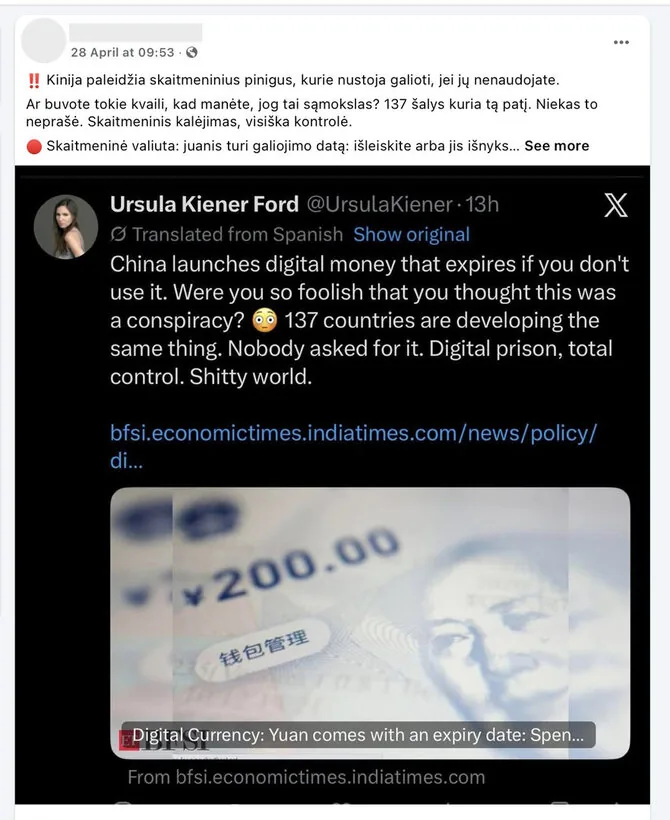
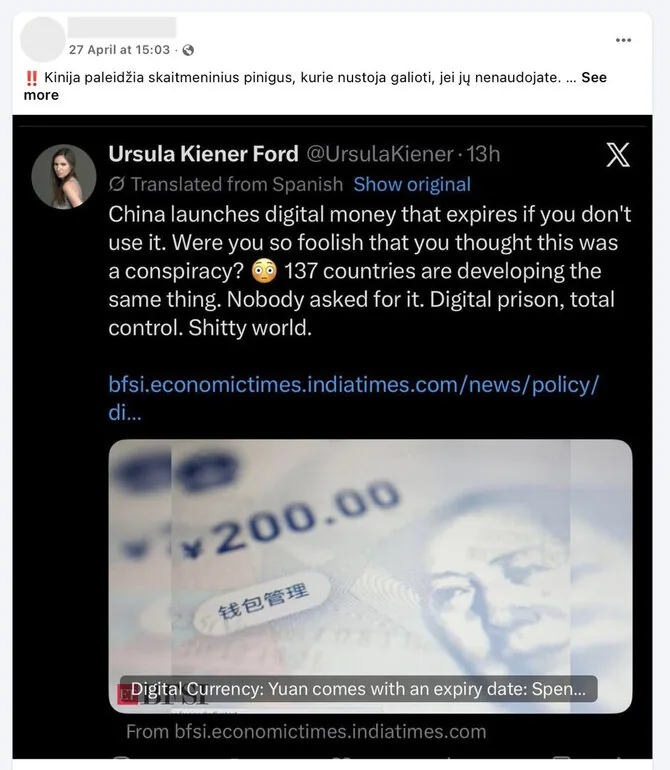
Were you so foolish as to think it was a conspiracy? 137 countries are doing the same. Nobody asked for it. Digital prison, total control.
Digital currency: the yuan has an expiry date: spend it or it disappears. China’s digital currency is programmed to have an expiry date, which allows its central bank to effectively stimulate consumer demand or set negative interest rates if necessary.
The Keynesian dream of increasing the velocity of money may finally come true.
China is considering expiry dates with its upcoming digital yuan (DCEP). This means that the currency will expire if not used within a certain period (language unedited – ed. note).”
It is accompanied by a screenshot of another post from the social network “X” published earlier. Part of the quoted text is simply a translation of this from Spanish.
The latter also included a link to an article from the Indian website “The Economic Times”, which states that “China is experimenting with expiry terms for its upcoming digital yuan (also known as DCEP – Digital Currency Electronic Payment, Digital Currency Electronic Payment)”. This reportedly means that the currency will expire if it is not used within a certain period.
Understand instantly
Did China really bring together 16 countries into one payment system to bypass the dollar?
Digital Euro – Europe’s response to US giants or a new tracking tool?
ECB head: Eurozone must strengthen the international role of the euro
“The digital yuan is programmed to allow for an expiry date, thus forcing consumers to spend it by a certain date. This is an unexpected turn towards a little-known, unconventional monetary policy innovation called Gesell currency – money with an expiry date, which gives the issuing government greater control over the velocity of money,” the article explains.
DCEP is a digital version of China’s physical currency, the yuan, a legal tender issued by the central bank. As a digital unit, it is stored in digital wallets, the article states.
However, social media posts omit an important detail – this article was published in April 2021, and some of the information presented in it is outdated.
They offered to pay for money
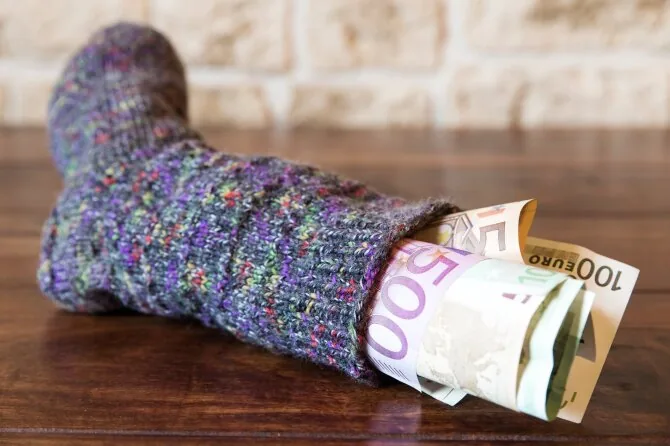
The aforementioned Gesell currency is what is known as depreciating money (figuratively described as demurrage, shrinking, oxidizing, or rusting). It is mentioned in the comments under the “X” user’s post. This is an economic concept meaning that over time, money naturally loses some of its value if, instead of being spent or invested, it is simply kept “in a sock” or a bank account.
This concept was proposed in the early 20th century by the German-Argentine economist Silvio Gesell (1862-1930) to prevent money hoarding. He explained that traditional money (banknotes and coins) has an unfair advantage over physical goods: a farmer’s tomatoes rot, and a manufacturer’s goods depreciate, but a rich person’s accumulated money remains unchanged.
To eliminate this asymmetry, S. Gesell proposed that money should have a certain “balance price.” This was represented by a paper stamp. For a banknote to be valid until the end of the month, the owner had to purchase an inexpensive stamp (e.g., for 1 percent of the money’s value) and affix it to the other side. This aimed to increase the velocity of money and prevent capital stagnation. An example of this process in modern times is negative interest rates, where a person does not receive a certain percentage for a deposit held in a bank but has to pay for it themselves.
The idea was controversially received, but it was praised by one of the most influential economists of the 20th century, the Englishman John Maynard Keynes.
Trial coupons were temporarily valid
In Shenzhen, the authorities distributed 10 million yuan (approximately 1.27 million euros at the current exchange rate) worth of digital currency through a lottery. Nearly 2 million people had submitted applications, and 50 thousand were successful.
Lottery winners had to download a special app to receive a “red packet” worth 200 digital yuan (approximately 25 euros). They could spend this money at over 3 thousand designated retail outlets in the city’s Luohu district. Residents could shop at pharmacies and supermarkets.
This was intended not only to test the digital yuan technology but also to encourage consumers to buy as the COVID-19 pandemic began. The digital yuan currently in use (referred to as digital RMB – after renminbi, the name of this currency in Chinese, or e-CNY) has even been equated to bank deposits since the beginning of this year. Interest is paid on them, and deposit insurance applies.
15min verdict: lacks context. The digital yuan introduced in China does not have an expiry date. Coupons issued to people testing pilot digital money applications were valid for a certain period.
This publication was prepared by 15min in cooperation with “Meta”, aiming to curb the spread of misleading news on the social network. More about the program and its rules – here.