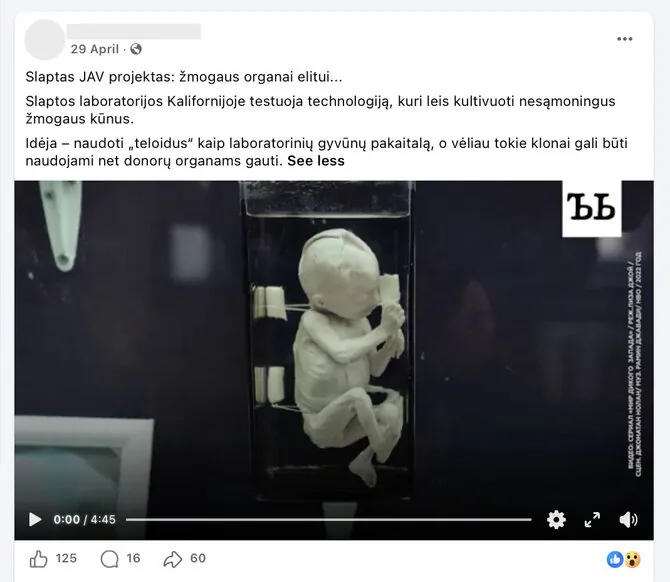
Secret laboratories in California are testing technology that will allow cultivating unconscious human bodies.
The idea is to use “teloids” as a substitute for laboratory animals, and later such clones could even be used to obtain donor organs.”
The video she posted together to present this technology has been viewed 2.8 thousand times, received 125 reactions, and was shared by 60 people.
The nearly 5-minute film explains that “bodyoids” will replace animals in laboratories and become an inexhaustible source of human organs for transplants. This is the ambition of the biotechnology startup “R3 Bio” from California.
“A ‘bodyoid’ is an artificially grown body with a minimal amount of brain, just enough to maintain essential bodily functions,” the voiceover explains. “Another name is ‘bag with organs,’ meaning something without consciousness but at least useful for science and medicine.”
Understand instantly
Scientists speculate – when could the first printed organ be placed in a human?
Winter records: in January, transplants gave 44 new lives
The word “teloid” used by the quoted internet user is the same as “bodyoid,” just in Russian. This name is derived from the word тело, meaning “body” in Russian, and the suffix -oid, meaning “similar to” (for example, “asteroid” – similar to a star, “android” or “humanoid” – similar to a human). This shows that the woman shared information published by Russian-speaking sources and confirms that it is spreading more actively online from Russian sources.
“Rumors are spreading on social networks that the startup is actually aiming for mass creation of full clones,” the film later says. “Eventually, it will be possible to transplant brains from old, sick bodies, radically extending human lifespan.”
The video even repeats an earlier spread lie that then US President Joe Biden died back in 2020, and a clone was seen in public.
Also read: “Likely, I will be dead in 2020”: what do these long-ago spoken Joe Biden words mean?
Also read: Did Joe Biden’s granddaughter really announce the president’s death and that he was replaced by a twin brother?
The film mentions a real idea that could help if human organs are needed for laboratory research or transplantation, but it has not progressed beyond the theoretical level. One of the obstacles is the ethical issues mentioned by internet users.
The legend is spread by Russian speakers
This innovation was recently discussed in the Russian internet space: on social networks, various websites. “In closed California laboratories, technology is being tested that will allow growing human bodies without consciousness,” it was claimed on social networks Vkontakte, Threads.
Also read: Do older wealthy people really target children’s blood to stay young?
Also read: A legend to scare the gullible: Ukrainian soldiers abroad become organ donors
It is also explained that life extension technologies are available only to “chosen” world leaders and billionaires. This information is based on unspecified sources, secret CIA programs, or “black transplantology.”
But the rumor about an alleged secret US project – creating human organs for the chosen – is a conspiracy theory. It has no scientific or documentary basis.
The truth is that the US startup “R3 Bio,” invested in by Silicon Valley billionaire Tim Draper and the Singapore-based longevity fund “Immortal Dragons,” has indeed proposed to grow a whole organ system in the lab without a brain that could replace animals used in experiments.
This idea was born out of a shortage of human biological materials. Thousands of people are waiting for various organ transplants, many die without ever receiving a suitable donor. Clinical trials of new drugs take many years and cost billions, and only about 15% of them are ultimately approved.
So there is hope that artificially grown organs would help save many lives (and could even be tailored to a specific patient’s body) and reduce research costs.
To address these problems, the idea of bodyoids was proposed. These are laboratory-grown human biological structures designed so that organs and tissues develop within them, but they would have no brain, consciousness, or ability to feel pain.
Faceless, brainless systems created from stem cells – heart, liver, kidneys, not just isolated tissues – would be intended to grow transplantable organs, test drugs individually, and replace animals in medical research.
The creation of “bodyoids” is based on three technologies: pluripotent stem cells (capable of turning into any of the three germ layers – ectoderm, mesoderm, or endoderm – and developing into any adult tissue type), artificial wombs, and genetic methods preventing brain development.
Also read: Babies from incubators? It’s too early to be angry – artificial wombs are not yet used
This technology is still very speculative, not yet common medical practice, only a scientific research proposal and a subject of active discussion.
Obstacle – ethical issues
One of the biggest obstacles to developing the “bodyoids” idea is ethics. The technology’s creators and supporters claim to offer a humane alternative to animal suffering in laboratory tests. According to Stanford University scientists, it is time for such discussions.
Critics, in turn, express concern about the ethical consequences of creating human-like bodies, the risks of human experiments, and possible abuse.
Discussions about “bodyoids” emphasize that legally they would be biological resources without consciousness, not human patients. However, it is still unknown whether these organisms would truly lack even the slightest consciousness and be unable to feel pain.
It is unclear where the limits of such technology’s use would be, or whether it would be accessible only to wealthy people, as it would undoubtedly be very expensive. Other unanswered questions: how long would the organisms be grown (up to human maturity?), whether such a being without consciousness and feelings would have certain rights, what would be done with the organism after taking the necessary organs or using it for research.
Until detailed answers to such questions are available, the “bodyoids” technology remains in the consideration stage.
15min verdict: lacks context. One US startup has indeed proposed growing organisms with human organs and tissues in laboratories that could be used for transplants and medical research, but this idea is still only considered theoretically and criticized for ethical reasons.
Publication prepared by 15min in cooperation with Meta, aiming to stop the spread of misleading news on social networks. More about the program and its rules – here.