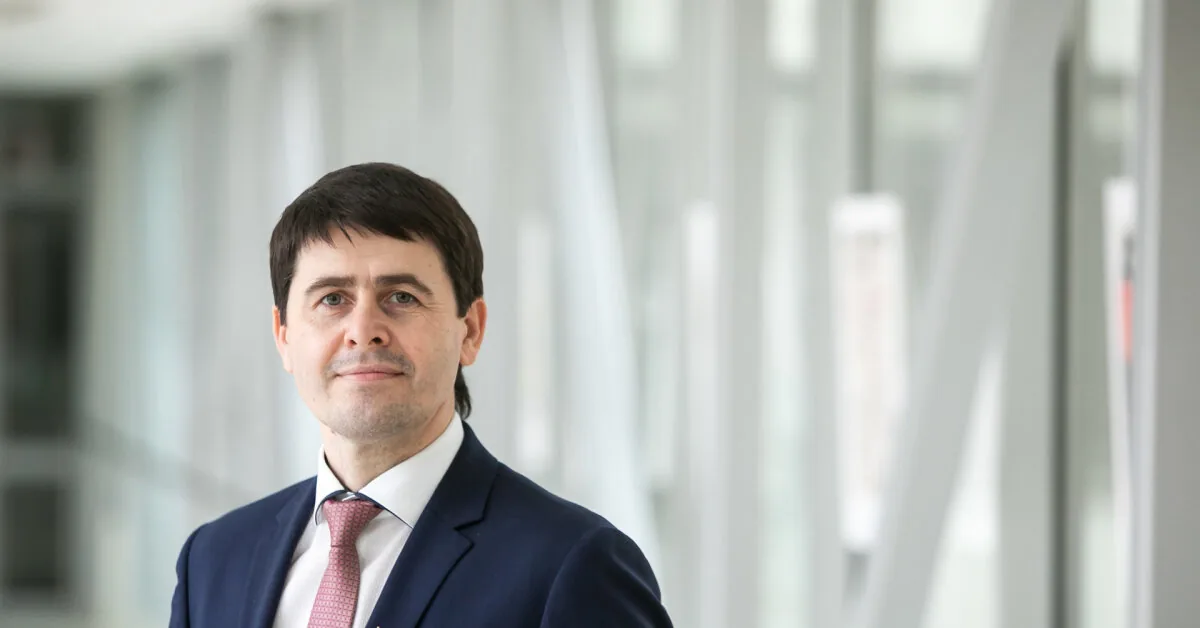
This is not the climax of a conflict between two politicians from Kėdainiai. It is a matter of bullying, responsibility, and hypocrisy in power. Especially when the person associated with the anonymous attack works in a ministry that itself talks to schools about bullying prevention, respectful communication, and responsibility for publicly spoken words. That is why this story inevitably goes beyond the reputation of a single politician. It raises a fundamental question: can a person associated with secretly conducted attacks against a political opponent continue to work in an institution that teaches children and schools respect, transparency, and responsibility on behalf of the state?
Read more Vilnius has started preparations for the winter holidays: merchant registration announced
Two complaints hinting at a much broader phenomenon
Member of Parliament V. Fiodorovas says that boundary-crossing anonymous attacks against him on social networks have been happening since 2023.
“The same writing style, the same rhetoric, the same photomontages, the same scheme: posts, comments, doubts, hints, and attempts to form distrust pour into various Kėdainiai region ‘Facebook’ groups from anonymous profiles and ‘anonymous participants’,” says V. Fiodorovas.
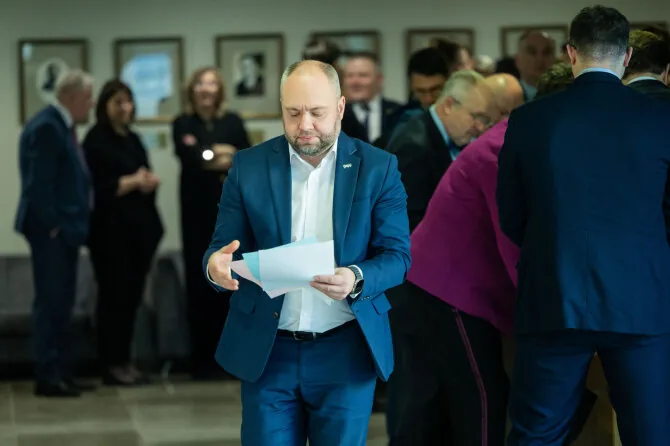
The MP turned to law enforcement back in October 2025 only because of two specific cases – not because there were no more defamatory comments, but because collecting, documenting, and complaining about all the anonymous attacks that poured in over two years would have taken a lot of time. According to V. Fiodorovas, it was enough to take a couple of the most striking examples to assess not a single comment but the very manner of operation.
One of the complaints was filed regarding comments and the post itself under the post “When will you start working in the Seimas?” in the Facebook group “Kėdainių bėdos.” V. Fiodorovas asked law enforcement to evaluate the actions of the comment authors as defamation (Article 154 of the Criminal Code) and incitement against a national group (Article 170 of the Criminal Code).
Some of the quoted comments written by an anonymous person certainly did not exude a respectful tone. Rather the opposite – political criticism was mixed with disparagement, emphasis on national origin, and attempts to label disloyalty to the state:
“J. S., just like you yourself work as Fiodorovas’s advisor with five convictions. And Russian Fedya is a cheap ‘PR man’ who cannot overcome a poor college”; “what difference does it make to you, Kėdainiai belongs to everyone, donkey, but for some reason Russian Fedya sits on the throne, and you yourself hide behind anonymity to comment”; “by the way, has this MP served in the Lithuanian army or joined the Riflemen’s Union? Will he be loyal only to the kacaps if they come?”
V. Fiodorovas himself emphasizes that he is Lithuanian, never belonging to any other national community. However, in anonymous comments, he is consistently called “Russian Fedya”, questions are raised about his loyalty to the state, and attempts are made to link him to a very sensitive social and political context as Russia wages war against Ukraine. In other words, the comments tried not only to ridicule but also to form a narrative that V. Fiodorovas might be less loyal to Lithuania simply because of his Russian roots.
The other subject of the complaint was another post sharing a photomontage combining the 15min.lt article headline “Seimas spendthrifts: who spent the most parliamentary funds in half a year?” with the parliamentary activity expense data published by the Seimas about V. Fiodorovas.
The investigation confirmed that V. Fiodorovas did not actually make it into the “top eleven” mentioned by 15min.lt – his name was not there, and journalist Ramūnas Jakubauskas confirmed this in writing to the police officers.
After V. Fiodorovas’s complaints about these posts and comments on Facebook, law enforcement started a pre-trial investigation.
“On October 31, 2025, a pre-trial investigation was initiated under Article 154, Part 1 of the Criminal Code ‘Defamation’,” the prosecution stated.
After completing the investigation in mid-May this year, the prosecution provided MP V. Fiodorovas with an explanation that he has the right to demand in court the retraction of disseminated data that demean a person’s honor and dignity and do not correspond to reality, as well as to compensate for the material and non-material damage caused by the dissemination of such data (Article 2.24, Part 1 of the Civil Code).
Author’s note.
The group administrator revealed who hides behind the masks of the anonymous
Essential testimony in the investigation was given by the administrator of the Facebook group “Kėdainių bėdos,” where MP V. Fiodorovas was defamed.
Apparently, some anonymous users forgot that anonymity does not protect from the administrator’s eye, and upon law enforcement’s request, information about the anonymous users is provided.
In the witness’s testimony and in seven voluntarily provided photos of her group’s activity logs, it is clearly visible that on October 14, 2025, at 23:09, she confirmed the anonymous post by Tomas Bičiūnas “When will you start working in the Seimas?”
The next day, after receiving V. Fiodorovas’s complaint about false information, she deleted the same anonymous comment by Tomas Bičiūnas with the photomontage.
It turned out that some comments in which V. Fiodorovas was disparagingly called “Russian Fedya,” “PR man,” and other discussion participants – “donkeys”, were not written from Tomas Bičiūnas’s profile. They were written from an obviously fake, so-called “bot” profile named To Mas. Apparently, just an incredible coincidence – and, of course, pure chance.
Has the right to demand retraction and compensation
After this investigation, the pre-trial investigation was terminated, stating that the comments were assessed as emotional, polemical evaluations, and politicians, as public figures, are subject to broader permissible criticism limits.
This is purely a legal assessment. It cannot be understood as confirmation that there was no anonymous attack against the politician.
There was. It just did not reach the threshold of a formal criminal case. However, the moral, professional, and political assessment begins exactly where criminal law stops.
After completing the investigation in mid-May this year, the prosecution provided MP V. Fiodorovas with an explanation that he has the right to demand in court the retraction of disseminated data that demean a person’s honor and dignity and do not correspond to reality, as well as to compensate for the material and non-material damage caused by the dissemination of such data (Article 2.24, Part 1 of the Civil Code).
Will not go to court
V. Fiodorovas himself says he will not go to court and does not need anything from T. Bičiūnas.
Read more Augonė Žygeda. How Scammers Test Our Vigilance with Fake Links
“I had even forgotten that a politician like Tomas Bičiūnas exists at all.
Well, the other thing is – I do not need anything at all from Tomas Bičiūnas: neither his money nor his apology, because if there were an apology, it would be insincere,” says V. Fiodorovas.
The politician does not hide that since 2023, during the systematic attacks against him on social networks, he has long understood the mechanism of how that attack works.
“The scheme possibly involves several subjects. One of them is a local blog writer who writes an article, and later, according to those schemes that have been operating for several years, the article starts to be shared from various anonymous profiles, from created profiles across all groups – trying to create the impression that there are many dissatisfied people who care a lot and raise mostly fabricated questions,” says politician V. Fiodorovas.
Kėdainiai is a small town, and the politician hints that he has heard from more than one person that the participants in such a scheme talk quite loudly without shame. Traditionally, half the town knows who is behind it, but until the court’s gavel strikes, pointing fingers is not allowed.
Anonymous attack costs mostly the politician’s family
V. Fiodorovas does not hide that what hurts him most is not himself but his family.
“All those nonsense writings, all those doubts, down to what family matters were descended and commented on – I feel most sorry when my children read them. They are old enough, they see these things, the social space is open to them, then all kinds of talks and rumors brew. It’s a pity they have to go through this and see such nonsense,” says the parliamentarian.
And here lies the essential nuance of this story.
T. Bičiūnas, before tasting the sweet fruit of power, was a teacher. So it is worth asking – what happens to a teacher who later became an advisor to the minister, that at a time when children, unable to endure bullying, come to school with knives, he himself appears in the anonymous space, inciting distrust against his political opponent?
“A teacher, knowing, working, and understanding how children react to any negative information, a person who has spoken out several times about bullying, an advisor to the Minister of Education at a time when topics about bullying in schools are discussed quite seriously… If Mr. Bičiūnas said in some debates that he sincerely cares about this topic, I would definitely smile. You cannot care about this topic when you behave like that yourself,” says V. Fiodorovas.
T. Bičiūnas found nothing to comment on, the ministry covered its advisor with a formal response
“Rinkos aikštė” addressed questions about this situation both to T. Bičiūnas himself and to the Ministry of Education, Science and Sports, attaching part of the anonymized investigation material – as neither T. Bičiūnas himself, according to his own statement, nor the ministry knew that the police had established that he created anonymous posts about a colleague from the Seimas on Facebook.
Responses came from two different sides – and probably the most telling part of this story is that within two minutes, the editorial office received practically identical responses from both T. Bičiūnas and the minister’s press representative.
“The sent copy (excerpt) text shows the content of the complainant’s complaint and the witness’s testimony, but not the investigation’s conclusions. Neither I nor the ministry have been informed about the investigation; I have not received any information about it from the responsible institutions, so it would be difficult to comment further,” says T. Bičiūnas.
The ministry essentially says the same. And no further comments.
Both, shoulder to shoulder, crafted responses are essentially not explanations but evasions. Saying “we do not see the entire investigation, so we cannot comment” would sound logical if T. Bičiūnas had been given questions that could only be answered knowing the motivated conclusions of law enforcement. But the questions were quite different.
We asked T. Bičiūnas why he chooses to discuss hiding behind an anonymous mask, whether he wrote comments and created posts during work hours, how this long-term campaign of forming a negative opinion hiding behind an anonymous mask fits with the fight against bullying, what his motives were, and so on.
T. Bičiūnas could have answered all these questions even without seeing any investigation. He knows perfectly well whether he wrote anonymous posts or not. He knows whether he did it during work hours or not. He also knows why he behaved that way.
In general, in this case, the argument that politicians – as public figures – are subject to broader permissible criticism limits is not even important. V. Fiodorovas, like any other MP, can and must be publicly criticized, disagreed with regarding his activities, have his votes publicized, questions raised about parliamentary expenses, answers requested, and political responsibility demanded.
But all this can and should be done openly: in your own name, with your own face, and taking responsibility for your words.
Ironically, T. Bičiūnas himself, while still an MP, reacted quite sensitively to every critical article about himself. But he did not have the courage to raise a discussion about another politician openly – in his own name, with his own face, with his own arguments. Clinging to a person’s parents’ nationality is at least low. After all, we do not choose our relatives.
Just as a person cannot choose their parents’ origin, they cannot choose the biographies, views, or public statements of other close relatives.
Three layers of social democratic shame
It is doubtful whether it is possible to further damage the party’s reputation than the social democrats have done in recent years. But this law enforcement investigation shows triple shame.
First – for T. Bičiūnas himself. A teacher now working in education policy, and a person whose name appears in the investigation material next to anonymous negative attacks against a political opponent.
Second – for the party, which declares social justice, respect, and tolerant discussion in the country’s politics, but whose member, as seen from the investigation material, tried to form a negative public opinion about an unfavorable colleague through anonymous comments.
Third – for the minister. After all, her personal trusted advisor is not an ordinary ministry employee selected through a competition. This is a person the minister personally chose for her team, who attends meetings with her, participates in shaping education policy, including anti-bullying policy.
If after all that is now known, this advisor continues to work calmly in his position, that is already an answer. And it is much more telling than any ministry attempt to hide behind the phrase “it would be difficult to comment further.”
Read more Lebanese media: Israel struck a vehicle near Beirut