The pretext for this conversation was the newly released book by the poet – a collection of the shortest poems “Emoticons and Interjections” (published by “Slinktys” publishing house). In this small-format booklet – more than three hundred poems from his four previous books, as well as recent works – something between haiku and even less.
Read more Utkus contributed with a goal and an assist to the team’s victory in the Saudi Arabian league
Laughter, absurdity, surprise, paradox, silences – these are probably the most important features of M. Valiukas’s work, which are especially effectively revealed in his short poems.
According to the poet himself, writing a two-word poem is not difficult, but writing a poem in which an event, a drama occurs between two words – that requires a lifetime of experience. However, the best, according to M. Valiukas, is when the poem strikes itself…
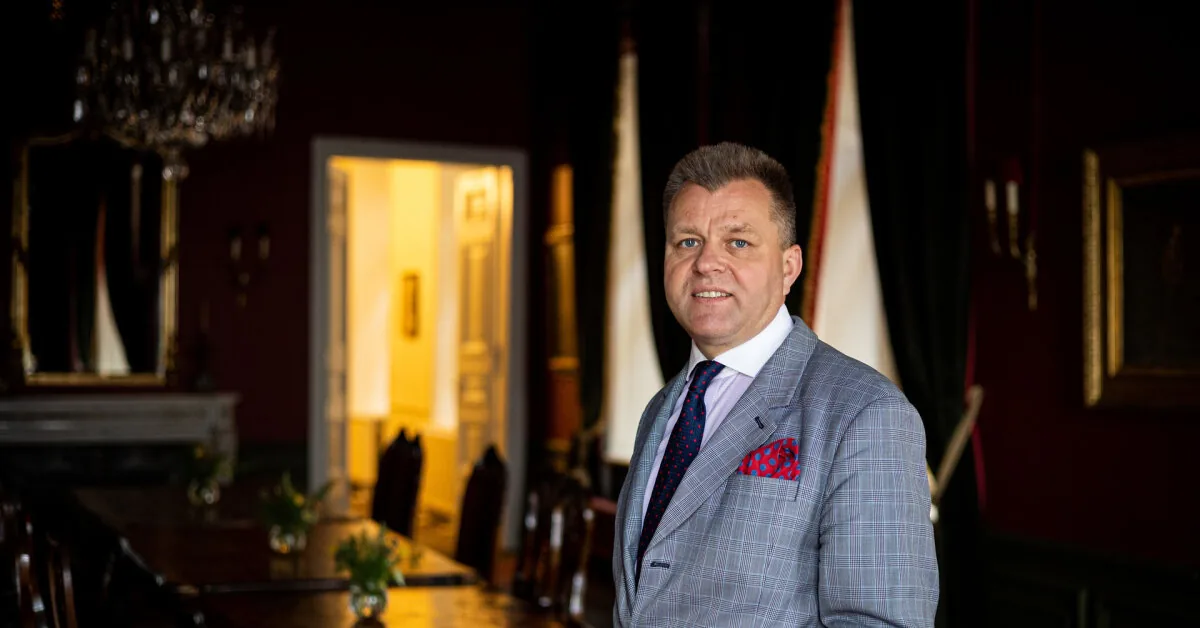
– Mindaugas, you recently celebrated your 50th birthday, and now we have a new book from you – a collection of the shortest poems. The anniversary is significant, but the booklet – at least in size – is quite modest. Didn’t you want a bigger effect for the anniversary – like a tour around Lithuania, a concert program with guest stars and fireworks?
– The format is small because the poems are small. But the book itself is almost four hundred pages. So there is a bit of a paradox: the shortest poems required my thickest book. It contains the best short poems from all my poetry books, with the newest ones in the last part. You could say it is both a collection and my latest poetry book in one volume. Thanks to the publisher, poet Juozas Žitkauskas!
And the anniversary was not very modest – my texts were read by national stars actors Nijolė Narmontaitė, Valda Bičkutė, Sakalas Uždavinys, Vaidotas Martinaitis, Gabija Jaraminaitė, Alvydė Pikturnaitė, and others. The witty but weighty word was spoken by maestro Rimantas Kmita. I still plan to travel around Lithuania with the book and songs. And the possibility of fireworks is not ruled out; I am already coordinating prospects with several libraries and churches.
– You not only write poems but also plays and scripts, perform songs yourself with a guitar, take photographs, have directed performances, and even acted. What do you currently devote most of your time and attention to?

– Theater, theater pedagogy, dramaturgy, screenwriting, and prose. Life’s prose and drama. And always a guitar at hand – I have been composing songs since I was sixteen.
Specifically, right now at the Telšiai Drama Theater, we are intensively rehearsing the play “God of Slaughter” with Valda Bičkutė, Andrius Paulavičius, and Daiva Rudyte. There are interesting theatrical plans with “LUMO studio.” Also, I am finishing a novel; maybe someday a bigger book will come out.
– Your debut poetry book “Moon Ceramics” was published almost three decades ago, and the new collection “Emoticons and Interjections” is your fifth poetry book. So the numbers speak for themselves – although the poems are short, you don’t write particularly much. But maybe that is your creative “strategy” – to write not only briefly but also sparingly?
– You should see my drafts… Books are just the tip of the iceberg. There are many ideas, even more notes; only texts that have undergone serious editing and selection make it into the books.
There is no particular strategy in writing poetry; I write when it flows, there are no deadlines, unlike commissioned texts. Also, I write not only short texts but also poems. Although thriftiness is a virtue. Besides, one book is lying around and slowly rotting, still unpublished.
– Donaldas Kajokas has said that as years pass, lightning strikes of poems occur less frequently because they simply become harder to bear. What is your experience with “emoticons and interjections”? Maybe they are not so demanding and “dangerous”?
With age, everything sharpens, and catching those strikes might even be easier. Because there is experience, and nerves don’t hold up as well.
– Both demanding and dangerous. And emotional, striking, and splashing, etc. This book has a very wide spectrum of emotions and even forms. Laughter, sadness, mourning, irony; haiku, senryu, micro-plays, micro-stories, standup poetry, etc.
And I would even say that with age everything sharpens, and catching those strikes might even be easier. Because there is experience, and nerves don’t hold up as well.
– Your book contains many tercets, although over time, it seems, a poem for you can be just a few words. Usually, this genre is associated with Japanese haiku, which has a very clear structure and syllable count. But you write your tercets disregarding the rules. So I’m curious, what did you learn from haiku? And what is a Lithuanian – Valiukas-style – tercet, couplet, or even one-liner?
– I am a winner of international haiku festivals, my haiku have appeared in many anthologies and collections, and I conduct haiku writing creative workshops. I have lived with this art for decades.
I write haiku both following the rules (especially if it is classical haiku) and not. If a good text turns out shorter than 17 syllables, I don’t spoil it by adding missing ones. Besides, haiku has many variations, so it may seem that they have no rules.

Haiku can teach one very good thing – to be here and now. Also, you cannot write haiku. Therefore, haiku is also an excellent meditation on being here and now, even therapy. And a short Valiukas-style text is usually mischievous and/or paradoxical.
– Poet and translator Marius Burokas has compared writing short poems to walking a tightrope – without safety nets and without being tied. What would you compare it to?
– The comparison is interesting and apt. In a short poem, you cannot hide behind a leaf of words. I even have such a diagnostic method – in any poetry book, I first find the shortest poems, and from them, everything about the poet is clear. It usually proves true. If even one word in a short poem is bad – the whole poem is bad.
I would only add that walking that tightrope, I carry almost everything I have learned all my life. A photographer’s eye – frame, detail, light, color, composition. From directing – situation, mise-en-scène, atmosphere, pause, relationship.
In any poetry book, I first find the shortest poems, and from them, everything about the poet is clear. It usually proves true.
From dramaturgy and screenwriting – event, action, conflict, character, subtext, structure, and the habit of throwing away everything that doesn’t work. From stand-up and comedy – expectation, twist, pause, mechanics of laughter. From music – rhythm and sound. From haiku – attentiveness and the ability sometimes not to invent a poem but simply to notice it.
Read more Many consider this drink healthy, but experts warn: it can harm the heart
Strangely enough, the shorter the text, the more of all this may be needed. But the reader must not see how many tools were used. In a good poem, the seams of the craft should not be visible.
– In your booklet, I found at least ten poems consisting of just two words. Moreover, there are even several one-word poems, although their titles are longer than the text itself. So how would you define – what is needed for a text of just a few words to become a poem?
– Simply put – an event. Something must happen between those words. Even in a landscape, still life. And there must be meaning. And most importantly – impact. Does it affect the reader? It’s like in dramaturgy – if a scene doesn’t work – you throw it away. Personally, I look for paradox with all my detectors.
About meaning as well. A good actor can read the same few-line poem in five different ways – and all five can be correct.
– While reading the book, poems stood out in which the poetic reality is not a natural landscape but everyday signs of our time, for example, a kebab shop, a bag of chips, a beer coaster, a wife’s lingerie, a Lego piece. So a poem can strike anywhere and anytime? Would you call that inspiration?

– I sometimes like the word “strike” more than “inspiration.” Inspiration sounds like you have to wait for the muse. But you can just get a text message from your sister. “VEGETARIAN SALAD ‘IKI’ / from the butcher’s hands / with a little bit of minced meat / on the lid” came as a message. Or: “Dad, look / firewood outside / like zephyrs!” Or: “Blooming pear / that’s what I want / for a wedding dress.”
Haiku is generally, in some sense, a ready-made; you just need to see and write it down. Hear it, pick it up from the ground. It’s enough to smell the lingering perfume in the middle of the forest, see how painfully hail beats blooming cherries, and petals fall so slowly compared to the fast white hail pellets. Or janitors dressed in yellow vests sweeping yellow leaves. Or (and this is a fact!) a black janitor raking last year’s leaves under a blooming cherry tree. Everything is at hand or around.
And if you get really stuck, you can go on a haiku journey through the riverside forests and sing about what you see. Because jokingly, haiku can be called – what I see, I sing, or about the weather. That’s why the artifacts you listed in your question get into the texts.
– But a writer’s work is also inseparable from sitting at the table, long, sometimes maybe boring, routine editing of texts, searching for the most suitable word and sound. What is your poetic work schedule? Do, say, three-word or three-line poems write themselves, or do you often have to gnaw your nails and suffer bent over a computer or a sheet of paper?
– A small poem – small problems.

– Considering that people nowadays rarely have the patience to read long texts, I thought your short poems could be especially impactful – after all, even while scrolling, one can manage to read a three-word poem and maybe even reflect. These texts could be successful on Instagram and Facebook. Have you tried?
– Some of my texts feel quite good there. Two about the weather even got over a thousand likes. It’s important that the pause in the reader’s mind after reading is longer than the reading process. Then the goal is achieved. And if they share it, that’s a triumph.
– People like such texts because they are catchy and not overly complicated or completely incomprehensible. But is it not the case that literary critics look at your texts rather dismissively, roughly saying – it’s “not serious,” “minor,” “too simple,” so not worth attention. And in general, is this poetry – anyone can do that…
– To be honest, I don’t know, maybe they will write, comment, then we’ll see, decide what to do with them. But Marius Burokas and Rimantas Kmita evaluate the book and author favorably, which gives hope.
– Alongside the poems, your photos are published in the book. I have read somewhere that haiku is like poetic photography. Would you agree? Maybe you find many similarities between poetry and photography?
– Yes, haiku can be compared to photography. What you see, you sing in 17 syllables. But a poem can catch what a camera cannot. In the book, there is: “blooming jasmine / pity that it’s impossible / to photograph the scent.” This probably answers best. There is also “a ring on the headboard at night. / the sound of marriage.” You can hardly photograph that either. A haijin (haiku creator) uses all their senses.
Jokingly, haiku can be called – what I see, I sing, or about the weather.
– You have already written a one-word poem, so what’s next – a one-syllable or maybe a one-letter poem?
– Too late. I already wrote the shortest one in the first book “Moon Ceramics” (1998). It is called “Tabula rasa.” The title is in the contents, but when you open the indicated page – not a word. A clean slate. The poem is so short that critics didn’t even notice it. Our beloved lecturer, literary scholar Marijus Šidlauskas, wrote that the author provokes with an empty page.
So I reached zero quite early. After that, I had to start using words again. And even lengthen.
– Your booklet contains at least ten poems consisting of just two words. Moreover, there are even several one-word poems, although their titles are longer than the text itself. So how would you define – what is needed for a text of just a few words to become a poem?
– Brevity itself guarantees nothing. Writing two words is easy. It’s harder to make something happen between those two words.
In a good short poem, every word has to do several jobs at once. Create an image, rhythm, relationship, subtext, sometimes paradox or story. And very important is what you don’t say. Sometimes the major part of the poem remains outside the text.

For example, “I keep putting / the second / plate.” It doesn’t say what happened, whose plate it is, or why the person still puts it. But if the text works, the reader creates the whole story themselves. For me, that is one of the powers of the short form.
The title can also be part of the poem, sometimes even half of it. It can create a situation, and those one or two words – overturn it. This is almost dramaturgy: the title makes the exposition, the text – the event.
Read more After the Competition Council’s remarks, «Lithuanian Basketball» changed the NKL licensing procedure
It is also important to me that the text can be read in several ways.