In about a week, Eradžas will already be in Cyprus, where he will spend at least two months far from Moscow.
Read more Before the trip to Lithuania, Alekna’s main rival lifted his spirits in Croatia
Counting on his fingers and presenting arguments at the same time, the man explained his logic: Russia has already lost tens of thousands of volunteer soldiers, who were lured to the battlefield in Ukraine with high salaries, but only achieved a small territorial advance.
“Are there any soldiers left fighting under contracts? There are none left,” he listed. “Did we capture anything? No. Did the negotiations yield any results? No. Will Putin stick to his position? He will definitely stick to his position.”

“Will there be mobilization? Most likely yes,” Eradžas said recently in an interview with The New York Times in a café in central Moscow.
Eradžas, like other newspaper interviewees, agreed to speak only on condition that their names would not be mentioned in the article.
Fear of possible mobilization—the second wave of conscription that began in September 2022—has been an inseparable part of daily life across Russia for several months.
Rumors that after the parliamentary elections on September 20, the Kremlin might force many people to join the war flooded social networks and are discussed in cafés, trains, and smoking areas near offices.
The Kremlin denied that any preparations for mobilization are underway.
Last Wednesday, Russian leader Vladimir Putin called these rumors “complete nonsense” and “an information attack against Russia.”
The next day, he repeated his words once, emphasizing that Russia has enough soldiers and “there is currently no scenario that would require mobilization.”
While rumors spread wildly, Russian authorities tried to continue simulating calm. Moscow remains as orderly and well-maintained as ever, and pavilions set up on central boulevards still offer free health checks, enticing with the slogan “Living longer is your choice!”
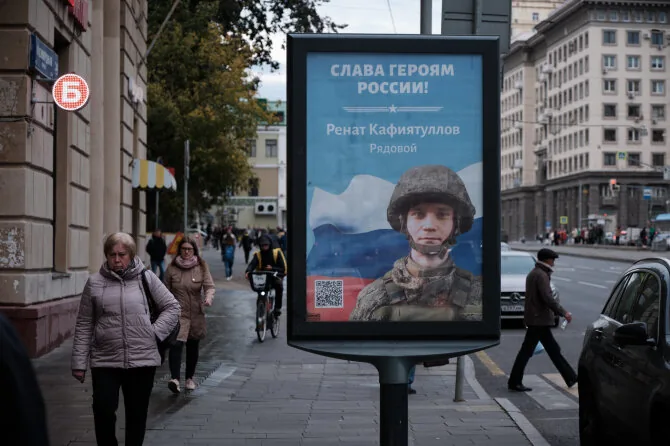
However, government assurances did not calm most Russians. They mentioned previous Kremlin assurances, such as how in 2022 Russia repeatedly said it did not intend to invade Ukraine or start mobilization in September.
Russians spoke about isolated cases recording the latest and much stricter conscription strategies. They also noted that Putin’s decree ordering the resumption of conscription into the armed forces in 2022 technically remains valid, so mobilization could be carried out secretly.
Their anxiety was only heightened by international media reports quoting Western intelligence officials emphasizing that Russia is currently losing more soldiers than it recruits. Ukrainian leaders’ statements also contribute to this.
In August, Ukrainian President Volodymyr Zelensky stated that after the parliamentary elections, Russia plans to mobilize 300,000 people. Zelensky made a similar forecast in April 2024.
When Russia announced the first large-scale forced mobilization wave in autumn 2022, hundreds of thousands of men fled the country. This shocked Russian society so much that officials hurried to stop it after a few weeks.

Military analysts assessed that this mobilization aimed to strengthen the Russian army, which was on the brink of collapse in Ukraine.
Smaller Moscow forces abandoned large occupied territories in eastern and southern Ukraine, leaving their equipment behind.
As analyst Dmitry Kuznets noted, Russia’s current frontline situation is far from what it was in autumn 2022. According to him, contrary to Western assessments, Russia still recruits more people into the army than it loses on the battlefield. He based this on Russian budget data, notary databases, and death announcements.
He added that, unlike in 2022, the Russian state lacks funds to pay conscripts if a second wave of mobilization begins.
“Theoretically, this money could be used to create new units and formations,” Kuznets assessed. However, he added that the potential benefit would be outweighed by the risk of widespread public outrage against the Kremlin.
Read more Why oral sex is not as safe as many think

Still, according to Kuznets, the Kremlin leader may not make a rational decision. Although Russia may not face a severe shortage of fighters overall, it lacks certain types of soldiers. Primarily drone operators, he noted.
Ultimately, it may be that only Putin himself knows whether there will be mobilization. Because of this, ordinary Russians do not know what to do next.
Alexander, a 36-year-old fitness trainer from Moscow, said he is already tired of not being able to fall asleep at night and “thinking over and over whether it will happen or not.”
At the end of August, he flew to Thailand with his wife, who is also a fitness trainer. According to Alexander, she cried because she had to leave her life in Russia. As a former special forces soldier, he admitted that the risk of being drafted is too high for him.
Ivan, a 24-year-old civil engineer, said he and his friends deliberately planned their annual vacation abroad to cover the period just before and after the parliamentary elections. He said he would follow events in Russia while traveling on foot through Georgia.
Ilia, a 26-year-old engineer, confessed he decided to leave after “Yabloko” — the only political party advocating peace in its program — was removed from the election lists. He added that his decision was also influenced by the fuel shortage caused by Ukrainian strikes and reports that officials at the border are increasingly looking for trouble.
“You never know what the authorities might do to restrict your movement and efforts to stay alive and healthy,” the man said bluntly.
Others who want to leave lack opportunities. Some said they try to officially register their residence in Moscow, hoping to avoid conscription.
Meanwhile, others withdrew money from their bank accounts, fearing that if they receive a summons online and do not show up at the draft office, their funds might be frozen.
Mikhail, a 40-year-old working in the film industry, read about possible mobilization and even consulted a psychiatrist.
“I’m trying to escape this bubble of rumors and speculation into what I really know,” the man said, “but in fact, I don’t know anything.”
Ilia, 31, working in logistics, said he is worried not about the mobilization itself but about its possible impact on the Russian economy.
This could stop the already slow growth and force even more companies to close due to a lack of employees: “We would have to start laying off workers.”
Many interviewees admitted that after the government digitized the conscription system, avoiding military service will be much harder than in 2022.
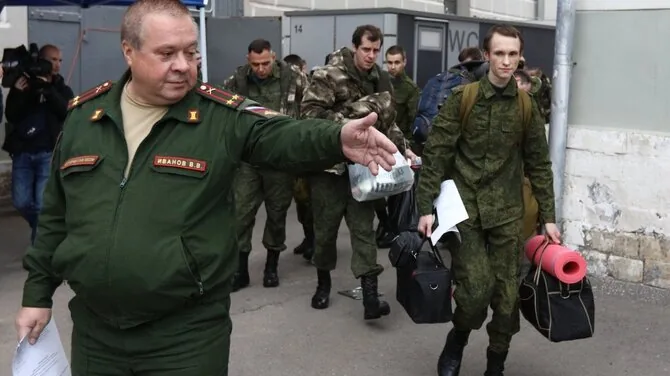
Now summons are sent electronically. Those who ignore them automatically face a ban on leaving the country, as well as freezing of their driver’s license and the right to make real estate transactions.
The automatic fine system is not fully operational yet due to a lack of coordination between government agencies and technical difficulties, said Grigory Sverdlin, founder of the organization “Idite Lesom,” which helps Russians avoid military mobilization.
Konstantin, a yacht trainer from Saint Petersburg, said that although he left Russia during the first mobilization wave, this time he plans to stay.
“During the first mobilization, many of my friends took drastic measures: spent a lot of money, tried to get citizenship of another country, and so on,” he said. “But in the end, they all returned.”
Read more Horoscope for September 9: one decision today can determine the success of the whole month
This article was published in The New York Times.
© 2026 The New York Times Company