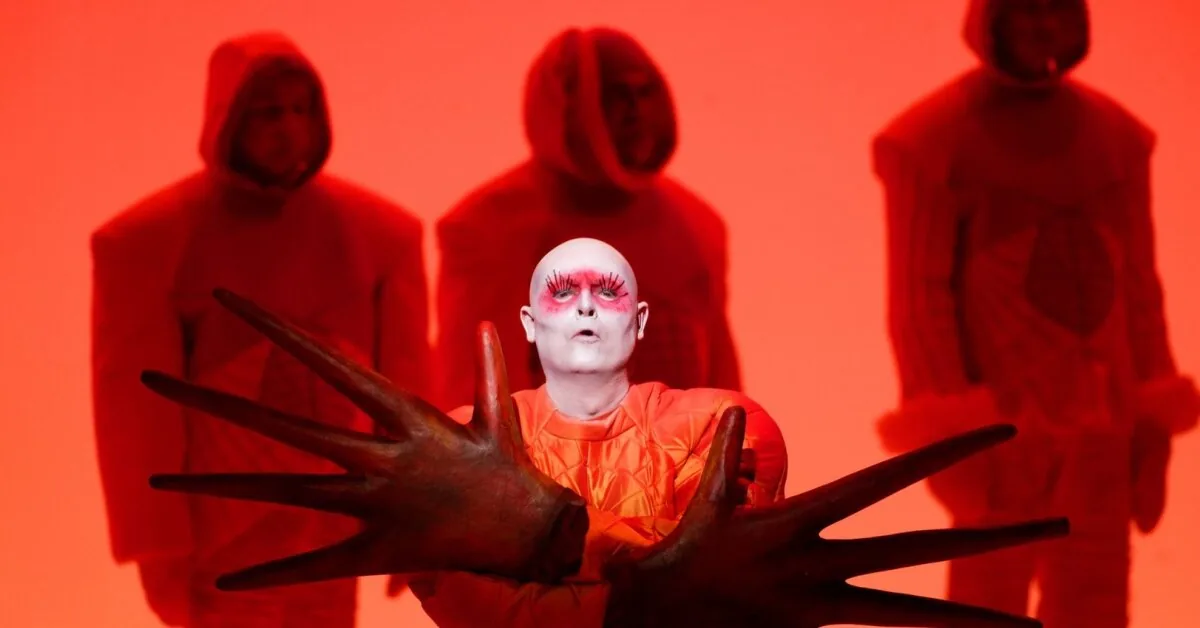
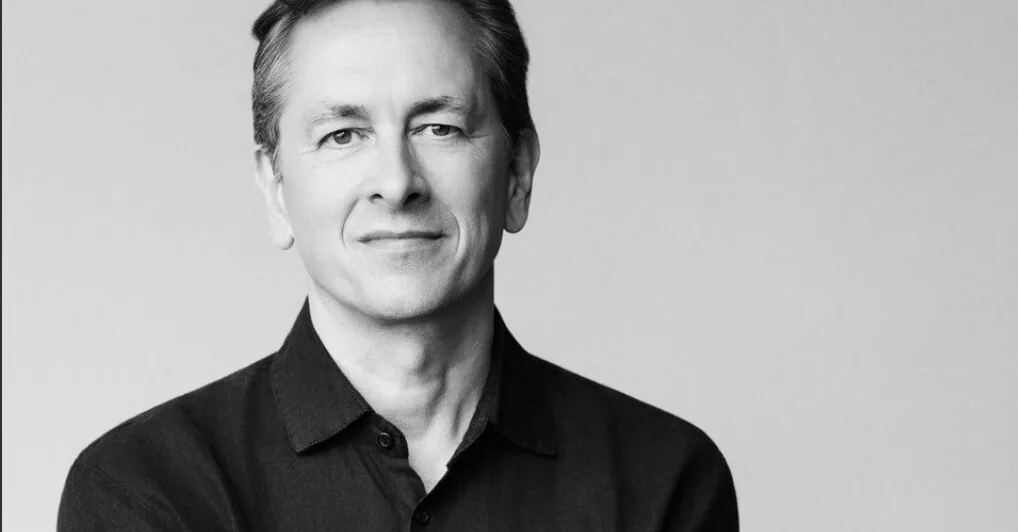
Oliver Frljić studied philosophy and theater directing. While serving as the director of the Croatian National Theater in Rijeka, O. Frljić received death threats, which eventually forced him to leave Croatia.

His plays have been shown at some of the most important European and international theater festivals, including Wiener Festwochen, Kunstenfestivaldesarts, Festival TransAmériques, and Festival Iberoamericano de Teatro de Bogotá.

O. Frljić’s work covers a wide range of themes – from social and political traumas to intimate questions of identity, family, and memory. His work is characterized by a constant exploration of the boundaries of theatrical expression, questioning dominant social narratives, and an intense connection with the audience. Due to his artistic consistency and distinctive authorial voice, he has established himself as one of the most prominent directors of his generation and one of the most internationally recognized theater artists from the Balkans.
In O. Frljić’s early works, much attention was given to the traumatic legacy of the Yugoslav wars. In recent years, his work has increasingly focused on the fragility of theatrical language and the politics of theatrical representation.
Lithuanian audiences had the opportunity to get acquainted with O. Frljić’s work in the program of the international theater festival “Sirenos.” Three years ago, he created his first play at the Lithuanian National Drama Theater – “Metamorphosis” based on Franz Kafka’s work.
This season he returns to the Lithuanian National Drama Theater with a new play inspired by Gustave Flaubert’s novel “Madam Bovary.”
Since 2022, O. Frljić has been one of the artistic directors of the Maxim Gorky Theater in Berlin.

In 2027, he plans to end his career as a theater director. In his own words, “In a world where the hyper-theatricalization of reality makes reality itself increasingly theatrical, theater has lost the ability to represent reality.”
We invite you to read Daiva Šabasevičienė’s interview with the director.
– First of all, I would like to thank you for returning to the Lithuanian National Drama Theater. After the play “Metamorphosis,” you were loved not only by LNDT actors but also by the audience. What does this theater mean to you, especially compared to the wide geography of your plays?
– Thank you for the invitation to visit again! I think LNDT and its actors are very open to various artistic approaches, and I greatly appreciate that. This is especially important nowadays when theater is becoming more conservative, often forgetting its history and the possibilities it still has. I see this openness in the context of Lithuania’s rich theater tradition and the work of prominent directors of different generations and artistic styles. I also enjoy getting to know new theater creators.
– Gustave Flaubert is still considered the greatest master of language in France. Obviously, this is related not only to his writing style but also to the internal logic of the work. Since you are choosing the novel “Madam Bovary” not for the first time, it is understandable that its themes are not easily exhausted and you want to continue them in the new production. Many literary works are dedicated to portraits of women, so why did you choose this novel written in 1857?
– Flaubert once said about Shakespeare: “He was not a man, but a continent.” Then he added: “Writers like him do not have to worry about style; they are powerful despite all their flaws and precisely because of them. But the value of us ordinary people depends on perfectly executed work.” For me, Flaubert is also a continent – a landscape I have been traveling since school days, but whose horizons keep receding as I approach them. What fascinates me most is his use of the indirect libre style, which makes it difficult to determine who is actually speaking, who is behind the voice telling the story.

In this sense, Flaubert seems extraordinarily modern. We live in a world full of voices, in all that “noise and fury,” where statements spread faster and their truthfulness decreases.
Flaubert reminds us that every voice contains another voice, and understanding begins with the question of who is speaking and from where. Moreover, there is Flaubert’s paradoxical ambition to write “Madam Bovary” as a book about nothing. Artistic challenges are rarely more radical. To build a cathedral around emptiness; to make everyday life tremble with the intensity of fate. Trying to say nothing, Flaubert somehow managed to say almost everything.
Trying to say nothing, Flaubert somehow managed to say almost everything.
– At first, the novel seems slow, not theatrical, but once it gains momentum, you don’t want it to end. You will adapt this work yourself. What main tasks do you set by choosing this path?
– “Madam Bovary” has a different dramatic potential than many novels of that period, which we tend to sterilize and homogenize under the label of realism. Flaubert’s narrative strategy constantly undermines the very assumptions on which realism is supposedly based. His language seems to describe objective reality but actually constructs it. At the same time, the novel explores the limitations of language and its inability to fully convey reality. Flaubert’s realism does not depend on the precise depiction of details.
The novel creates an impression of reality while raising questions about the mechanisms by which reality is represented. Flaubert’s realism is full of betrayals. The novel creates the illusion of an objective world only to reveal how fragile that objectivity is. The closer it seems to approach reality, the more reality slips into language.
– Choosing dramaturgy for a play is simpler in every sense, but for your directing style – quite the opposite, prose works are “more convenient.” Why?
– A play already has a theatrical structure, but a novel does not. Adapting prose requires a different kind of work. It means reading and rereading, listening to the rhythm of the text, recognizing its tensions and contradictions, and gradually discovering what theatrical form could emerge from them.
Adapting a novel gives me the opportunity to read very slowly and carefully – something rarely allowed in this world where culture turns into fast food, prepared for quick consumption and even faster digestion. Who knows what consequences this has for our digestive system.

Reading a novel requires a different metabolism. It requires slowness, repetition, and attention. In this sense, reading has become a form of resistance for me, a paper shield that protects me from all the unwanted information with which I am constantly bombarded.
– The portrait of a complex woman obviously lends itself to contemporary interpretation, but we would like you to reveal your main idea behind staging this work.
– Of course, “Madam Bovary” can be read as a story of internal patriarchy, and this perspective remains very relevant today. However, there is also that famous phrase, rightly or wrongly attributed to Flaubert: Madame Bovary, c’est moi (“Madam Bovary is me”). Because of it, every firm interpretation begins to crumble. The boundaries between author and character, observer and observed, man and woman become less clear than we would like.
This is what interests me most in this novel. Instead of confirming a single interpretation, it constantly complicates our interpretations. Every interpretation illuminates something but at the same time leaves something in the shadows. I feel best in the rehearsal room when I do not know exactly in which direction the work is developing.
Read more The main highlight of the Year of Valančius – the mystery «Symphony of Light and Faith»
I feel best in the rehearsal room when I do not know exactly in which direction the work is developing.
Not because I reject interpretation, but because theater for me is a process of discovery, not illustration. The most interesting moments arise when the work begins to resist the concepts we have prepared.
– You are the keenest researcher, critic, and analyst of the social field. What processes do you see today?
– We live in an age of increasingly unprecedented social and psychological control. This control is not repressive in the traditional sense. It is subtle, dispersed, and often voluntary. It operates through platforms designed to be attractive, convenient, and seemingly free, but in reality, they turn attention, emotions, and behavior into measurable and marketable resources.
The logic of these platforms often treats human attention as an extracted resource. At the same time, technology companies have unprecedented capabilities to determine our psychological states: mood, anxiety, loneliness, excitement, or fatigue. They monitor not only what we do but also how we hesitate, what we choose, how long we stay on a single piece of information.
I am concerned not only about surveillance in the classical sense but also about the long-term effects of constant screen time on perception and attention. Some researchers even describe such phenomena as “virtual autism,” indicating changed patterns of attention and social interaction in an environment dominated by screens.
I am concerned not only about surveillance in the classical sense but also about the long-term effects of constant screen time on perception and attention.
Behavioral studies related to addiction show that suddenly losing access to such systems can cause some individuals to experience withdrawal-like reactions, including agitation and very often aggressive behavior.
– How did you form the cast for the play “Madam Bovary”? Did you select based on imagined character traits or more on the actors’ own qualities?
– I tried to gather actors whom Flaubert could interest not only with the usual, traditional interpretation. When meeting people, I rely more on intuition than rational calculations. Very often, the most interesting artistic potential reveals itself precisely when there is no obvious “compatibility,” when there is no clear correspondence between the actor and the character.
Many things I try to explore in theater exist beyond rational categorization, beyond the requirement to explain or justify every artistic decision in advance.
– What tasks do you set for the people creating the visual aspect – the designers and the music designer?
– I have to say that this time I was very inspired by what my colleagues responsible for scenography and costumes offered. When Christoph Marthaler worked with Anna Viebrock, they started from the scenography and tried to figure out what kind of people (or characters) could inhabit that space. It is a completely different process than one where the text remains at the center of the play.
– How do you reconcile your particularly intense work on various productions, working tirelessly? Where do you draw your strength from?
– Over time, my work has gradually changed almost everything – social life, rest, distances, even thoughts about leaving it. Although theater drains my energy, it also nourishes me, allowing me to see reality beyond its programmed form. Increasingly, I notice that my dreams, when they visit me (which happens less and less), are the best theater I know.

They do not follow any logic, despite our constant attempts to include them in various psychoanalytic, psychopolitical, or other interpretive frameworks. The roles we assign in dreams to the fragments of reality that infiltrate them are unlike anything else. I am left wondering why we value the reality we wake up to more than the one we experience in dreams.
– Working in various theaters, you observe different processes, theater, and country traditions. Which theater or country would you consider most acceptable for your creativity and why?
– It is difficult to answer this question without offending anyone. I don’t know. I constantly travel, mostly being outside the language I am most comfortable speaking. Being outside the language sharpens my perception of what theater is and what it could still become. I would like to settle down, but as soon as I settle, I want to travel further again.
Being outside the language sharpens my perception of what theater is and what it could still become.
As Charles Baudelaire wrote: “Anywhere! Anywhere! Just not in this world!” But then the question remains: what happens when you actually get there?
– What do you generally think about current theater trends worldwide? Do you have time to follow contemporary directing in a global context?
– I don’t really follow those trends. It creates a kind of cultural colonialism situation, where attention is constantly directed to a few recognized centers, and everything outside them is considered peripheral or secondary. I am more interested in what slips out of this logic.
Read more Van driver who veered off the road left schoolchildren alone in the forest: investigation started