The subject created by the author captures passing romantic love, speaks about a complex relationship with the internalized parental figure and family in general, mentions the vulnerability of body and spirit, illnesses, belonging to still marginalized minorities, articulates the dark episodes of history, and looks ironically, even critically, at the possibilities of writing and poetry to act and fix the world.
Read more In France, 5.7 thousand more deaths than usual were recorded in June during a heatwave
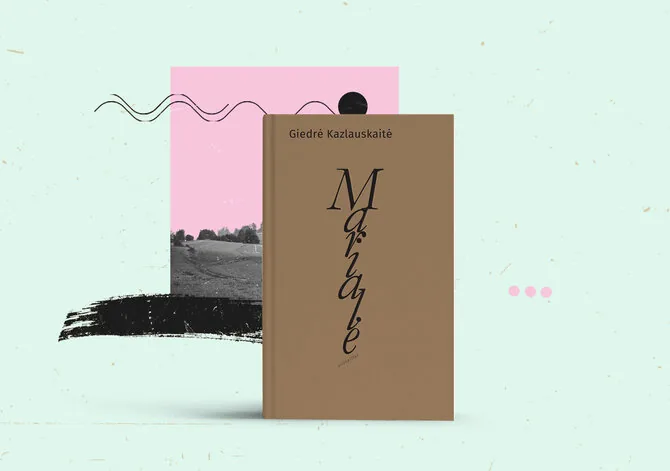
However, having read Giedrė’s poems more carefully, I grasp what I can also call the miracle of the collection’s subject – one can simply get on a bicycle and ride, and let everything be, and despite force majeure, many things that are beyond our control, by focusing on that small part of life that one can partially influence, to endure – through a clear understanding of one’s vulnerability, through a non-trivial openness, through language itself, even if it was never the sole home of being. As Neringa Butnoriūtė notes, the author’s “Marialė” “texts resemble an uncombed fabric of language woven from different threads and ornaments – everyday life, biographical episodes, hearsay, quotes, so they can only be briefly described, but not retold. In the insights woven from them lies the sting of the poem-conversation, because even through rationality, an unexpectedness slips through, capable of correcting my existing knowledge about the world” (Neringa Butnoriūtė. Priešgynos polilogai).
This is where, for me, the miracle of Giedrė’s poetry lies, rough, stinging, intellectually engaged, and at the same time brutally everyday. “Marialė”, like the author’s previous poetry collections, invites a Buberian conversation, allows one to ask questions of oneself and the book’s subject, to get a little closer to the other, to question the boundaries of poetry itself, to re-evaluate the potential of “counter-dialogues” (the title of N. Butnoriūtė’s review), of poetic language itself.
Before writing this text, I read several apt reviews of “Marialė”, and all that remains for me in this text is to further highlight the most striking and impressive aspects.
The first thing I want to discuss is the feminist – psychoanalytic aspect. In a dozen texts, I noticed a contradictory relationship (especially) with the masculine archetype of the father/parents – from internalized figures (internal parents) to religious discourse (the Pope – spiritual father). The subject of “Marialė” reflects on psychoanalytic concepts that have become clichés, and at the same time seems to realize that the biological givenness of sex and its social construct still determine many things important to our lives: “It happens on swings – you get scared that being/already an adult, you experience that supposedly/erotic transference” (“Crystal Mountain”, p. 10); “We rush to him, wanting to touch him/or for him to embrace us, who have become men,” (“The Pope’s Visit”, p. 24).
In the book’s poems, a unique and different relationship is created with female figures. The words of the women of the family (true, in this poem, the grandfather – a male figure – is also mentioned) are retold, while perfectly understanding their limitations and the neurosis of being, of history, inherited through language. Nevertheless, words from the past are perceived “as a language of love”. A special relationship in the book unfolds between the poem’s subject and her daughter – both sensitive moments and the inevitable separation brought by adolescence are captured – one of the most beautiful poems in the book for me is “Primer”, which I interpret as the revelation of fundamental truths to her growing offspring.
Another important block of “Marialė”‘s poems is a kind of non-conformity, the voluntary adoption of the identity of an “unsuccessful earth dweller”. However, unlike the exaltation of the protagonist of “White Shroud” and his immersion in the role of a suffering writer, Giedrė’s poem’s subject views her deviance or non-conformity to societal norms with a healthy distance, self-ironically. And although it is understood that health is a utopian concept, she avoids looking at everything through rose-tinted or dark-tinted glasses. By revealing herself, the subject of “Marialė” takes responsibility and avoids the victim position – by building a relationship with her body, recovering from addictions, understanding her psychology (the aspect of cyclothymia).
By revealing herself, the subject of “Marialė” takes responsibility and avoids the victim position – by building a relationship with her body, recovering from addictions, understanding her psychology (the aspect of cyclothymia).
And yet, “Marialė”‘s poems create an interesting “social” effect – at least for me, it’s much easier to identify with the mentioned “non-normativities”, experiences of illness, that beauty of “defects” which is so real and authentically lived: “After lessons, I would fall into a deep sleep./ It’s hard to endure the world sober, so/many of us escape into sleep./ While we sleep, the rivers in our veins don’t stop” (“June”, p. 60). Important themes in Giedrė’s poetry include the “queer” motif, with some poems caricaturing societal stereotypes through the eyes of another (“Alcoholic’s Dream”).
As already mentioned, Giedrė’s poetry goes beyond the boundaries of confessional poetic dialogue – geopolitical threats and the past pandemic are mentioned, and controversial political motifs (Palestine, Gaza Strip) are not avoided. “Marialė” is open-eyed poetry – it looks openly and penetratingly both at oneself and at the surrounding environment.
The last thing I want to discuss is the reflections on poetry, culture, and cultural press. Here too I notice contradictions – although words are “the language of love”, at the same time, the powers of literary creation, slogans, grandiloquence, and also a kind of “liquefaction”, egocentrism, and self-confinement within one’s own framework are doubted. Writers’ self-promotion and self-positioning are viewed ironically: “Of course, I have an opinion about the weepers./ Don’t remind me, it was different a decade ago. My new text, it’s impossible that it would disappoint” (“Writer Scammers”, p. 79). In the poem “First Day of Vacation”, the reality of a cultural worker, a cultural publication editor, is revealed with good humor, where, to survive, one must check work emails and respond to inquiries even during vacation.
In summary, I can say that, quite unexpectedly and without waiting for it, Giedrė Kazlauskaitė is writing her book of miracles – looking closely, unhurriedly, palpably, and very effectively. I recommend it to all cloud shepherds and shepherdesses, fans of good poetry and life’s prose.