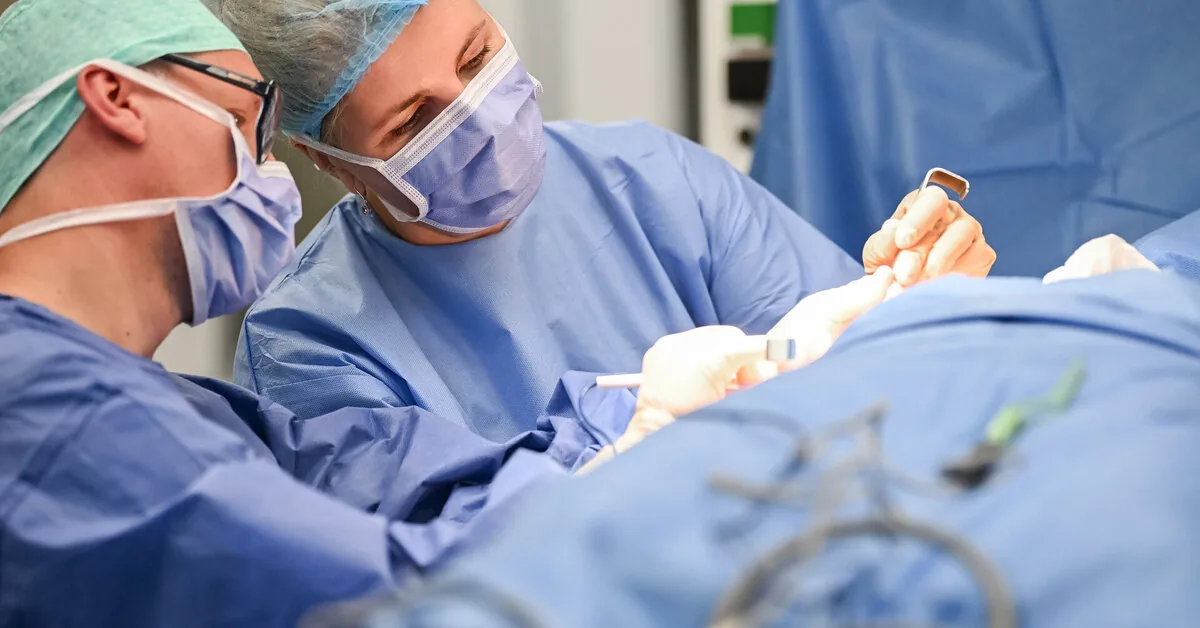
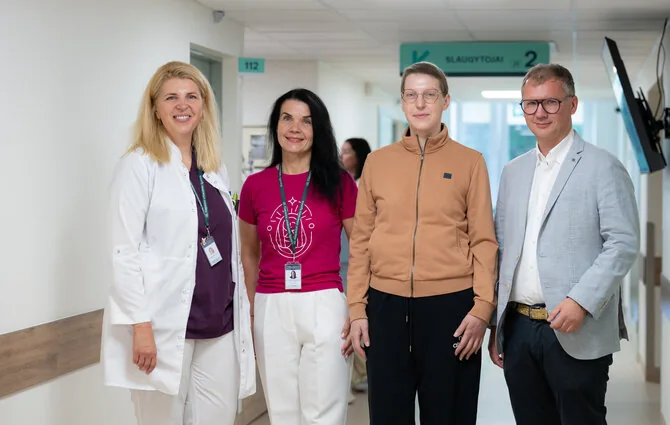
The operation was performed by Dr. Agnė Čižauskaitė, head of the KUL Breast Diseases Center, in collaboration with one of the specialists with the greatest experience in minimally invasive breast surgery in Europe – Polish breast surgeon Prof. Piotr Pluta. The innovative mastectomy was symbolically performed during the “St. Magdalena’s Night” – a celebration of femininity, hope, and solidarity, aimed at raising awareness about breast cancer prevention and supporting women fighting the disease.
Read more All ministers surpass Sinkevičius in wealth: one of them is nearly a millionaire
Next-generation breast surgery
Minimally invasive endoscopic subcutaneous mastectomy is a surgery during which all breast glandular tissue is removed while preserving the skin and usually the nipple-areola complex. Breast reconstruction with a silicone implant is performed during the same operation.
“Unlike a conventional mastectomy, this procedure is performed through an incision only 3–3.5 cm long, which is usually hidden in the armpit area or a natural inframammary fold. As a result, there are no visible postoperative scars on the breast itself,” says the head of the KUL Breast Diseases Center.
According to her, the endoscopic system used during the operation allows the surgeon to see the operative field magnified up to five times. Greater visibility enables more precise differentiation of tissue layers, careful preservation of blood vessels, nerves, and the natural supporting ligament system.
“The image magnified up to five times allows much more precise preservation of the subcutaneous layer, blood vessels, and nerves that do not need to be removed. This means a better aesthetic result, more preserved sensitivity, and a better quality of life after surgery,” notes A. Čižauskaitė.
This method is most suitable for patients who need to have all glandular tissue removed due to breast disease but can preserve the skin and undergo immediate reconstruction. The most common indications are pathogenic BRCA-1 or BRCA-2 mutations, multifocal breast cancer, large pre-cancerous or borderline malignant changes. Also, situations where radical tumor removal is not possible after breast-conserving surgery or a complete pathological response is achieved after systemic treatment.
Early diagnosis allowed advanced treatment
The first patient in the Baltic states to undergo advanced mastectomy at KUL was 36-year-old Rasa. The woman consulted doctors after a preventive self-examination when she noticed a small change in her breast. After thorough examinations, she was diagnosed with early-stage right breast cancer, and later, after detecting a pathogenic BRCA-1 mutation, a medical board recommended bilateral subcutaneous mastectomy to not only treat the existing disease but also reduce the risk of developing cancer in the other breast in the future.
Read more Smuko „Ryanair“ quarterly profit, company blames war in the Middle East
During the operation, the patient’s nipple-areola complexes were preserved, a sentinel lymph node biopsy was performed, and both breasts were reconstructed with silicone implants.
“When the doctor offered the opportunity to undergo this operation, I did not hesitate for long. It was important for me to choose the most advanced treatment method. I am only 36, so I wanted a solution that would be not only oncologically safe but also preserve quality of life and achieve the best possible aesthetic result. When there is an opportunity to choose the most modern treatment, you want to take advantage of it,” says the patient. According to her, peace of mind was also provided by knowing that the operation would be performed by an international team with extensive experience.
According to A. Čižauskaitė, Rasa’s story once again reminds us of the importance of early diagnosis.
“The earlier we detect the disease, the more options we can offer the patient. Early diagnosis allows not only effective treatment of oncological disease but also the application of advanced surgical technologies that help preserve a better quality of life after treatment,” says the doctor.
KUL leadership – responsibility to implement treatment innovations
According to A. Čižauskaitė, head of the KUL Breast Diseases Center, the first minimally invasive endoscopic subcutaneous mastectomy performed in the Baltic states is not a coincidence – it is the result of consistent team work, international cooperation, and the long-term strategy of the university hospital.
“Most of the most active members of the Lithuanian Breast Cancer Association work at our hospital. It is no coincidence that this association was founded in Klaipėda – it was established by people who aimed to be leaders in breast disease treatment in Lithuania. Therefore, we constantly organize educational and social projects, implement new treatment methods, and perform surgeries that are the first of their kind in our country. We want to carry the flag of leadership, take responsibility for treatment innovations, and set an example for other centers. This is the result of KUL’s consistent strategy – it is important for us to ensure that the most modern breast cancer treatment methods are available to Lithuanian patients in their own country,” says the doctor.