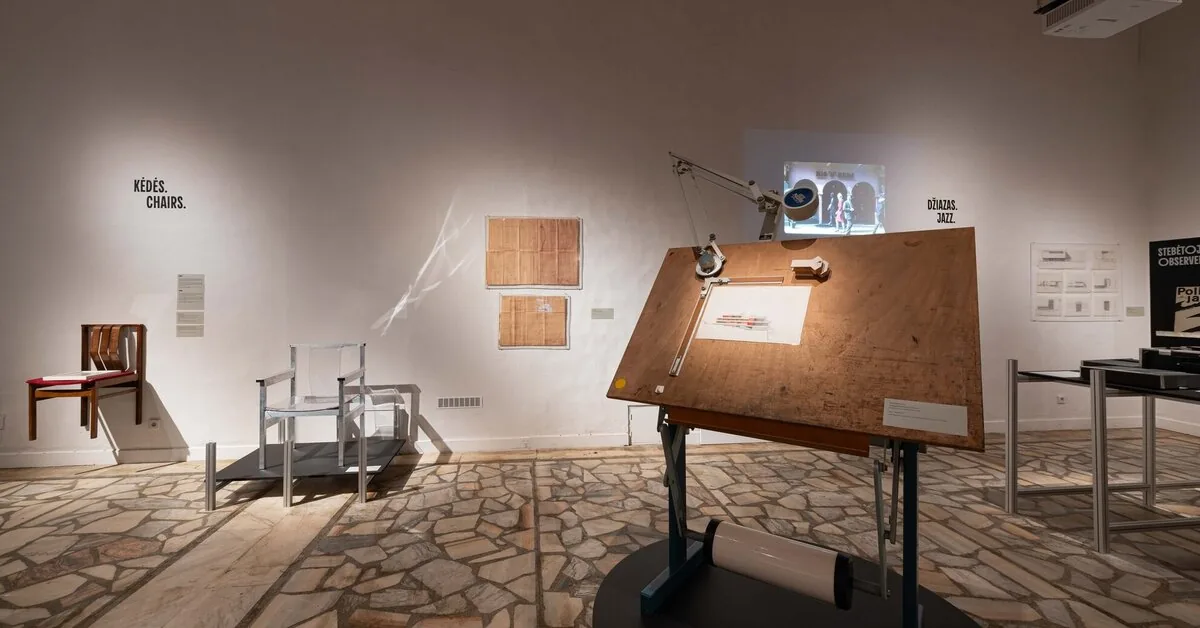
Visitors to Greta’s creative legacy spanning more than six decades can also see contemporary designers’ interpretations created especially for this exhibition. One of them is artist Vladas Suncovas’s newly reimagined legendary “Amber Furniture” chair by Tadas Baginskas.
Read more On the weekend, Palanga will become the largest daytime dance floor in the country
At the suggestion of the exhibition curators, V. Suncovas interpreted one of the most famous pieces of furniture by Tadas Baginskas, but did not aim to replicate it – the most important thing was to understand what makes this chair relevant today. “I liked how simply and clearly Tadas Baginskas himself spoke about the creation of this chair, its design, and the simplicity of its production. I set myself a fairly clear task – to remake this chair from aluminum, applying the simplest possible production principles and maintaining proportions as close to the original as possible,” says V. Suncovas.
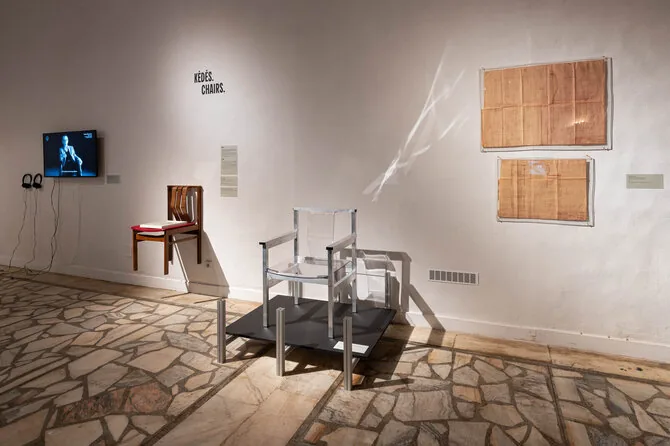
The new interpretation not only transfers the legendary object into a contemporary context but also reveals how designers from different generations communicate in the same design language. According to the author, while in his previous project interpreting designer Liucija Zaveckienė’s chair he wanted to “liberate” the object, in the case of Tadas Baginskas’s “Amber” chair, the opposite direction was chosen. “I wanted to emphasize its pragmatism and institutional undertone,” says the designer.
Although Vladas Suncovas admits that he has not thoroughly studied Lithuanian design history until now, he has been familiar with Tadas Baginskas’s work since childhood. “It’s hard not to know his work. I grew up surrounded by his furniture and other design objects, and only later in life did I realize that these were the works of the same person,” he recalls.
According to the creator, it is precisely Tadas Baginskas’s approach to functionality that sounds especially relevant today. “I believe that his principles of functional design remain relevant today – the idea that design must solve problems has not disappeared. Today, more and more young designers have unique aesthetic expressions, but paradoxically, losing functionality, aesthetic solutions begin to resemble each other,” reflects Vladas Suncovas.
Read more Dangerous VW, MB, and BMW drivers: police stopped 4 suspects in Kaunas alone
In his opinion, Tadas Baginskas’s significance to Lithuanian design lies not only in the furniture or interiors he created but also in his influence on several generations of creators. “I think that all of us who grew up in Lithuania are in one way or another influenced by designers like Valerija Cukermanienė, Brigita Adomonienė, Liucija Zaveckienė, Tadas Baginskas, and other creators of the classical generation. His work and long-standing educational activity undoubtedly laid the foundations for both contemporary designers and craftsmen.”
Working on this interpretation also became a professional experience for the designer himself. “With every project, I learn something new. In this case, it was very interesting to get acquainted with a representative of the older generation and look for common connections. I think I found them in simplicity and clearly formulated design language,” says V. Suncovas.
The exhibition “Design Counterpoints,” dedicated to architect and designer Tadas Baginskas’s 90th anniversary, presents his work spanning more than six decades – from furniture, lighting, and interiors to graphics, architectural drawings, and design ideas. One of the exhibition’s main themes is design as a continuously ongoing dialogue, in which creators of different generations do not copy the past but interpret and extend it. The exhibition at the Museum of Applied Arts and Design will run until August 23.