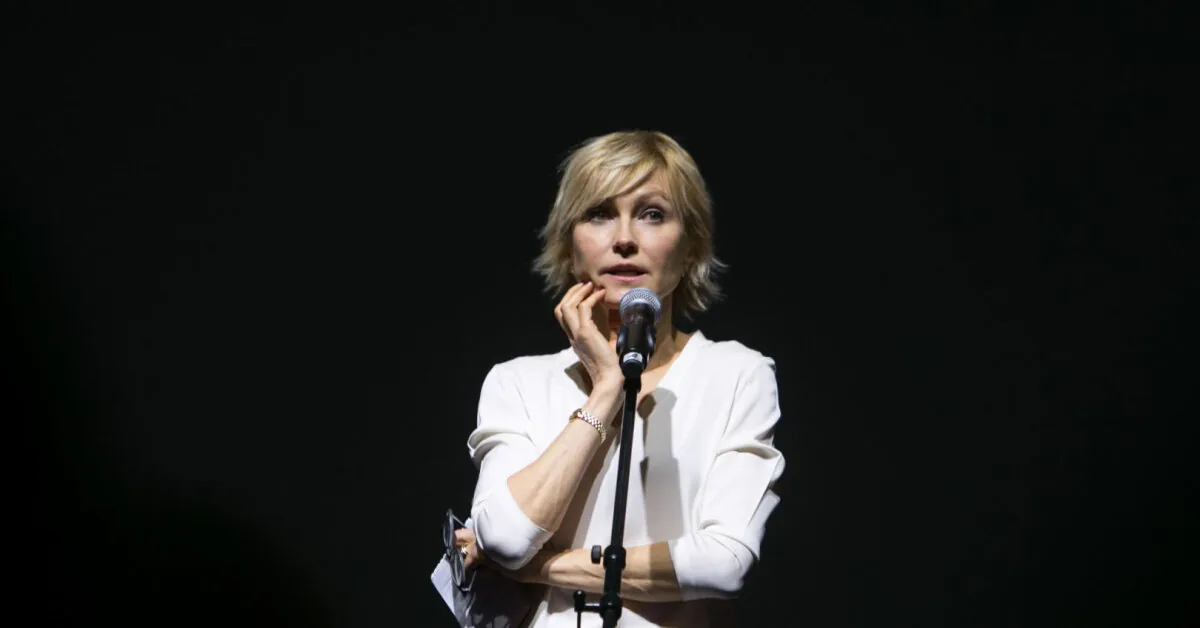
The play is shown from August 5–31 as part of the Edinburgh Festival Fringe program, at the Pleasance Courtyard theatre. In “A Pebble in the Road,” I. Dapkūnaitė not only acts but is also one of the creators of the work, with Simon Stokes as the director.
Read more Hong Kong activist accused of collusion with foreign forces pleads guilty
As writes Donald C. Stewart, critic for the British Theatre Guide, the play is an autobiographical story about life in Lithuania, covering the period from the late 19th century to I. Dapkūnaitė’s childhood during the Soviet occupation.
“It is a reminder of what Lithuania had to endure,” the critic summarizes the play.
From family home to Lithuanian history
According to the British Theatre Guide, the play begins with the reconstruction of I. Dapkūnaitė’s family home on stage. From this personal space, the actress moves to the broader history of Lithuania – a country whose territory at different times stretched from the Baltic Sea to the Black Sea.
It is a reminder of what Lithuania had to endure.
The play touches on various turning points in Lithuanian history: the country’s relations with Poland and Russia, Soviet occupation, German invasion, periods of independence, and resistance to occupations. However, all this is told not as a history textbook but through the fate of the actress’s own family.
C. Stewart highlights stories about partisans killed by the Germans, I. Dapkūnaitė’s father, who became part of the Soviet diplomatic service, and family life.
One of the stories told in the play is also related to her childhood abroad – due to her father’s work in the diplomatic service, she could not continue her studies in Sri Lanka, where the family had moved.
Family meals hold an important place in the play. The critic notes that the abundant tables become not only a symbol of food but also of connection: the viewer supposedly begins to long not so much for the food itself but for closeness and togetherness.
“Personal and universal”
The British Theatre Guide review especially praises I. Dapkūnaitė’s acting. C. Stewart writes that the actress “acts excellently,” and her experience on stage allows silence to become an important part of the story.

According to the critic, the play’s script is multilayered, and the story told reveals human resilience to the flow of history. “It is personal and universal,” he writes.
Read more Lightning struck a building in the Kėdainiai district: a large fire broke out
C. Stewart also draws attention to the minimalist stage design of the play. The single chair on stage, he says, does not become a limitation – on the contrary, it allows the actress to fill the entire space with her storytelling and acting. Different, thematically related stories, according to the critic, are told modestly, but precisely because of this, the play becomes impactful.
At the end of “A Pebble in the Road,” the focus shifts to three generations of women whose lives were shaped by war, forced separation, love, laughter, and resilience.
C. Stewart calls these stories a testimony about the entire nation – through a personal narrative in which both the individual and a wider audience can recognize themselves.
Donald C. Stewart, who wrote the British Theatre Guide review, also recalls his visit to Vilnius and the people who left the Soviet system and believed in a new stage of the country’s life. According to him, I. Dapkūnaitė’s play precisely reminds of that historical turning point – the time when Lithuanians realized that it depended on themselves what new chapter of history they would write.
Ingeborga Dapkūnaitė – one of Lithuania’s most international theatre and film actresses
Born in Vilnius in 1963, Ingeborga Dapkūnaitė is one of Lithuania’s most international theatre and film actresses. In 1985, she graduated from the Lithuanian Conservatory, in Jonas Vaitkus’s class, later working at the Kaunas Drama and Vilnius Youth theatres.
I. Dapkūnaitė built her career not only in Lithuania. Since 1992, she has acted in theatres in the United Kingdom, the USA, Austria, and other countries. Among her stage roles are works with directors such as Jonas Vaitkus, Eimuntas Nekrošius, and John Malkovich.
International recognition was also helped by cinema. She acted in films such as “Moscow Nights,” “Sunburnt,” “Mission: Impossible,” “Seven Years in Tibet,” and other international projects. For her role in “Moscow Nights,” I. Dapkūnaitė was awarded the Russian film award “Nika” as the best actress of the year.
“A Pebble in the Road” became an opportunity for her to tell an international audience not a fictional story but that Lithuanian past which the actress herself inherited through her family.
According to the British Theatre Guide, the story of three generations of women in this play becomes a broader narrative about a nation that survived war, occupations, losses, and forced separation but preserved resilience, love, and the ability to create a new chapter of its history.