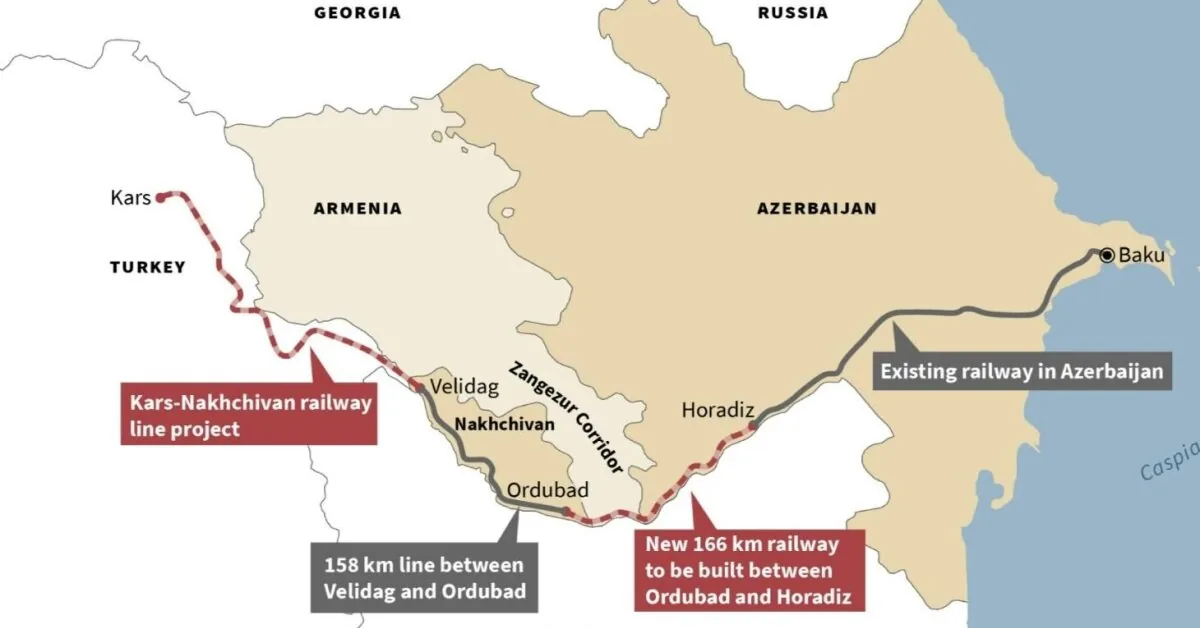
The Armenian government has given the green light to the large-scale TRIPP project (Trump Route for International Peace and Prosperity), submitting the foundational agreement document between the US and Armenia to the Constitutional Court for review regarding its compliance with the country’s constitution. Alongside this process, Washington launched a new investment fund, TRIPP+, with a base capital exceeding 200 million US dollars.
Read more Gitanas Nausėda: no one raises the question of withdrawing from the International Criminal Court
Leading this structure, focused on strategic infrastructure development, is 52-year-old American businessman Konstantin Sokolov, originally from Russia. His persona in Armenia attracts no less interest than the unprecedented infrastructure project itself. In a short time, K. Sokolov has gone from a little-known regional businessman to the owner of strategically important assets for the country.
From telecommunications to mining: expansion amid sanctions
Konstantin Sokolov, who moved to the US in his youth and founded the investment company IJS Investments in Chicago, began his path in the Armenian market in the telecommunications sector. In 2024, he became a shareholder of the largest communication operator Viva-Armenia by buying a stake from the Russian corporation MTS. Shortly after this deal, 20 percent of the company’s shares were transferred free of charge to the Armenian state – this step was explained by the government as due to the company’s strategic importance.
The business expansion did not stop there. Recently, structures co-owned by K. Sokolov (together with Chinese businessman Zhe Zhang) acquired 100 percent of the shares of the Russian Rostelecom’s Armenian subsidiary.
However, the most famous, though quietly conducted, deal was the purchase of the Techut copper-molybdenum deposit. This ore deposit, ranking second in Armenia by reserve volume (about 450 million tons of ore), previously fell to the Russian state bank VTB due to huge debt obligations; VTB is currently on the Western sanctions list.
To avoid direct contact with Russian capital subject to sanctions, a two-step legal scheme was implemented, writes the Armenian service of Radio Svoboda. The credit obligations were initially bought out by the local company Kuprar RA, owned by former banker Sergei Virabian, which later resold the debt-free asset to the American corporation Dynamic Frontier Holdings. According to open registry data, this company is registered in Texas and is led by Konstantin Sokolov.
“The main rationale for this step is that Sokolov sought to avoid a direct deal with the Russian bank subject to Western sanctions, so the mine was acquired from a third company,” explains Svoboda investigative journalist Mkrtych Karapetyan, who studies foreign capital flows into the country, to DW.
K. Sokolov’s investment portfolio also extends to the financial sector. Although political circles associate his name with control over the local commercial bank AMIO, Armenian publication Hetq.am researchers note only the American’s involvement as a hired consultant acting in the interests of the true foreign beneficiaries when purchasing this asset.
The government welcomes, the opposition sounds alarm bells
While the government and its supporters welcome the influx of Western capital into Armenia’s infrastructure projects, the opposition sees serious risks. K. Sokolov was especially sharply criticized from the parliamentary tribune by the “Armenia” faction deputy Mesrop Manukyan.
He is concerned that within a few years, large financial, mining, and telecommunications assets have ended up in the hands of the American investor. The politician’s concerns are essentially shared by his entire faction. This opposition force, advocating close ties between Armenia and Russia, does not support the TRIPP project, considering this initiative a disguised “extraterritorial corridor” and the “greatest threat” to Armenia’s security, as it aims to ensure transport communication between the main part of Azerbaijan and its Nakhchivan exclave through Armenian territory.
Investor with direct access to the American elite
Despite the large investment amounts, K. Sokolov remains essentially a little-known figure to Armenian society. He usually does not give high-profile interviews to the local press, preferring business visits. He last visited Yerevan in early August, meeting with Prime Minister Nikol Pashinyan and Foreign Minister Ararat Mirzoyan, accompanied by US Special Envoy for Peace Missions senior advisor Aryeh Lightstone.
Read more Lavrov’s harsh words to Ukraine supporters – received a strong response from Germany
In Western media, K. Sokolov’s profile is quite clearly defined. Having left Russia at 21, he developed active investment activities in the US and Switzerland. Today, he is known not only for business projects but also for an active political stance. K. Sokolov is one of the most generous supporters of the US ruling Republican Party and a supporter of Donald Trump.
According to the Associated Press, he donated about 11 million US dollars to the MAGA movement in just one year. The British Guardian, writing about his new appointment, noted: “Russian-born Chicago investor Konstantin Sokolov will lead a new State Department fund controlling more than $200 million… including investments in transport, energy infrastructure, and key mineral resources.”
Later registered in the US as the Trans-Caspian Enterprise Fund, TRIPP+ focuses on investments in the South Caucasus and Central Asian countries, which experts believe fully aligns with Washington’s strategy to create a transit corridor between Europe and the region, bypassing Russia and other Western-adverse regional actors.
Western representative or “compromise figure”?
The scale of investments and the investor’s Russian origin have become fertile ground for conspiracy theories. In the Armenian social media segment, the version is actively discussed that K. Sokolov, born in Saint Petersburg, may be a non-public “compromise figure” between Moscow and Washington. Supporters of this theory point out how non-conflictually and smoothly American structures take over assets once belonging to Russia, facing Western sanctions pressure.
Assessing the motives why the businessman, having bought large assets in Armenia, was appointed head of the Trans-Caspian investment fund aimed at investing in a regionally significant transport project, senior researcher at the analytical center APRI Armenia, Beniamin Pogosian, highlights two equally plausible scenarios.
The first is political. The appointment of an American with Russian roots, in his view, could be “a subtle Washington gesture aimed at reducing Moscow’s harsh criticism” of the project. The second version is based on pragmatism.
“Perhaps Russia had no involvement here at all. Sokolov may have been chosen simply because he deeply understands the former USSR business environment, knows Armenia and its state machinery well,” the analyst considers to DW.
Nevertheless, many skeptics dismiss the version of K. Sokolov as a compromise figure. He publicly and harshly condemns the actions of the Russian authorities and the war in Ukraine. Moreover, the $201 million grant allocated by the US State Department to the TRIPP+ fund with an implementation deadline until 2036, experts believe, indicates Washington’s long-term strategic intent in the region. As Aryeh Lightstone emphasized in an interview with Armenian internet TV CivilNet during his visit to Yerevan, this amount is only the “floor, not the ceiling” for future investments.
The version that K. Sokolov is some kind of “compromise figure” for Moscow is also rejected by the leader of the Republic party and political ally of Prime Minister Nikol Pashinyan, Aram Sarkisian. However, he acknowledges the pragmatic value of his experience, seeing not a cause for concern but opportunities. “K. Sokolov is a man with serious business connections who understands the Russian mentality well, speaks the language, and knows how to work with the relevant Russian structures,” the politician summarizes.
Read more Putin’s war on the bank – a blow: lost 50 billion rubles in half a year