






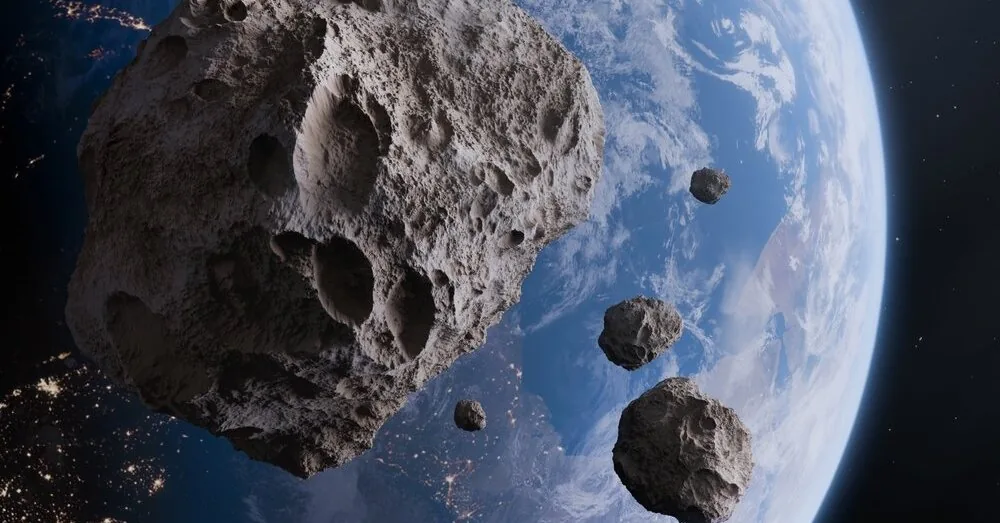
Asteroid 99942 Apophis – a space rock about 370 meters long – will fly very close to Earth, at a distance of less than 32 thousand kilometers from our planet.
Read more Google AI Gemini conducted cyber attacks and guessed passwords
Scientists have recalculated the data multiple times and carefully checked it again – they are as certain as possible that Apophis poses no close threat to Earth’s inhabitants.
But could Earth’s inhabitants pose a threat to Apophis? It turns out the answer to this question is unexpected – possibly, according to a study published in the journal The Planetary Science Journal.
According to physicist Giulia Schettino and astrodynamics specialist Alessandro Rossi from the National Research Council of Italy (CNR) Applied Physics Institute “Nello Carrara” (IFAC), our habit of littering near-Earth space could threaten a unique, once-in-a-lifetime scientific opportunity.
“I am an expert in space debris and asteroid dynamics. So from the very beginning, when I saw the usual animations of Apophis’ trajectory showing its approach to Earth, I immediately started wondering if there was a chance it could collide with a huge mass of human-made space debris,” A. Rossi told ScienceAlert.
The close flyby of Apophis could fundamentally change our understanding of asteroids.
When the asteroid flies very close to Earth, our planet’s gravity will act strongly enough to change its rotation, possibly cause landslides and even “asteroid quakes,” and perhaps reveal what lies beneath its surface.
Two spacecraft – ESA’s RAMSES mission and NASA’s OSIRIS-APEX – plan to observe this encounter with unprecedented detail.
However, these changes would be much harder to interpret if Apophis unexpectedly experienced some other object’s influence before the spacecraft began observing it.
Read more Experts warn hotel guests: check these 3 things as soon as you enter the room
A. Rossi and G. Schettino sought to find out whether the asteroid, flying through the geostationary orbit (GEO) region – the space around Earth extending tens of thousands of kilometers – could collide with human-made objects.
They hoped there was almost nothing to worry about. Most human-made space debris orbits much closer to Earth than the place through which Apophis will fly.
“I have to say I expected a so-called ‘zero experiment,’ i.e., that there would be no possible interaction. I was surprised by the possibility that some objects could approach the asteroid within just a few kilometers,” said A. Rossi.
But when scientists ran simulations, the result of the “zero experiment” was definitely not obtained.
They modeled Apophis’ trajectory – very precisely determined after all calculations – and the number of known objects in the GEO zone. This is the altitude at which an object orbiting Earth can maintain the same rotation speed as our planet. Usually, this is about 36 thousand kilometers altitude.
They also included the population of invisible but existing space debris in the simulations and modeled possible scenarios.
In most cases, everything goes well. However, to the scientists’ surprise, there is a small but real chance that something in the GEO zone could collide with Apophis.
You probably remember NASA’s Double Asteroid Redirection Test (DART) mission, during which the orbit of the asteroid Dimorphos was deliberately changed – a spacecraft crashed into it.
Read more Do you have high blood pressure? Be sure to eat these 3 products for breakfast