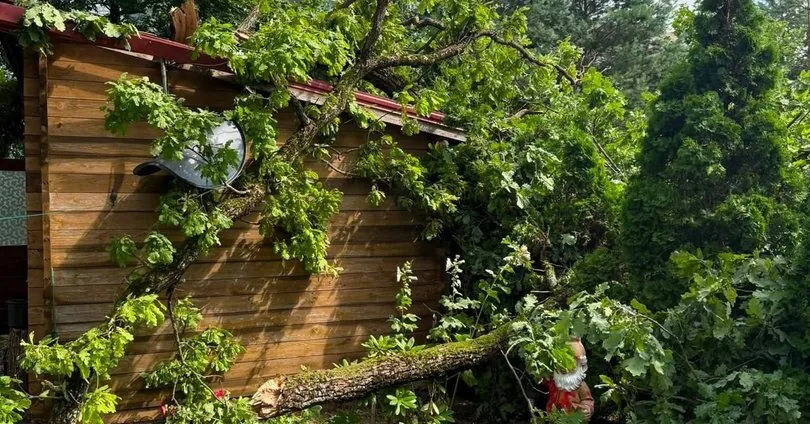
According to Artūras Juodeikis, Head of the Claims Department at “Lietuvos draudimas,” a house that was considered well-designed 20 years ago will not necessarily be sufficiently resistant to the weather of the coming decades: “Today, it is important not only to have warm walls and airtight windows but also to consider where water will drain on the plot, how rooms will be ventilated during heat, whether the roof will withstand wet snow during thaw and strong winds during storms, and whether the heating system will be reliable during prolonged frost.”
Read more Volodymyr Zelensky proposes a deal to Donald Trump
According to the insurer’s data, the first quarter of this year reminded how harsh winter can be in Lithuania: losses caused by cold and snow for residents accounted for 38% of all housing damages recorded by the company, which overall in the first quarter of this year were 73% more than in the same period last year, with 15 million euros more paid out for them.
“Recent summers also remind us that the climate in Lithuania is changing. This year, summer, in terms of the scale of damage caused by natural forces, is harsher than last year. According to our data, the number of registered incidents this year is about 100 more damages, and the amount reserved for compensation has already reached 1.7 million euros – about 30% more than paid to clients during the entire last summer,” says the claims expert.

He shares examples of what we already need to pay attention to when designing or renovating houses.
Heat resistance. The European Environment Agency indicates that heat waves in Europe are becoming longer, more frequent, and more intense. During them, air conditioning can be an auxiliary tool, but it should not be the only solution.
“If a house is improperly oriented, windows are unprotected, and ventilation is unplanned – residents will become dependent on electricity and mechanical cooling. A greater demand for resources needed for cooling in the future may lead not only to higher electricity costs but also to power supply disruptions. Therefore, when designing a home, more attention is recommended to be paid to the house’s orientation,” says A. Juodeikis.
According to him, large southern or western windows provide a lot of light, but without outdoor shading, they become a source of heat in summer. Meanwhile, properly planned roof overhangs, pergolas, external blinds, trees, or other shading solutions help reduce heat impact while maintaining natural light and utilizing sunlight in winter.
Rain is not just a roof issue. Another increasing risk is intense precipitation. The Lithuanian Hydrometeorological Service platform indicates that in Lithuania, by 2100, the average annual precipitation may increase by 3.7-13.5%, with the greatest changes expected in the cold season. Increased precipitation intensity and periodic recurrence of heavy rainfall are also forecasted.
According to the expert, this means that when building a home, soil permeability and whether water will drain toward the house during heavy rain should be assessed. Accordingly, it is advisable to form drainage layers, install rain gardens, infiltration wells, or other local water absorption systems.
“Equally important is the choice of roofing material and rainwater drainage system. Traditional gutters and downspouts may be too weak for sudden, intense downpours, so when designing a house, it is worth planning downspouts of sufficient diameter, a roof slope that prevents water accumulation, and solutions that protect against water entering structural joints. Meanwhile, the roofing material should be chosen keeping in mind that it will have to withstand intensifying hail,” says A. Juodeikis.
Storms are no longer rare. The insurance company representative notes that as storms intensify, damages related to roofs, facade elements, terraces, canopies, fences, solar panels, and other structures attached to the house increase.
“The more lightweight, large-area, and poorly fastened elements there are, the greater the risk that a storm will damage or tear them off. Therefore, when designing a house, it is worth carefully evaluating not only the main structures but also all external details. Roof fastening, chimneys, downspouts, facade panels, terrace canopies, gazebos, or solar modules must be selected and installed considering wind loads. However, quality installation and periodic maintenance are no less important than good design solutions,” says the claims expert.
Cold winters are rarer but will still occur. Recent years have accustomed residents to milder winters, but last winter reminded that more extreme cold periods can still return. According to the Lithuanian Hydrometeorological Service, this winter was the fourteenth coldest in Lithuania since 1961.
“This is an important reminder for those building or renovating homes. Even if very cold winters occur less frequently, the house must be prepared for frost challenges. This year, from client experience, we saw that a heating system that reliably works down to about -15 degrees Celsius may fail during prolonged colder periods. And this happens when homes need heat the most. Therefore, the heating system and its quality installation are areas where the desire to save can turn into much greater losses,” says A. Juodeikis.
He notes that as winters warm, some residents tend to think that frost risk decreases, so water supply or other pipes can be installed more shallowly. However, a colder winter showed that such a decision can result in frozen pipelines, water supply disruptions, and costly repairs. Also, deep frost “lifts” fence, outdoor gate, or stair structures that are concreted too shallowly.
“As the climate becomes increasingly unpredictable, housing must be planned to withstand heat waves, heavy rains, storms, and rare but still possible frost episodes. At the same time, it is worth thinking about prevention: solutions that help detect damage early, stop it automatically (for example, an automatic shut-off valve with leak monitoring at the water inlet), or reduce its extent (for example, a heat sensor above the stove).