



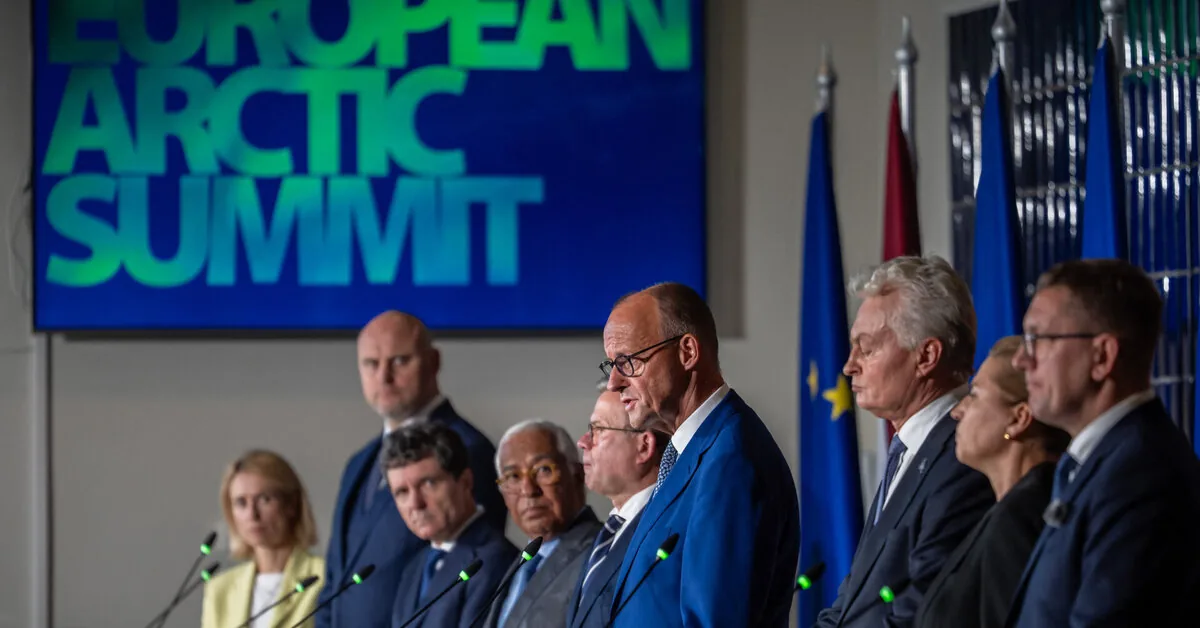
„We urge the European Union to take a more strategic and active role in the European Arctic,“ reads a joint statement by the country leaders after the European and Arctic countries summit held in Rovaniemi, Lapland, Finland, which was attended by Denmark, France, Germany, Greece, and Sweden, among others.
Read more Critical situation in PAO ranks: virus has laid down a large part of the team
D. Trump’s repeated threats to take control of Greenland – a huge autonomous Danish territory – sparked a diplomatic crisis among Washington’s allies.
Although his tone has softened since the beginning of the year, EU countries are determined to increase their involvement in the region, fully aware of the hostile neighbor on the other side of Finland’s long eastern border.
The countries, noting the “huge and long-term threat posed by Russia,” stated that Moscow’s ambitions to increase its influence in the Arctic and its “hostility towards Europe, including intensified hybrid activities, underline the need to strengthen the EU’s Arctic policy.”
Among the officials attending the meeting were German Chancellor Friedrich Merz, Danish Prime Minister Mette Frederiksen, EU foreign policy chief Kaja Kallas, and EU Council President Antonio Costa, as well as leaders from countries such as Lithuania, Romania, and Greece.
“What is happening here is not just a regional story. It is a matter for all of Europe,” said A. Costa.
Environmental concerns
No official decisions were to be made at the summit.
However, the European Commission (EC) is expected to present a new Arctic strategy in a few weeks, which will outline the Community’s guidelines for the Arctic region in the coming years.
Countries and leaders can still influence the final document, “so in this sense, this is a fairly timely meeting,” AFP news agency was told by Tuomas Tikkanen, senior advisor for European affairs to Finnish Prime Minister Petteri Orpo, who initiated this meeting.
“The idea is basically to strengthen the overall EU strategic approach to the Arctic in this situation, where the region’s geopolitical and economic significance is noticeably growing,” he said.
Interest in this region has significantly increased since the last EU Arctic policy was adopted in 2021. This is also shown by the large number of high-level guests from non-Arctic countries.
“The security environment has changed a lot, and recently the region has attracted a lot of attention,” said T. Tikkanen.
The leaders discussed various topics – from economic interests to security.
According to experts, due to climate change, the Arctic region is warming almost four times faster than the global average, which causes serious consequences for both the environment and the livelihoods of local residents.
As ocean ice melts, countries such as Russia, China, and the USA have intensified activities in this region, racing for natural resources and new sea routes.
In August, China and South Korea sent container ships through the Northern Sea Route in Russian waters to test its viability, as this passage remains ice-free for longer each year.
Earlier this year, D. Trump claimed that Washington needs to control Greenland for national security reasons, although he ultimately rejected the possibility of annexing it by force.
Soon after, to calm D. Trump, NATO launched a new mission aimed at strengthening security in the Arctic.
On September 7, during a visit to this huge island, EC President Ursula von der Leyen announced a 200 million euro package for Greenland and promised to “be more visible and more engaged in Greenland and the Arctic.”
Read more NATO leader openly: this shows the despair Putin has fallen into