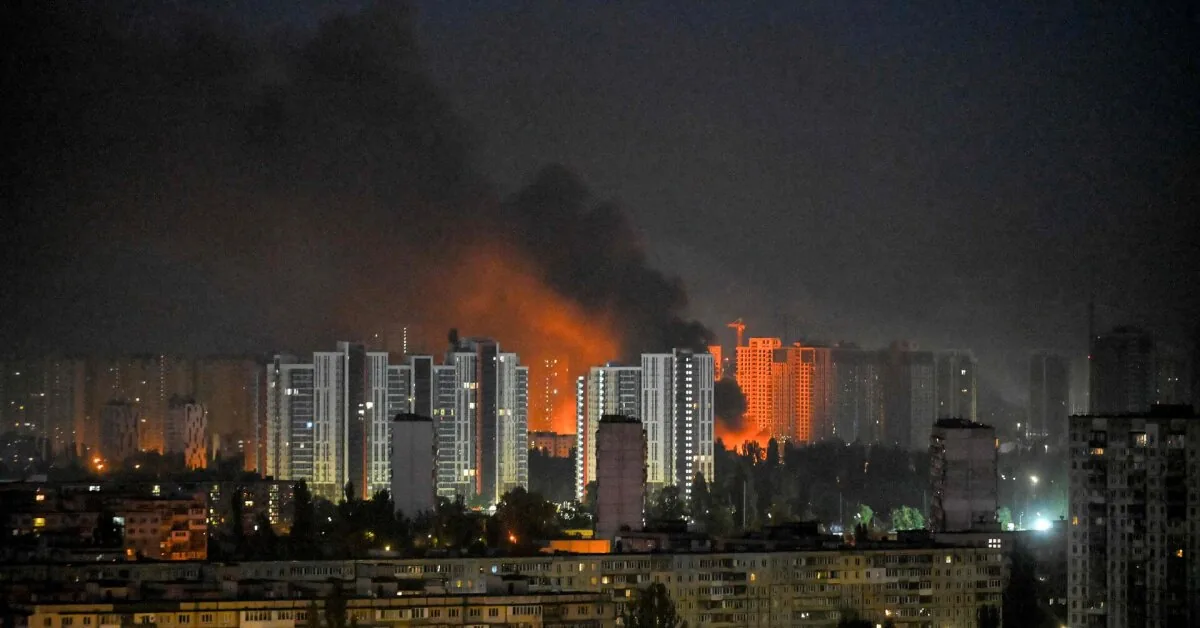
After the massive Russian strike on Kyiv and Kyiv region on the night of July 6, 2026, false reports began to spread on social networks claiming that the attacked sites stored “NATO projectiles with depleted uranium and cluster munitions.”
Read more Football miracles in Lithuania – sold the coach just after signing the contract
The posts call Vyshneve the “second Pripyat,” and Kyiv residents are frightened that their children supposedly “breathe uranium all day.” It is also claimed that it was precisely the “uranium projectiles” that allegedly destroyed five city streets and forced the authorities to evacuate residents.
This falsehood has also reached Lithuania. A “Facebook” post quotes former Ukrainian Verkhovna Rada deputy Ihor Moseichuk, who spread a false version that during the Russian strike in Kyiv region, a warehouse with depleted uranium projectiles transferred to Ukraine by the US and the UK in 2023, intended for Abrams and Challenger 2 tanks, as well as cluster munitions, was destroyed. It is claimed that their detonation allegedly caused a very powerful explosion.
Statement not supported by evidence
The original source of these false claims is the “Telegram” channel of former Ukrainian Verkhovna Rada deputy Ihor Moseichuk.
Since 2022, he has been living outside Ukraine, and in May 2025 he was included in the sanctions list of the Ukrainian National Security and Defense Council.
Later, his post was picked up and widely disseminated by Russian state and pro-Kremlin media, as well as anonymous channels, adding apocalyptic stories about a supposed “radioactive cloud” formed over Kyiv.
It is noteworthy that even in these reports it is acknowledged that there is no official confirmation of this claim. It was not confirmed by Ukrainian authorities, nor by US or UK defense institutions or OSINT analysts.
Moreover, official sources identify “Vizar” as a company producing and repairing components for anti-aircraft missile systems, aircraft parts, and drones, not a tank ammunition warehouse.
What happened?
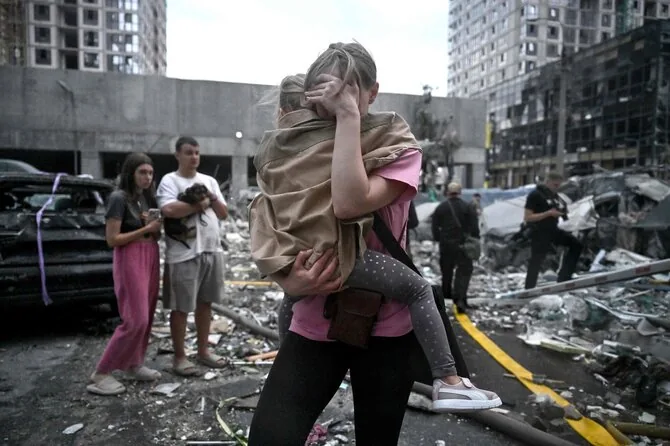
On the night of July 5 to 6, Russia struck Vyshneve — a city in Kyiv region near the capital. Strikes were inflicted on various sites, including an ammunition warehouse belonging to “Ukroboronprom,” causing a secondary detonation that destroyed five streets and damaged about 300 residential buildings.
The number of casualties gradually increased: currently, the number stands at 19 people.
Due to the threat of repeated explosive detonations, more than 600 people were temporarily evacuated from the city, including 117 residents who were in a shelter at the explosion epicenter. Evacuation points were set up in Vyshneve and Kryukivshchyna.
A separate discussion arose regarding the site’s affiliation. ZSU General Staff representative Dmytro Lychovyi confirmed in several comments that the site where the explosions occurred does not belong to and is not under the control of the ZSU.
He added that the order of the chief ZSU commander prohibiting the deployment of ammunition warehouses and similar facilities near civilian infrastructure and residential areas remains in effect.
According to information provided by Ukrainian authorities, the explosion in Vyshneve was caused by a Russian strike on an ammunition depot belonging to one of the state concern “Ukroboronprom” enterprises.
This was publicly reported by Ukrainian President Volodymyr Zelensky, who stated that this information was provided to him by special services and law enforcement.
The president also announced the initiation of a criminal investigation and declared that responsibility will fall on “Ukroboronprom” officials, as the warehouse was located in a facility belonging to one of the concern’s companies. Meanwhile, the leadership of the Ukrainian Armed Forces Logistics Forces emphasized that this warehouse was not on the military balance sheet.

Radiation background unchanged
After the explosion, the Kyiv regional military administration, having evaluated the results of 24-hour radiation monitoring, reported that the gamma radiation level in the region corresponds to the natural background, and no increased radiation levels were recorded after the Russian attack.
The Kyiv city state administration confirmed the same, emphasizing that the radiation background in the capital’s territory remains normal.
The independent environmental monitoring network “SaveEcoBot”, which publishes real-time radiation background data in Kyiv and Kyiv region, also did not detect any deviations from normal levels. Data published on July 6 showed no signs of radioactive material release.
If a large amount of depleted uranium munitions had indeed detonated in the region, it would have caused a measurable increase in radiation background, which would inevitably be reflected in sensor readings.

The destruction recorded in Vyshneve corresponds to the effects of an intense Russian combined missile and drone attack, not the version spread on social networks about allegedly detonated depleted uranium munitions.
According to Mykola Kalashnyk, head of the Kyiv regional military administration, nearly five streets were completely destroyed, many residential buildings were damaged, people died, dozens were injured, and more than 600 residents were evacuated due to the risk of repeated detonation.
According to the Ukrainian Air Force data, Russia used 68 missiles and 351 drones during this attack.
Therefore, the scale of destruction is explained by the intense missile and drone strike, not by the unsubstantiated version of allegedly detonated depleted uranium munitions in the warehouse.
Old falsehood
Depleted uranium is a byproduct of uranium enrichment, whose radioactivity is about 40% lower than natural uranium. It cannot cause a “second Pripyat” or Chernobyl-scale radioactive contamination because it does not contain nuclear fission products that caused the consequences of the Chernobyl accident.
Claims that depleted uranium munitions could harm Ukrainian health began to be spread in 2023 by the pro-Kremlin news agency “RIA Novosti.”
At that time, it was asserted that the supply of Abrams and Leopard 2 tanks posed a threat to civilian health due to the depleted uranium projectiles used by these tanks.
This was stated to “RIA Novosti” by Russian military doctor Konstantin Sivkov. However, his words do not correspond to the truth.
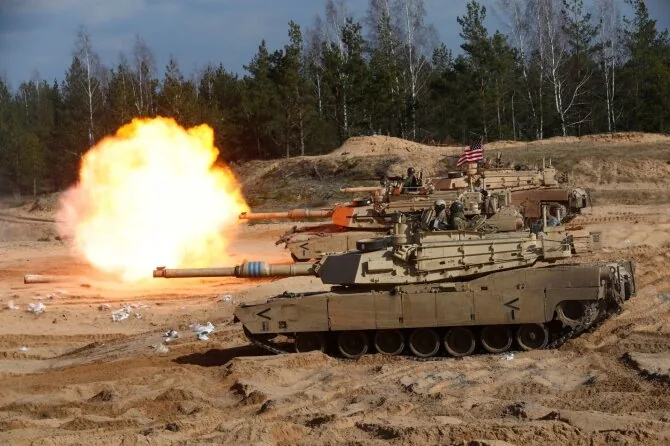
As 15min previously explained, weapons and military expert Giedrius Petkevičius noted that some tanks, such as the American Abrams, do indeed use depleted uranium munitions, but this does not significantly affect the environmental radiation background.

“Americans use depleted uranium both in Abrams tanks and their armor. It provides very strong penetration power.
A tank projectile is not ball or bullet-shaped; it resembles an arrow. An arrow made of depleted uranium penetrates enemy targets much more effectively than other metals, such as hardened steel ammunition,” the expert said.
According to G. Petkevičius, depleted uranium, no longer suitable for use in nuclear power plants, has several advantages. First of all – cost. Power plant operators would have to dispose of or store uranium, so making munitions from it, which have a high output during war or exercises, can save a lot.
“Theoretically, munitions could be made from titanium or tungsten, but such a projectile would be worth its weight in gold,” the expert commented.
The environmental impact of depleted uranium munitions is still debated. G. Petkevičius recalls that after Operation Desert Storm, where large amounts of depleted uranium munitions were used for the first time, environmental activists complained and claimed they could alter the natural radiation background or even harm tank crew members’ health. But this did not happen.
“The radiation background increased only slightly, very insignificantly. It could not affect health. I could not say strictly that uranium munitions have absolutely no environmental impact, but it is certainly not the terrible bogeyman it is portrayed as,” the specialist emphasized.
Minimal health risk
Studies have not found that people exposed to depleted uranium munitions face serious health risks.
In 2000, an article by Steve Vetter and Frank von Hippel was published in the journal “Science & Global Security,” noting that due to the low radioactivity of the munitions, radiological risk to humans would become significant only with long-term exposure, for example, if shrapnel fragments remained in a soldier’s body.
It is unlikely that individuals downwind from the ammunition would reach the chemical exposure limits for heavy metals. The risk arises only for those who spent a long time in vehicles affected by such munitions.
In the same year and journal, an article by Teodoro Liolios was published.
The authors state that any long-term increase in overall cancer mortality due to depleted uranium would be so small that it would be impossible to distinguish.
15min verdict: falsehood. There is no evidence that a depleted uranium munitions warehouse was destroyed during the Russian strike in Kyiv region. Radiation background measurements showed no deviations from normal.
Publication prepared by 15min in cooperation with Meta, aiming to stop the spread of misleading news on social networks. More about the program and its rules – here.
Read more Mindaugas Balčiūnas escaped from the press conference: «Less talk, more work»