1. Buried Villages of the Curonian Spit
– For most, the Curonian Spit is first associated with impressive nature, vacations, the seaside. What did you understand about this land while creating the performance-tour “Buried”?
Read more „Boeing“ plans a comeback, opened a new „737 MAX“ production line
– In general, the current layer of holidays and luxury resorts quickly fell away while creating the performance. Then I saw that life here was truly a huge drama. I kept thinking – how did people choose to live in a place where sand fills your mouth, gets into every fold of your body, and eventually swallows your home.
From the 16th to the 19th century, the Curonian Spit experienced one of its greatest tragedies. Due to natural factors and human activity – cutting down forests, expanding pastures, construction – the dunes began to shift. Sand gradually buried entire villages. People were forced to leave their homes, move closer to the lagoon, but after a few decades, the sand caught up with them there too.
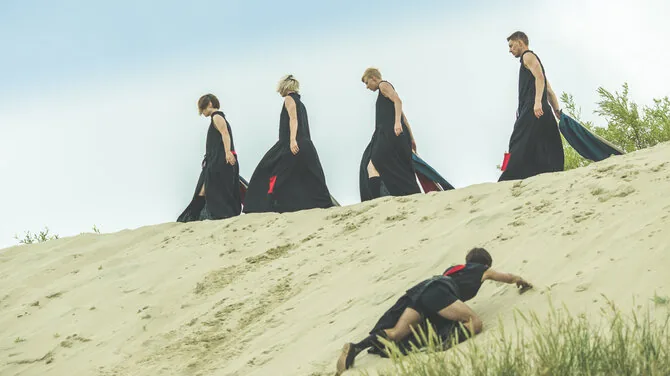
I remember the physical sensation when we prepared the texts for “Buried”. I tried to imagine what it means not to be able to open the door because the house was buried in sand. Or to be completely helpless when you have to pack your things and leave, and your home disappears right before your eyes. After this performance, Neringa no longer only associates with relaxation for me.
2. Boundless Space for Creativity
– The Curonian Spit has always attracted creators. Why do you think that is?
– Although the Curonian Spit is geographically very narrow, it gives a feeling of boundless space. This is contributed to by the harsh nature, the light, the scents, and the constantly changing colors. All of this cannot help but affect you.
Perhaps that is why this place has always attracted artists. They very sensitively “read” the environment. Here, space naturally arises for thoughts, imagination, creativity. It is no wonder that so many paintings, books, and musical works were born on the Curonian Spit.
I see that even today. If they have the opportunity, contemporary artists want to be here and create. It seems that here the mind becomes freer, thinking broadens, ideas come easier. The Curonian Spit has a hard-to-explain power to slow a person down and at the same time open them up.
3. The Artery Connecting Eastern and Western Europe
– In the 17th-18th centuries, the Curonian Spit was the shortest land postal route connecting Eastern and Western Europe. Can you tell us more?
– One of the most important European land postal routes ran here. Letters, parcels, and people traveled from one part of Europe to another along it. From present-day Tallinn, it was possible to reach Gdansk, and from there – other European cities. Because of this route, postal stations, inns, and settlements developed on the Curonian Spit. Therefore, it was certainly not the edge of the world – it was an important European communication artery.
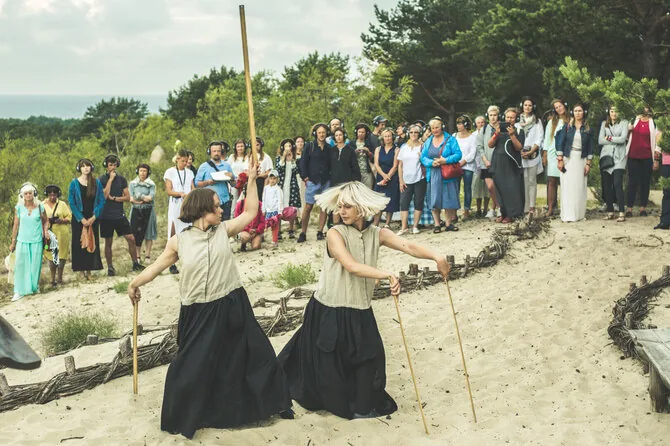
In the performance, we tell about it as a land route with a light irony because it wound along the Baltic coast. One wheel rolled on land, and the other on water. The performance includes a scene about traveling this route. Imagine: winter, wind, storms – what harshness of nature! There were no heated cars. After twenty hours of travel, postal couriers arrived white from sand, exhausted, barely able to stand. Carts got stuck, horses drowned in the mud. In the performance “Buried,” we tried to create an experience for the viewer as if they themselves were traveling this route.
4. The Curonian Spit – a Porcelain Cup
– What would you want every vacationer to understand about Neringa?
– First of all, its fragility and changeability. I think this is very important; it must be treated carefully, like a porcelain cup. It is important to preserve it because nature is very fragile and changing. It is important to see that change, which is incredibly beautiful. When showing “Buried” on Parnidis Dune, we have to adapt every season because the landscape changes every year. Also, there is special light here, the reflection of the sunset in the lagoon, moments of storms. It is worth coming to the same place at different times, under different lighting – each time you will see a different view.
5. How Nida Avoided Hitler’s Gigantic Constructions
– Adolf Hitler was a fan of gigantic buildings and planned to turn Nida into a mass vacation spot. Tell us more.
– The Third Reich planned to establish a huge “Kraft durch Freude” (“Strength Through Joy”) recreation complex here, intended for the German elite and deserving workers. If these plans had been realized, today’s Nida would resemble the coast of Rügen Island, built up according to Adolf Hitler’s vision with several kilometers of blocky multi-story “summer houses.”
It is said that the painter Ernst Mollenhauer, upon learning about these plans, approached Albert Speer, Hitler’s architect who was visiting Nida at the time. During a secret ride through the deer grove, he convinced the architect and received a promise to “take care of the matter.”
Read more Iranian media: explosions near the Strait of Hormuz
It is a miracle that this did not happen, even during the Soviet occupation. The unique place was preserved.
In the performance, we link this story with the theme of war and destruction. The story about Rügen Island becomes a kind of warning about what could have happened to the Curonian Spit. We develop this idea not only through text but also choreography, direction, and music. Many parallels arise: construction and destruction, war and the disappearance of people, forced displacement from their homes.
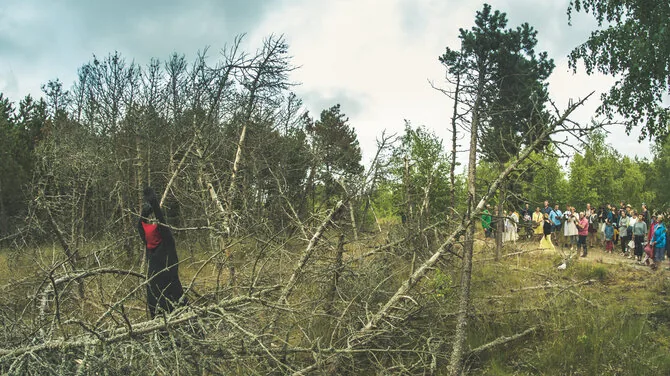
Standing in that place, you realize what a miracle it is that Neringa was preserved. And at the same time, you clearly see what it could have become.
Not to know, but to experience: the performance as a time machine
– Let’s return to the performance dedicated to this land. What can “Buried” tell about the Curonian Spit that a travel guide cannot?
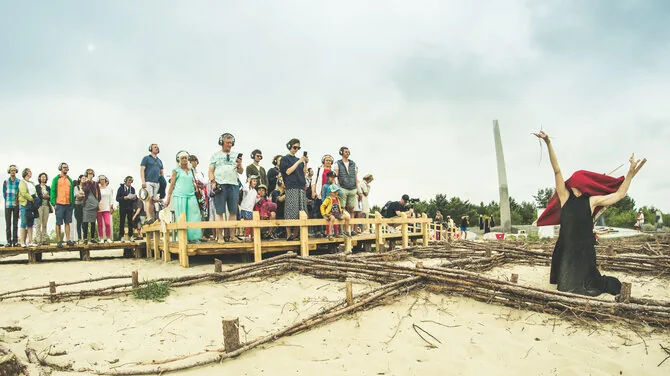
– I think the most important thing is the state a person experiences. We can all read historical facts in books or hear them from an excellent guide. But the performance allows you not only to understand them but also to live through them.
Dance, music, sounds, the setting or scorching sun, wind, the dune landscape – all this transports you to another time. One moment you see a contemporary dance dancer, and the next, the terrace of Thomas Mann or the world of the buried village inhabitants appears before your eyes.
I think this is where the power of dance lies. It is abstract enough to awaken a person’s imagination and allow everyone to create their personal connection with this place.
– The soundtrack in the performance also creates a very unique atmosphere. How was it created?
– Together with composer Kristijonas Lučinskas, we searched for a long time for the sound world that would suit this story. We quickly realized that electronic music does not fit here. We are talking about very real things – a person, sand, wind, light.
Therefore, Kristijonas recorded improvisations by Benas Šarka and his colleagues. Wooden wind instruments, strings, various acoustic instruments sound. He subtly combined all these sounds into a coherent soundscape.
I really like the feeling that all the voices and music of the performance seem to rise from the sand itself. As if we gradually dig through its layers and under them find the stories of the people who lived here.
I think Kristijonas very aptly managed to create a sound world that becomes part of this journey.
The dance performance-historical tour “Buried” will be shown this year in Nida, on Parnidis Dune only from July 16-18.
Read more The photo of «Šeškiai» became the epicenter of gossip: not everyone noticed what was wrong with it