Emergency medical services and the Fire and Rescue Service are already preparing for the worst-case scenarios, but they warn: closing a major city artery on such a scale without a real alternative route poses a direct threat to people’s safety and could cost dearly – human lives.
Read more JT condemns escalation in Russia’s war against Ukraine
Human life should come first
Jolanta Vaišvilienė, the administrator of the Kėdainiai emergency medical service department, said that not just individual employees but the entire team is anxiously looking at the upcoming, although very necessary, but complication-causing bridge repair works.
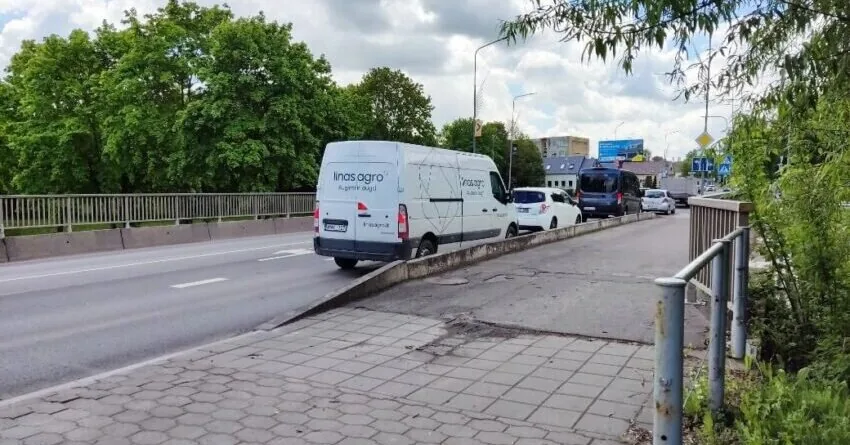
“We are very concerned that the bridge over the Smilga stream is planned to be closed without installing a temporary bridge. We want to draw attention to the possible negative impact on residents’ safety and the operational efficiency of the emergency medical service,” says J. Vaišvilienė.
The EMS building is at Budrio St. 7 – which means that when receiving a call on the eastern side of the city, the only real detour route to Kėdainiai Hospital leads via Šėta Street. And there is a railway crossing on Šėta Street.
“If a train is passing, the crossing is closed and we all wait there. A regular train passes quite quickly, but if those big freight trains are coming, and we are waiting for a dying person, every second, every minute is very important. This is not so much about response time indicators as about human lives.
We can theoretically arrive even in an hour, but, you know, human life should probably come first.
When such a situation arises, it is unclear how long it will take us to arrive at the call or how long the trip to the hospital with the patient will last,” emphasizes the administrator.
According to her, the greatest fear is not everyday calls but critical situations – resuscitation, childbirth, traffic accidents, where every second determines whether a person will survive.
“We can theoretically arrive even in an hour, but, you know, human life should probably come first,” says J. Vaišvilienė.
She adds another painful circumstance – a person waiting for help often evaluates the waiting time very uncritically. Sometimes the ambulance arrives in just a few minutes, but for someone waiting next to a dying relative, it feels like the medics took an eternity. In a state of stress, people often cause conflicts, lose control of their emotions, shout at medics, so in such cases, they have to work under even greater pressure and negative emotional conditions. Moreover, the medics certainly will not start explaining to a frightened relative that they were delayed because they had to wait for a train at the crossing, the interlocutor says.
However, some consolation is that one EMS team is on duty in Vainotiškiai, and another is located in Pelėdnagiai. In critical situations, these teams will be called for assistance, but the fact remains – the detour via the busy crossing will be a real challenge for paramedics.
Firefighters: the time standard will definitely change
Andrius Eidimtas, head of the Kėdainiai Fire and Rescue Service (PGT), assesses the situation soberly and diplomatically – as a leader whose service does not have a mandate to evaluate political or infrastructure decisions but must ensure that help reaches the recipient.
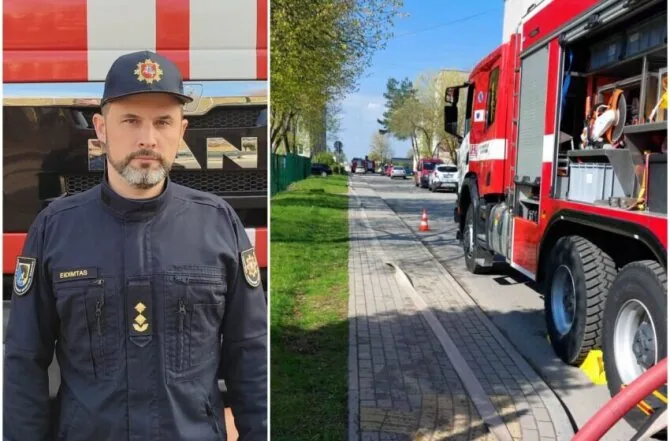
“The fact is that our service does not evaluate the city streets, bridges, or other infrastructure repair decisions. If it was decided this way, then we must ensure the arrival of fire trucks at the incident site,” says A. Eidimtas.
However, the chief does not hide that concerns are justified. If the only bridge over the Smilga is closed, traffic to Žemaitė, P. Lukšys, and adjacent streets will have to move via a detour – and the response and arrival times will objectively change.
“We clearly see that travel time will change. Because crossing the Smilga stream and turning right is one thing, and driving via Šėta Street is quite another. And if there are any problems at the railway crossing – we cannot be sure whether a train will be moving through the crossing at that time or not. There are many unpredictable factors,” he admits.
A. Eidimtas notes that the service has a clear response time standard: to reach at least 80% of incidents in the city within 8 minutes, and in rural areas within 18 minutes. This standard will undoubtedly change due to the closed bridge.
“Of course, this statistic will change,” he says.
The service is already planning routes, evaluating detour roads, and maintaining communication with the General Emergency Center so that in case of a traffic jam or malfunction at the Šėta St. crossing, teams from neighboring districts can be dispatched immediately.
“We communicate with the General Emergency Center, and in such cases, they send not only city but also other nearest municipality fire teams or even state PGT teams from other districts. Everything will be done so that rescuers reach people as quickly as possible,” explains the chief.
However, A. Eidimtas openly admits that the Šėta crossing itself is the weakest link in this detour: “The Šėta Street crossing can further prolong the response time. And simulating the situation, driving anytime through Šėta Street, one can get into very difficult situations.”
The news that Lithuanian Railways (LTG) plans to invest in crossing upgrades and reduce unexpected barrier failures does not reassure residents much – in recent years, drivers in Kėdainiai and surrounding districts have sometimes waited at a stuck railway crossing barrier for up to an hour.
Read more Seeing a blood clan in the stairwell, the neighbor did not panic: concerted efforts – a life saved
Business: barely catching a breath, facing a new crisis
Vilma Likšienė, head of the Kėdainiai branch of the Kėdainiai Chamber of Commerce, Industry and Crafts (KPPAR), reminds that after the Bridge Street bridge saga, the city is only now beginning to recover economically, and a new challenge would return it to a similar or even more difficult situation.
“We definitely feel that after more than three years of Bridge Street bridge repairs, Kėdainiai can finally breathe easier. The bridge was a very important connection for the city, so its closure strongly affected not only residents but also businesses,” says V. Likšienė.
During the entire period of the Bridge Street bridge closure, business representatives complained about increased fuel costs, lost time, more complicated logistics, and more difficult employee movement between different parts of the city.
“The city was effectively divided into two parts. To reach the center or the other side of the Nevėžis River, one had to take large detours through Vilainiai or the southern bypass. This meant extra time, extra costs, and more stress for both residents and businesses,” recalls the KPPAR representative.
According to her, the closure was especially painful for the service sector, small businesses, and companies whose employees or clients move between different parts of the city. For some businesses, this also meant fewer customer flows.
Now, with the closure of the bridge over the Smilga without a temporary bridge, the city will again be divided, and movement to the hospital, police, fire stations, business facilities, and schools will again become very difficult.
“After the Bridge Street bridge story, businesses clearly understood how much normal infrastructure means to the city.
Therefore, the most important expectation now is that decisions regarding the Smilga bridge are made responsibly, providing real alternatives for residents and businesses,” she emphasizes.
Vilma Likšienė is supported by Ieva Vargalytė, a businesswoman who runs the “Radvilų sodas” café near the planned-to-be-closed Smilga bridge.
“We understand that bridge infrastructure needs to be maintained, and investments are necessary.
However, the news that no temporary bridge is planned during the repair of the bridge over the Smilga stream was really surprising.
In our case, this would mean that the business would practically be cut off from a large part of the city for at least one and a half years,” says I. Vargalytė.
Such a prospect, according to the “Radvilų sodas” manager, could significantly affect customer flows, employee movement, and daily logistics. The company is already looking for ways to adapt.
“We are currently looking for solutions to adapt to the situation – we have started offering lunch menus, adjusting working hours, and looking for other ways to maintain accessibility for customers,” shares the interlocutor.
Detour is unreliable, and talks about a temporary bridge are vague
The fundamental problem, equally pointed out by special services, businesses, and residents, is that the geography of Kėdainiai city simply does not provide many route options when the bridge over the Smilga is closed. The only real detour to reach the eastern part of the city leads through the Šėta St. crossing.
This crossing is heavily loaded. Both passenger and freight trains pass through it, and the latter take much longer to pass. Moreover, in recent years, unexpected barrier failures have been recorded multiple times at Lithuanian Railways crossings, where drivers had to wait much longer at lowered barriers than the time it takes for a regular train to pass.
All interlocutors – from medics to business representatives – agree on one thing: the bridge repair is necessary, infrastructure must be maintained. However, the way it is done determines whether the city will withstand the repair or whether it will demand sacrifices – both economic and, in extreme cases, human lives.
The Kėdainiai community today awaits a concrete answer from decision-makers: whether a temporary bridge will be installed or other real solutions will be found to ensure the operational efficiency of special services and business activity.
After the experience of the Bridge Street bridge closure, the city understands better than ever what it means to live in a divided city – and why it does not want to return to this experience without necessary preparation.
Read more Vaidotas Žala and Gabrielė Martirosian checked out the new «Škoda Epiq»: what does it feel like?