KnyguKurejai.lt – a project telling about children’s and youth books and their authors. The theme of 2019 is the anatomy of books. Writers and artists open the doors to the backstage of their works, sharing special stories never published before.
Read more JAV and Iran War: What is Happening in the Middle East
The anatomy of the text according to Laurynas Peluritis
Beginning
The idea arose from two incentives – the calls of the book publisher Dr. Tomas Šinkūnas (“Phi Books”) to write the first Lithuanian booklet of the Little Platos series and my dissertation research, during which I had to delve quite a bit into the history of philosopher Vosylius Sezemanas and his family. Since many things about the professor settled in my memory rather than in the dissertation text, I wanted to use those things somewhere. The main motifs of the book came together in my mind in the summer of 2023, then I carried everything in my head for a good year and a half, and the final text was written at the end of 2024. The procrastination was caused by the fact that the author of the text is not very skilled with the pen and was doubly afraid to write for a young reader – after all, here you cannot hide behind academic jargon or other cleverness.
Preparation
I thought I knew enough about Vosylius Sezemanas and Vilnius at that time, but the problem was to find a partner for him who would turn the facts of his life into an attractive, engaging story. Remembering Socrates, a daimonic figure was needed – a guiding voice that would direct the hero’s choices in a certain direction. Probably the article by Pavel Lavrinenko about the history of the Vilnius Basilisk legend, which caught my eye, prompted me to turn that daimon into a Basilisk. After all, V. Sezemanas came to a city completely unknown to him, so it was necessary to find who would be his guide.
Characters
I tried to create the character of Vosylius Sezemanas based on memories of his family and acquaintances, in philosophical dialogues I quite directly relied on his own writings (mostly from the interwar period) dedicated to classical philosophy. The inspiration to create the Basilisk came from Vinco, the cat who guarded the Faculty of Philology at Vilnius University (rest in peace!), who is also mentioned in the book. Maybe that’s why the Basilisk turned out so cat-like.
Environment
I had a very clear map in my head of where, who, and how things happen, but I left it as a writing background because the goal was not to describe Vilnius at that time. The essential action was to be about the characters and their ideas. I wanted to briefly tell at least a few thoughts that concerned Sezemanas himself and at least somewhat reveal what an interesting person he was. I don’t know if it succeeded even a little.
Plot
The main plot points were born together with the idea of the book. Still, when you are lazy, it is hard to write even a few pages… Knowing roughly what I had to write about, I wrote each episode of the book in short but intense sessions. In each case, I tried not to write but to let the logic of the characters and plot unfold. The hardest part was to write clearly on philosophical topics without vulgarizing or oversimplifying them. It was also a difficult task to subtly tell about the Jewish tragedy. If we believe family memories, V. Sezemanas’s family hid a young Jewish girl in their home. It was important to me that this appear in the booklet at least as a fact. V. Sezemanas was generally a person of very complicated fate, yet he always remained faithful to his principles.
Creative process
The writing of this small booklet was one big creative and writing pit for the author. Like every writing. First came the first couple of pages of the book, which Živilė Žvėrūna intertwined with her drawings. The funding received from the Lithuanian Council for Culture and the publisher’s reminders made me move more seriously with the writing. Later the whole process went roughly together with Živilė’s drawings: I write something, it is intertwined with the image, then a bit of editing and we move on. It was especially useful to read the text aloud both with family members and with Ž. Žvėrūna, listening to how the sentences sound and connect with each other; the smooth birth of the text was also contributed to by the editor Iveta from the “Phi Books” publishing house.
I managed to write the text in about four or five focused sessions of a day or two – it was impossible to fit this work into the daily schedule, so I rather had to look for special time on days off or weekday evenings. Most of the text was written at home on the sofa, often with the help of Mija, although I had to fight with her sleep spells.
The anatomy of illustrations according to Živilė Žvėrūna
Style
I studied classical graphic techniques at university, but I was always interested in the digital world of colors, so after acquiring a tablet, I naturally became interested in illustration. Digital graphics allow quick decisions and reconstructing the drawing. I think that an artist’s style does not form suddenly; it mutates with each new creative work, especially influenced by the creativity of the people you work with – thus you are inevitably forced to expand your field of vision.
So probably this booklet is the result of such a long process.
Characters
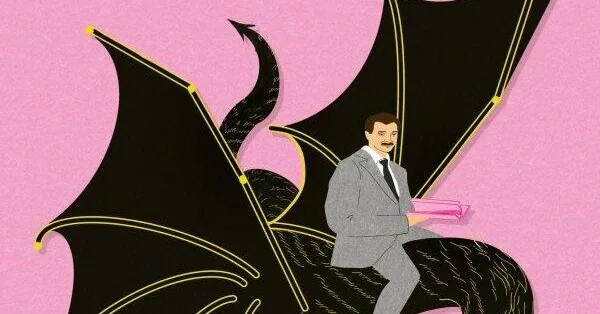
The book’s characters are historical figures, so I relied on historical photos, articles, and literature, and most of all, of course, on Laurynas’s text. The most interesting was to find the image of the Vilnius Basilisk. The idea to depict it as a half-cat was suggested by Tomas Šinkūnas (director of the “Phi Books” publishing house). After all, it is a mythical creature, so it can be whatever you want!
Read more Ticks are attracted like a magnet: which plant has no place in your plot
Environment
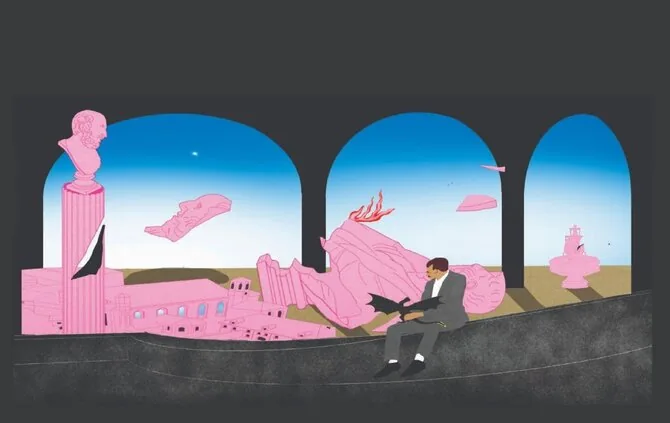
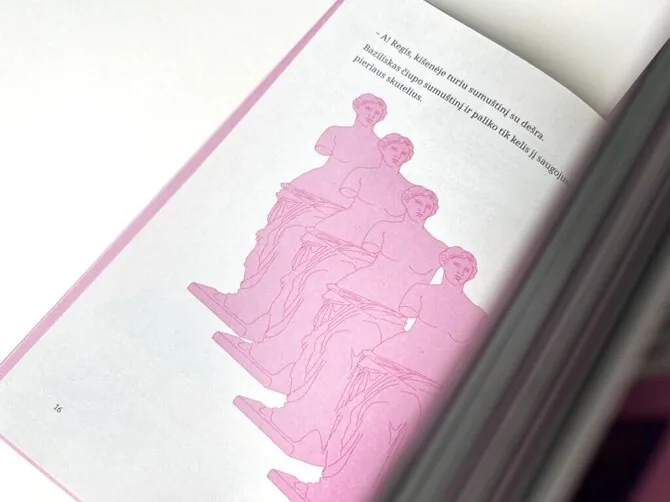
An important part of this visual story is the contrast of colors. They must strengthen the good and evil analyzed in the text. I consciously avoided directly illustrating Soviet or Nazi occupiers and depicted them only as hints by embodying them in wolf shadows. This was to show that evil is not always clearly recognizable; at first, it comes unnoticed like a shadow. I chose the depiction fragments so that they would not stray too far from historical truth or at least visually help reflect the spirit of that era, although the illustrations also include a lot of antique iconography and architectural elements. Previously, when creating, I relied on the visual legacy of past epochs, and in this case, in the text about Sezemanas, we can also see connections with the ancient world, so it was important to supplement and strengthen this impression with the image. Sezemanas and the Basilisk speak about beauty and truth in the face of evil. These two opposites naturally suggest images.
Plot
It was important for me to hear Laurynas’s own thoughts about what images he himself sees in the text, so I was open to his ideas, but I tried to look freely at the accents he set. Since this is my first attempt to illustrate a booklet – I had no specific rules. I think the whole creative process was very organic because Laurynas would send me a part of the text, and I would try to illustrate it. This correspondence gave birth to this book.
Creative process
I have previously illustrated music album or book covers, but this project is special to me because it gave me the opportunity not only to illustrate but also to tell a story in the language of images. This required a more attentive look and concentration, care, because it talks about a historical figure, his ideas in a particularly difficult period.
Like every creative project, this one had to be combined with everyday work. I work at the Šiauliai Art Gallery. There, with a small group of colleagues, we actively carry out educational activities, curate exhibitions, and have other creative activities, so the time is always intense. I finished the last illustrations of the book just during an event!
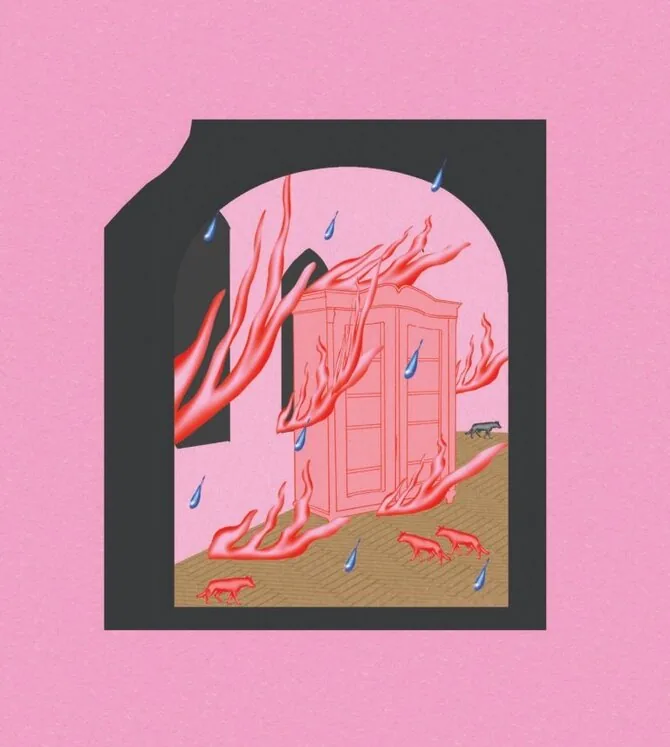
In the creative process, the beginning is always the most interesting to me because then you explore sources, look for ways of depiction. I am glad that there were no disputes at all during the creation! I was given complete freedom to interpret, although I always kept in touch with Laurynas and shared thoughts on how one or another part of the story could be depicted, but all this went smoothly, without conflicts!
Authors’ biographies
Laurynas Peluritis
I was born on September 24, 1990 (Monday) in Vilnius. In 2009, I graduated from Vilnius Karoliniškės Gymnasium, studied for a year at the Institute of International Relations and Political Science at Vilnius University, to my father’s great stress, I dropped out of these studies and, together with friends, transferred to philosophy studies. Somehow I obtained bachelor’s and master’s degrees in philosophy, later wrote a dissertation at the Faculty of History of Vilnius University.
Although I currently teach the history of ideas and concepts and political philosophy at the Faculty of Philosophy of Vilnius University, I have had to do various jobs and tasks. I worked as a boy (unqualified worker) at the publishing house “Naujasis Židinys – Aidai,” which I later had to lead, simultaneously unsuccessfully studied editing, worked with cultural projects, and some other things.
I have no great achievements to boast of. This book is my first work for young readers.
Živilė Žvėrūna
I was born in 1992 in Mažeikiai. I studied art-graphics at Šiauliai University. I have worked as a cultural activity manager and art educator at the Šiauliai Art Gallery.
Read more 5 expenses that many forget when planning a vacation
This book is my first illustrated book for young readers!