The counterstrike in case of a Russian attack consists of three interconnected strategies that make up the “NATO land warfare concept,” writes Bild. One of the main authors of the concept is named by the newspaper as U.S. Army Major Andrew Pingrey.
Would stop strikes
If the Russian army attacked the Baltic states with missiles and drones, and also began to advance with tanks, as it did in Ukraine, NATO intends to first stop missile strikes, writes the newspaper. For this, Alliance fighters, missiles, and unmanned aerial vehicles would have to disable Russian missile systems. In this case, one of the targets would be Kaliningrad, where many Russian air defense systems and missile complexes are deployed.
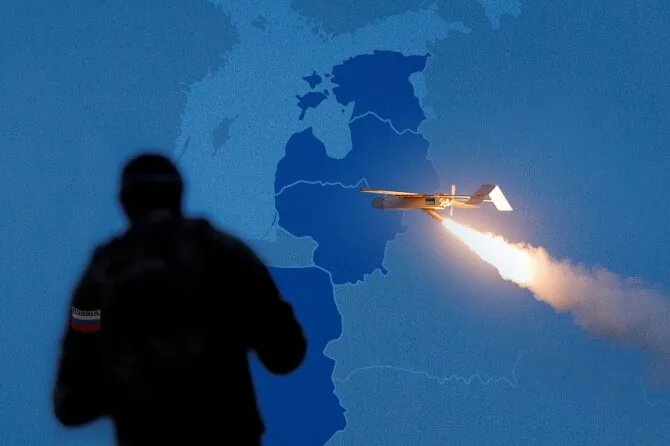
At the same time, along the borders with Russia and Belarus, an “autonomous zone” is planned to be created, which should become a protective barrier where the initial contact with advancing Russian forces would be made by machines. NATO troops are not planned to be deployed in this zone. The Russian attack should be stopped by unmanned aerial vehicles and other autonomous military machines.
In the next stage, as the concept foresees, NATO will strike deep inside Russia. Special forces will have to destroy main military bases and supply points. Such objects include airfields, defense industry enterprises, bridges, and railways, the newspaper describes.
Would enlist Russians opposing Putin
Operations inside Russia are also planned to involve Russians who oppose Vladimir Putin, notes Bild.
Additionally, the creation of an “air bridge” is being considered, through which drones and robots would be transported by plane into Russia. The task of this equipment would be the destruction of airfields and military bases.
The ultimate goal of this stage is to severely weaken Russia’s supply lines and also prevent further waves of strikes.
NATO’s goal, as emphasized in the concept, is not to occupy Russian territory. The Alliance aims to push Russian forces back to the border.
Wants to deter Russia
Bild separately notes that NATO military personnel do not want to keep these plans secret. In their view, deterrence only works when the opponent knows exactly what to expect if they attack Alliance countries, the newspaper summarizes.
In recent months, Western media and intelligence agencies have increasingly warned about a possible direct conflict between Russia and NATO. In early August, The Wall Street Journal, citing the latest U.S. intelligence assessments, reported that Russia could launch a limited attack against a NATO country as early as this fall.
Moscow is actively reviewing previously prepared NATO strike plans, wrote The Washington Post columnist David Ignatius in July, citing Western officials. Latvian intelligence warned in June about signs that Russia is preparing military provocations against the Baltic states or Poland.
In early August, the portal 15min published that Lithuanian military intelligence has data that Russia is considering attacks against critical infrastructure in the Baltic region, using drones produced in Ukraine.
“Very close to reality”
Lithuanian Army reserve major and military expert Darius Antanaitis, commenting to the portal 15min on the defense concept outlined by Bild, noted that it is based on certain assumptions and is very close to reality regarding how things would unfold if a war with Russia started.
“I call it a concept, not a plan, but every plan is valid only until the first shot. In general, NATO plans for the defense of the Baltic states have been developed for many years. Similar ones were created together with the Lithuanian army. The emergence of such information shows that planning is ongoing and not stagnant, but constantly adapted to the current situation,” noted the military expert.

According to D. Antanaitis, this concept only confirms that adaptation to the real situation is taking place, based on what we have seen from Russia’s fighting in Ukraine, assimilating what works and what does not in Ukraine.
Asked how he evaluates recent reports about possible Russian provocations against the Baltic states and Poland, the expert recommended relying on Lithuanian military intelligence and NATO intelligence assessments.
Lithuanian society is now much safer
“The greatest danger was in the first years of the war when there was a high probability that Ukraine would not hold out. Currently, what we see and what we are told is that there is no conventional threat around us or one that could cause an existential danger,” said D. Antanaitis.
In his opinion, Lithuanian society is now much safer than before.
“When we talk about security, we must talk not about how many rifles, tanks, or drones the army has. We must talk about how prepared the society itself is to defend its state. The state is all citizens, not just those who agreed to sign contracts with the Defense system.

I assess that we are much stronger, we know much more about Russia and its capabilities. And, most importantly, we support our own freedom and independence much more strongly,” said the expert.
“The ABC of NATO actions”
Military expert and historian Egidijus Papečkys pointed out that the information presented in the Bild article is no news: “This is basically the ABC of NATO actions.”
According to him, similar steps and strategies can be found in declassified NATO documents from the 7th or 8th decade, when preparations were made for a possible war with the Soviet Union.
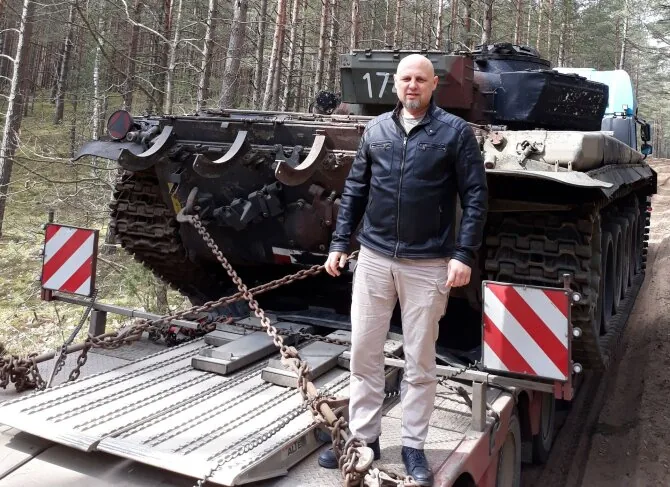
Bild provides very general phrases about how things could be. And I found it strange that the text mentions a major who supposedly prepared this new defense concept. NATO defense plans are certainly not prepared by individual majors, but by groups and committees,” he said.
According to E. Papečkys, overall, what Bild writes about the Baltic states “rarely comes true.”
“Apart from those general things, I see only what we already know: NATO has a plan for what to do if some kind of aggression arises. Every war starts with air strikes and shelling. Of course, NATO would try to repel those air strikes in any Alliance country, especially the Baltic states, which have a border with Russia.
It would not be that we are sleeping and suddenly a war starts and hundreds of thousands or millions of forces are introduced into the Baltic states. As we have seen perfectly in Ukraine, everything is monitored, everything is visible,” he explained.
NATO, although a defensive alliance, does not mean “sitting in a corner waiting to be beaten”
The expert emphasized that NATO, although a defensive alliance, does not mean “sitting in a corner waiting to be beaten.”
“If NATO really knows that an attack is being prepared and air strikes will begin, I have no doubt that, having such information, the Alliance can be the first to attack missile or drone launch systems. NATO has the capability to deliver longer-range strikes than Ukraine can today, and to do so with stronger means,” explained E. Papečkys.
Although in recent years, especially with the return of President Donald Trump to power in the White House, there have been more doubts about whether NATO’s collective defense principle really works, E. Papečkys reminded that similar doubts have accompanied NATO’s entire existence.
“I think maybe all this happens only in our heads. Perhaps that distrust came from the 1990s, thinking that no one would defend us here. Thinking that we would have to do everything ourselves. I see the situation a little differently. It has never been that the West committed if it was not going to fulfill those commitments. After all, this is not some memorandum, but a treaty that has been in effect for a very long time,” the historian dispelled doubts.
In summary, he added that when reading such texts, one should not be frightened that something “could happen right now.”
“I am sure that any Russian preparations will be detected in time, and NATO will take adequate measures to deter and, if necessary, stop the invasion. On the other hand, currently none of our unfriendly neighbors have forces that could suddenly catch us off guard or pose a greater threat,” said E. Papečkys.
Read more Road repair stopped on the way to the seaside: what happened?