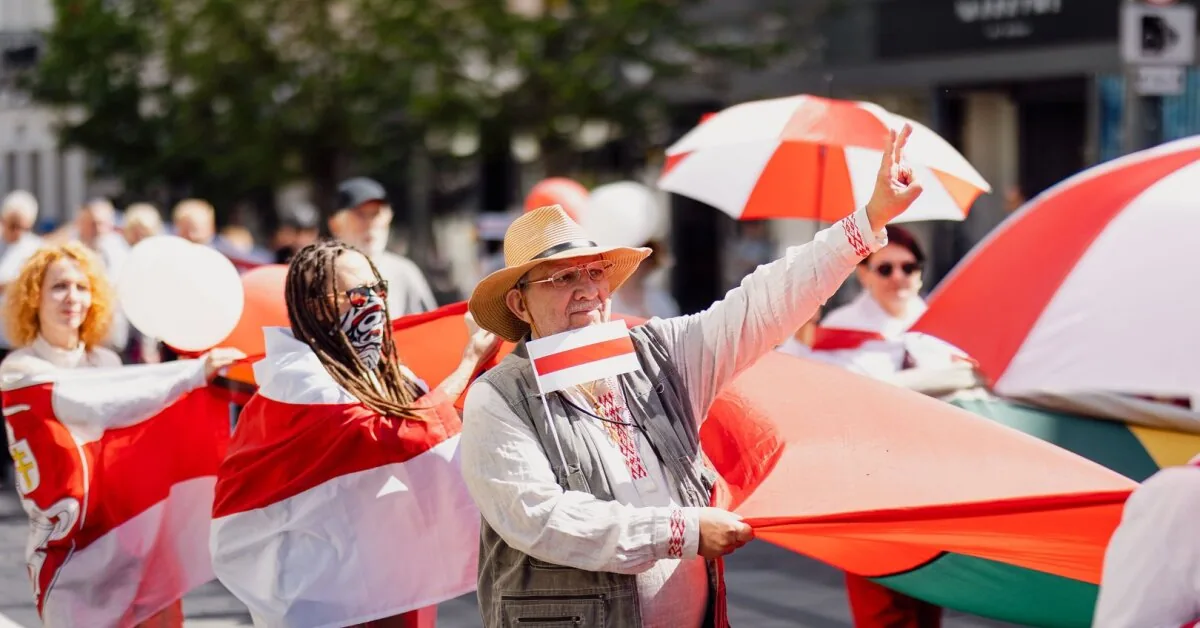
Participants at the rally chanted “Long live Belarus!” and sang songs that have become symbols of Belarusian solidarity.
Read more In fines for car parking last year, the municipality collected almost half a million euros
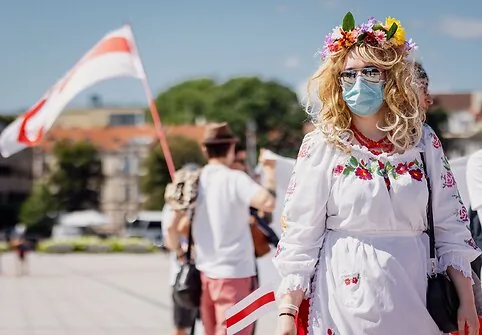
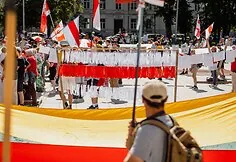
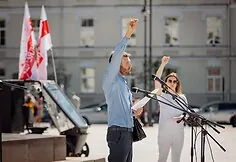
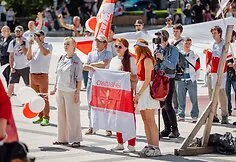
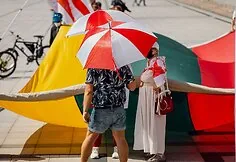
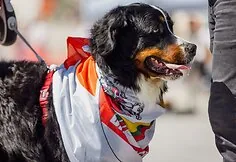
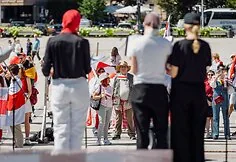
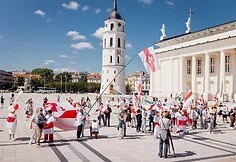
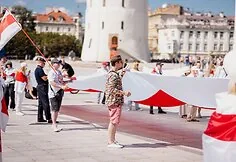
The majority of Belarusians who spoke to BNS at the rally, although without much enthusiasm, said they believe the political situation in Belarus could change in the near future, but there were also those who thought otherwise.
“I am not as optimistic as I was six years ago,” said 32-year-old Anatoliy Chinevich, who worked as an IT specialist in Belarus, to BNS.
“This day is about me because I was a political prisoner. (…) I was in prison for two and a half years. The official version is that I kicked three OMON officers during the riots,” the man said.
Meanwhile, 31-year-old Kaciaryna Kanapliova, who moved to Lithuania four years ago and works as a French language teacher in Vilnius, said she still has hope that the situation in Belarus will change.
“Of course, we have hopes, the belief has not faded. Maybe in a few years (the situation will change – BNS). Our goal is to preserve our Belarusian identity. Even if we live in different countries, (…) we want to preserve our identity,” she told BNS.
“Today we want to remember that many people continue to fight. Many people continue to suffer and our goal is to show that Belarus is still resisting Lukashenko, still resisting (Vladimir – BNS) Putin, and we want to show this to everyone around, Lithuanians, representatives of other nations,” K. Kanapliova said.
In turn, 53-year-old Tatjana, who worked as a medical center administrator in Belarus, said she still hopes for change in her homeland even after six years, and came to the rally to remind those around her that “Lukashenko lost the 2020 elections.”
“Today we continue the fight for a free, democratic Belarus. We do what the Belarusian people cannot do. (…) I myself left, escaped criminal prosecution. I was detained twice – in 2022 and 2024, then a criminal case was brought against me,” she noted.
44-year-old Ilya Mironov, who worked as a logistics specialist in Gomel and was later imprisoned in a Belarusian prison, told BNS he also hopes the political situation will change.
“We all remember the Soviet Union – it collapsed literally within six months, and no one in 1990 could imagine that it was possible. But that Soviet empire collapsed and independent republics emerged, including the Baltic states, Belarus, and others. So, everything can change in Belarus too,” I. Mironov explained.
Read more In the Balkans – a record number of horses: who will win the champion title?
According to him, the situation in Belarus primarily depends on how quickly Ukraine wins the war started by Russia.
“In August 2020, I went out to the square in Gomel, despite their attempts to scare us, showing brutal arrests on television (…) I do not regret going out. I would go out again. For my activities, I spent two years in prison and was forced to leave,” the man said.
This year, Belarusian opposition leader Sviatlana Tsikhanouskaya, who moved from Vilnius to Warsaw, said in a statement released on Sunday that the Belarusian fight for democracy is not over yet.
“We are determined to finish what we started in 2020. And I truly believe that Belarus can become a success story – a story about the transition from dictatorship to democracy. So today I ask you to support Belarus, fight for the release of political prisoners, continue to pressure the Lukashenko regime, and of course, firmly support Ukraine,” she said.
According to the Migration Department, about 48,000 Belarusian citizens have residence permits in Lithuania. Most of them came to Lithuania after the events of 2020, but as labor migrants.
After the rally, participants will proceed in a Freedom March to the Light Watch near the Belarusian embassy. There, a moment of silence will honor the victims of political repression in Belarus and the heroes who died for Ukraine’s freedom, followed by an open microphone event.
The events will conclude with an acoustic concert by Jurij Stylsky, leader of the Belarusian rock band “Dai Darogu!”, at the “Alaus namai” bar.
As BNS reported, in early August 2020, after the presidential elections in Belarus and A. Lukashenko again declaring himself the winner, hundreds of thousands protested in the country, to which the authorities responded with repression.
About 65,000 people were detained during the repressions, main opposition figures were imprisoned or fled the country. As a result, Western sanctions were imposed on Belarus.
Read more A forest fire rages in southwestern Spain, 470 people evacuated