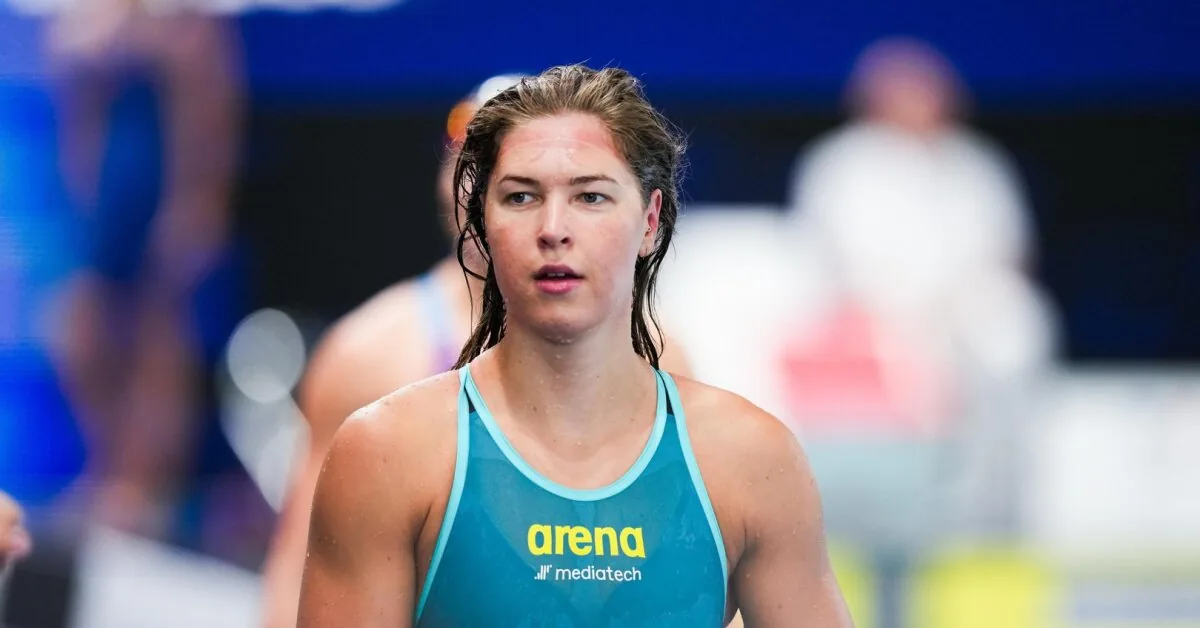
Sunday morning swimming competitions ended, but the stands were still more half-full than half-empty in the 5,000-seat Paris Olympic Aquatic Centre in the Saint-Denis district.
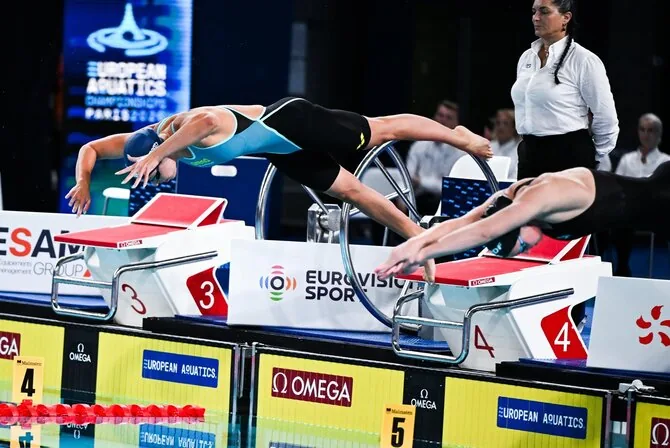
The spectators began to applaud in unison, coach Tadas Duškinas shouted calls of encouragement, and someone among the Lithuanians folded their hands in prayer as two swimmers entered the pool to compete: Kotryna Teterevkova and Ralina Gliazova.
It was another one-on-one battle in the 50 m breaststroke distance, on one hand for nothing – the reserve 9th place before the Sunday final, but at the same time for a lot, because the Lithuanian swimmer’s opponent was from the aggressor country.
It so happened that K. Teterevkova shared 9th-10th positions in the semifinal with the Russian Ralina Giliazova, who recorded an identical time – 30.55 seconds.
According to the rules, the swimmer who took ninth place is considered the first reserve athlete who would enter the final if any of the top eight swimmers refused to swim in the final for any reason.
At first, K. Teterevkova thought that would be the end of it, perhaps she would only need to appear before the competition organizers on Sunday before the final so they could call her if a spot unexpectedly opened up in the final – which happens very rarely.
But then the news came that she would have to compete in a swim-off with R. Giliazova late Saturday evening, after all the events of that day had finished. Then both swimming specialists and journalists in Paris were stunned – the swimmers again swam identically for the second time in a row – this time faster, but both exactly 30.43 seconds.
Understand instantly
In total, on Saturday she had to swim the 50 m breaststroke three times, as there were also qualifying heats in the morning, where she was 16th (R. Meilutytė was third both in the semifinal and the heats).
Therefore, they had to swim once more – this time on Sunday after all the morning swims.
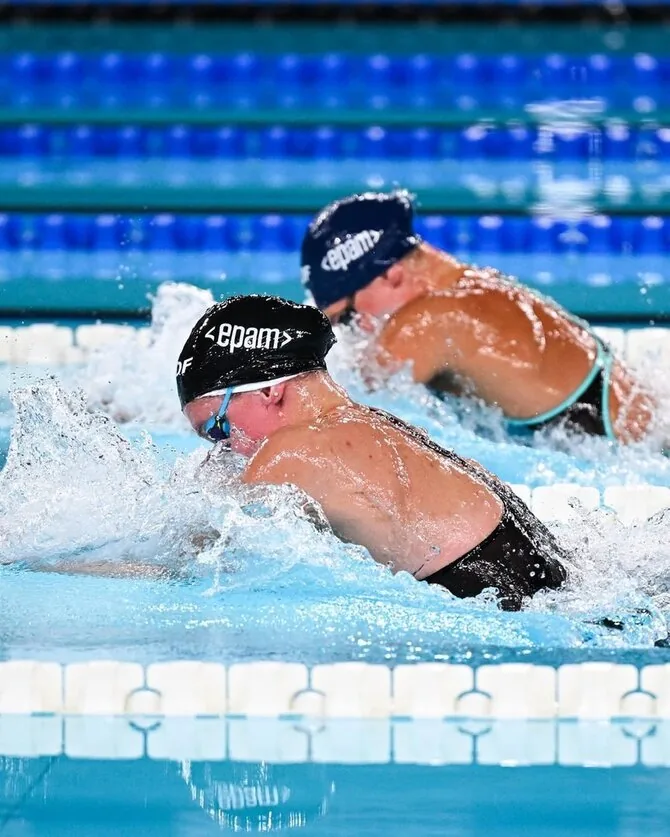
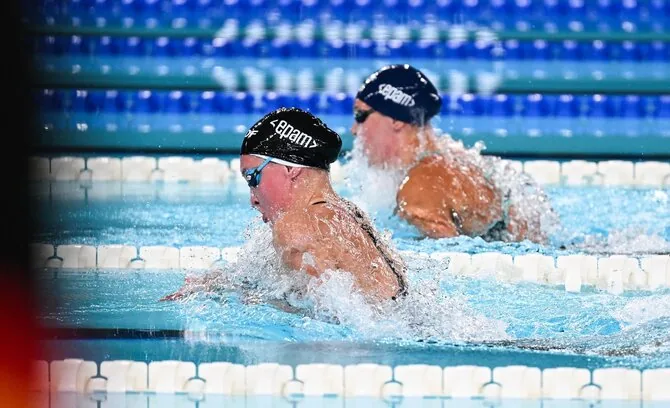
With the stands roaring, it initially seemed that our 24-year-old swimmer was edging out her opponent by centimeters in the sprint distance.
But the finish was more successful for R. Giliazova, who timed her last move to the wall better and was 0.17 seconds faster.
R. Gliazova swam in 30.41 seconds, K. Teterevkova – in 30.58 seconds.
– Kotryna, you wanted to swim less in this championship, but had to swim more times. How did that happen? – we asked K. Teterevkova after the finish.
– Karma, as our physiotherapist said. I didn’t swim the 100 m event, so now I had to keep swimming. Apparently, God wanted me to swim further and improve.
– How did these morning races look through your eyes?
– For me, it was a matter of national significance. The 50 m breaststroke is not my strongest event, but it was interesting and important, I wanted to defend Lithuania, even if indirectly.
Understand instantly
Despite the bombs still being dropped on Ukrainian cities and people, over 40 representatives from the aggressor country are competing at the European Championships in Paris.
The championship is also covered by a group of Russian journalists, usually representing Kremlin propaganda channels.
Swimming in the morning was not easy because we finished competing only at 10 p.m. the previous day. But now everything is over, so I am happy.
– How does the specificity differ when competing not against seven opponents, but one-on-one?
– I always try not to get distracted and not swim according to others, because then I lose my rhythm.
But partial motivation, when someone is nibbling at your side, definitely adds something.
– Have you ever heard before that two swim-offs were needed somewhere in competitions?
– When I was training in the USA, I personally saw how in the American Olympic trials two swimmers also competed in two swim-offs because they twice showed the same time. However, they were fighting for eighth place.
I remember the whole arena was like… Wow.
Now I am glad I experienced it because such experiences are needed in the future.
– Are you sad that you didn’t succeed?
– Of course. If it were from another country, it wouldn’t be so sad, but now it was a matter of principle that I competed against her (Russia). Never mind, we move on.
Anyway, I swam close to my previous best result in this event, so for the morning and after so many swims, I would say it’s quite a good result.
Understand instantly
Why didn’t it work? Our fastest swimming sprinters looked for answers in the Paris pool
Rūta Meilutytė, who made it to the final, received encouragement: “If you swim well, you’ll get a cake”
– Rūta Meilutytė is awaiting the final, where you will also face well-known opponents. What to expect there?