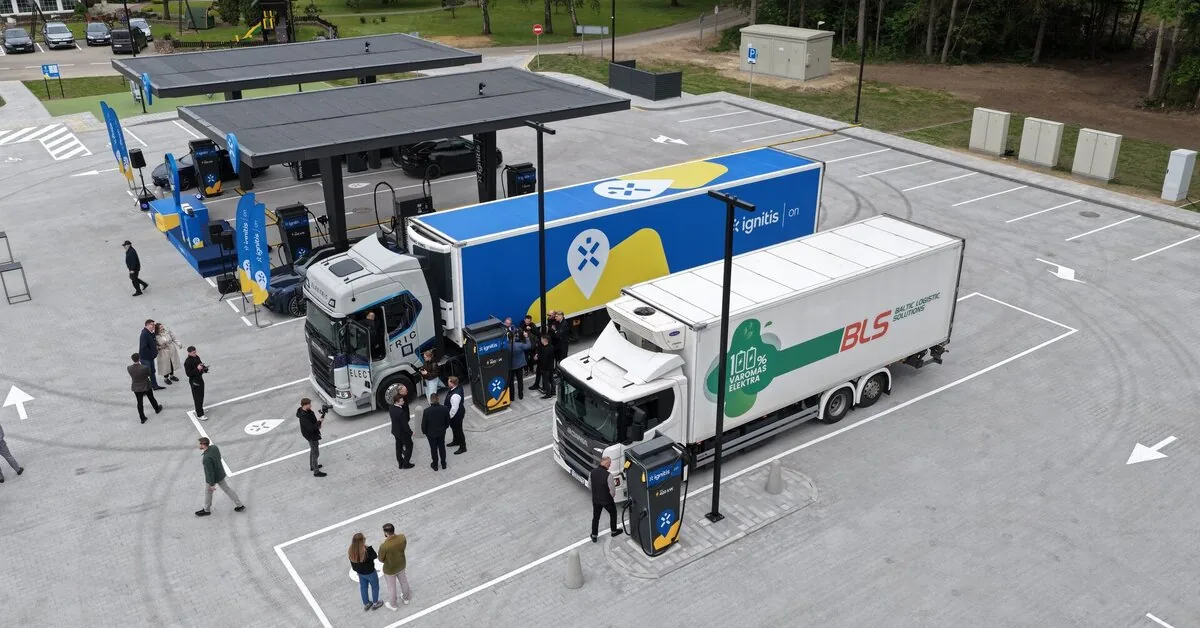
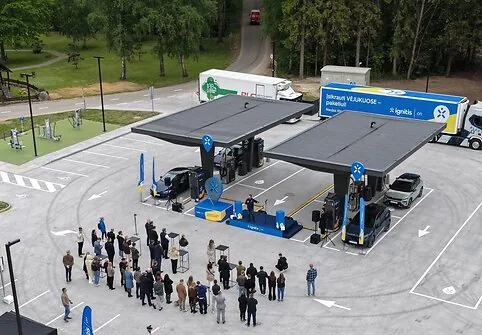
Next-generation „Ignitis ON“ charging park in Vėjukai
+1
“The current geopolitical situation causes increased and hard-to-predict fuel prices. Therefore, today, more than ever before, the transition to electric vehicles becomes not only an environmentally friendly but also an economically attractive choice. It is critically important that electric vehicle charging infrastructure is rapidly expanded and becomes conveniently accessible to residents not only in big cities but also in the country’s regions,” says Minister of Transport Juras Taminskas.
“The new park in Vėjukai marks an important stage in the development of our network. Now, those traveling along one of Lithuania’s busiest arteries will have the opportunity to conveniently and very quickly recharge their batteries both at our network stations in Vilnius or Kaunas, halfway to the seaside, and upon reaching it. Drivers across the country can find our chargers within a radius of no more than 30 kilometers, on the busiest transport routes, which ensures smooth and convenient use of charging services and electric vehicle usage,” notes Eimantas Balta, head of the leading fast electric vehicle charging network „Ignitis ON“.
All stations in the Vėjukai park are equipped with very high – 400 kW – power charging, allowing for rapid replenishment of battery energy reserves. Due to the high charging power and convenient location next to the busiest road in the country, the park is especially suitable for charging heavy electric transport.
Therefore, the entire park infrastructure was designed from the start to accommodate both light and heavy electric vehicles. “It is pleasing to see that the project presented already at the planning stage is today becoming a real, modern service for residents, businesses, and travelers passing through the Raseiniai region.
This charging park strengthens our district’s position as a convenient and open territory for investments, contributes to more sustainable mobility, and creates added value for the entire region. We believe that such projects not only improve infrastructure but also encourage new initiatives and strengthen the competitiveness of the Raseiniai region,” says Arvydas Nekrošius, mayor of Raseiniai district municipality.
Payment for services provided in the park can be made very flexibly: using the „Ignitis ON“ app, RFID key, or the recently introduced new automated charging function „autocharge“. Unregistered „Ignitis ON“ customers will be able to pay for charging services with a regular bank card or by scanning a QR code.
Adapted for all types of electric vehicles The entire Vėjukai park area is planned taking into account the needs of different groups of people, including persons with disabilities. While travelers recharge their electric vehicle batteries, they can spend time in modern children’s play and outdoor gym areas, as well as in the nearby restaurant or hotel.
The installed technologies allow charging any electric vehicle here, regardless of whether it uses 400 V or 800 V voltage. In addition, the physical environment infrastructure is adapted for larger vehicles – not only drivers of passenger cars with trailers but also minibus, bus, or truck drivers will feel comfortable here.
The importance of such specialized places is also confirmed by data collected by the Lithuanian Energy Agency: this spring, the number of electric light commercial vehicles registered in the country already exceeded 1,000.
Infrastructure development in Lithuania outpaces EU averages
As of April 1, 2026, according to „Regitra“ data, a total of 49,316 electric light vehicles had already been registered in Lithuania, of which 26,016 were pure electric cars, and another 23,300 were plug-in hybrid cars. Just last year, according to „AutoTyrimai“ data, 3,492 new electric cars were registered in our country, which is 88.5% more than in 2024.
According to the publicly accessible charging access information system data, by the end of April, a total of 5,146 publicly accessible charging points were operating in Lithuania. Several dozen fast charging stations are currently operating on the country’s main highway A1, and this number is constantly growing.
Understand instantly
The legendary „Citroën“ 2CV returns: how much will it cost?
„Ferrari“ presented its electric „Luce“ to the Pope of Rome: will this save it from critics?
“We see rapidly growing popularity of electric vehicles in the country, so we are doing everything to ensure that the expansion of the charging network exceeds travelers’ expectations. Today, we strive to ensure infrastructure that meets European Union standards both on main roads and in cities,” adds E. Balta.
Looking at the international context, Lithuania currently shows infrastructure development results exceeding expectations. In the country, there are about 9.5 electric cars per one public charging point, while the EU recommended average foresees the need for one charger per ten electric cars.
The ratio of the number of stations to the population is also improving: according to data from the European Alternative Fuels Observatory, at the end of 2025, Lithuania had about 70 public fast charging points per 100,000 inhabitants, while the overall EU average is about 45.