









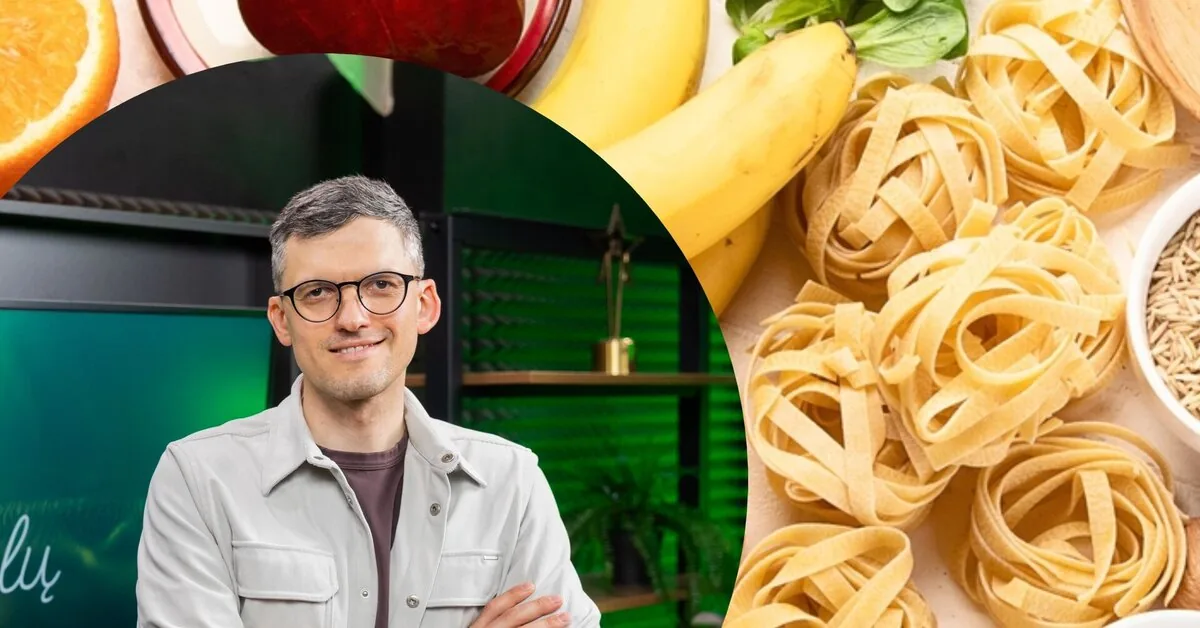
According to the scientist, not all carbohydrates can be put into one basket and say – let’s give them up. T. Vaičiūnas explained how specifically different carbohydrates behave in the human body and explained why giving up these products is fundamentally a mistake, unless specific clinical settings and indications are discussed.
Read more Five young football talents who can shine at the World Cup
– People seem to be lost today – one week they try to completely cut out carbohydrates. Then they start reducing sugar, reading labels more carefully. Suddenly they hear someone saying – carbohydrates are fine, you just need to include whole grain products. It’s obvious that people want to eat healthier, but they don’t know how.
– There are many topics here, but perhaps it’s worth defining – when we talk about carbohydrates, we most likely mean sugar, and two important things need to be discussed.
First, there is a part of the population that is relatively healthy and has no chronic disorders, this is one group of people. Second – a part of the population with chronic disorders, whose sensitivity may be slightly higher. Let’s say, if we have insulin resistance, type 2 diabetes, cardiovascular disorders, wildly fluctuating blood pressure, challenges with cholesterol or similar, sugar consumption should be under a magnifying glass.
But if we are talking about that part of the population that essentially has no chronic disorders, sugar is not a very big bogeyman, but there must be a criterion of reason here. And at this point, we move on to the most important thing – what do we call carbohydrates and sugar?
Both in society and from specialists, it is common to lump all carbohydrates into one basket and say that it is sugar – avoid it.
Then a rhetorical question always arises for me, not to criticize, but to provoke critical thinking. After all, biologically, according to the laws of nature, Darwin’s theory, Curie’s principles – no matter what we believe, we are essentially dependent on carbohydrates in some sense, because it is our main and primary fuel source.

So if we throw all carbohydrates into one basket and say to avoid them as much as possible – doesn’t that go against our biological factor? That is wrong. Where could this possibly have come from? If you allow me, I will raise a doubt.
I believe that this arose from the fact that we tend or used to tend to look at food chains more through a Petri dish. We place an apple on a Petri dish, look through a microscope, and what do we see? A carbohydrate. It can also have its own name – for example, fructose.
Now, on another Petri dish, we place a piece of sugar, look through a microscope, and what do we see? Carbohydrates. Then we put everything into one basket, because they are – carbohydrates.
In my understanding, we should evaluate the food chain or food products not only by what we see in a Petri dish – proteins, carbohydrates, fats, etc., but by what happens to food product groups when they pass through our digestive tract.
And that’s where a very interesting story begins, we see that carbohydrates are not equal to carbohydrates, because their chemical structure is completely different in several specific components. And how they behave when they enter our body can cause either a very positive added value, or on the contrary – a very undesirable one. That’s why lumping all carbohydrates into one basket is very wrong.
What is wonderful today is that we have started to avoid added sugar, to read labels. Well, this is the sugar that we usually have in the sugar bowl, also called white death. Of course, the market plays with us, turning that sugar into sweeteners, wanting to get sweetness. Because today, in the 21st century, human receptors are very dulled, to feel saltiness or sweetness, a very intense taste is needed.
Returning to sugar – we seem to replace it with sweeteners, we have learned to recognize added sugar, but we don’t see where we can consume a very, very large amount of sugar. I am talking about Lithuania, because we have a very interesting socio-cultural phenomenon of nutrition.