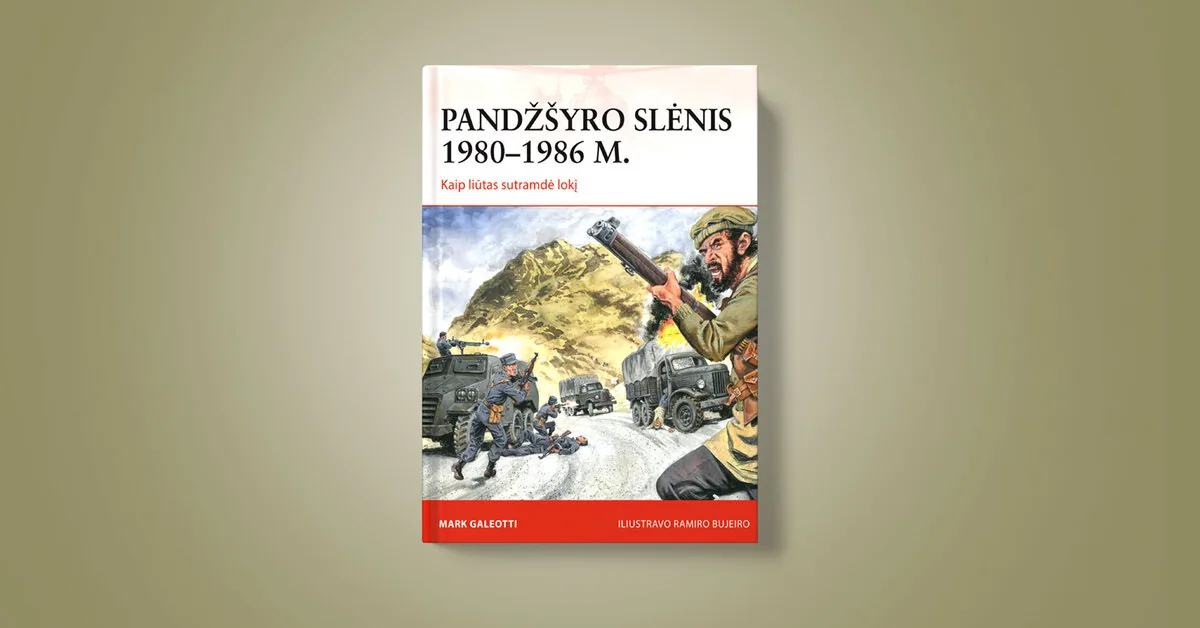
The leadership of the Soviet Union and military strategists focused all their attention on the country’s major cities and administrative centers, believing that their rapid capture and control would mean a final and crushing victory. However, this belief proved to be a fatal mistake. The invaders quickly realized they had entered a bloody, exhausting dead end where conventional warfare methods did not yield the expected results.
Read more For the Baltic Cup, the Lithuanian football team will compete with a significantly changed lineup
The strategically important Panjshir Valley became a particular hotspot of resistance and a true nightmare for the Soviet army. In this mountain-surrounded territory, the Soviets and the Afghan regime forces subordinate to them faced an extraordinary opponent – the most talented, tactically astute, and charismatic rebel leader Ahmad Shah Massoud (1953–2001), who is known in history as the Lion of Panjshir for his courage and indomitable character.
In an effort to break Afghan resistance, Moscow, together with local communist regime forces, organized several large-scale military operations, trying to finally clear and seize control of the Panjshir Valley. However, all these attempts failed each time. The rebels either easily repelled the clumsy, heavy-weapon-based attacks of the occupiers or lured them into deadly ambushes in narrow mountain passes. Soviet success was only short-lived: as soon as Moscow’s attention shifted to other hot spots in the country and the main forces withdrew, the mujahideen rebels instantly regained full control of the valley.
Over the years, this exhausting conflict forced both sides to change. Panjshir became a kind of testing ground for military innovations and tactical experiments. The rebels gradually equipped themselves with new, modern Western weapons and refined guerrilla warfare methods, while the Soviet army was forced to abandon outdated textbook warfare rules and change its offensive strategy. But it did not help. In 1986, the occupiers were forced to withdraw from Afghanistan.
Mark Galeotti’s book reveals that the battles in the Panjshir Valley left a deep mark in the history of war. They directly influenced even the current tactics of the Russian army and the mistakes made in contemporary conflicts.
This book contains colored battle images by illustrator Ramiro Bujeiro, many other illustrations, photos, and maps.
The author M. Galeotti is a famous British historian, political scientist, expert in military history and international organized crime, who devotes much attention in his books to the history of Russia’s mafia power and special services, especially when discussing the Putin regime.
Read more The competition in Argentina is halfway through: «CFMOTO Thunder Racing Team» already has two medals
The book was translated from English by Norbertas Venckevičius.