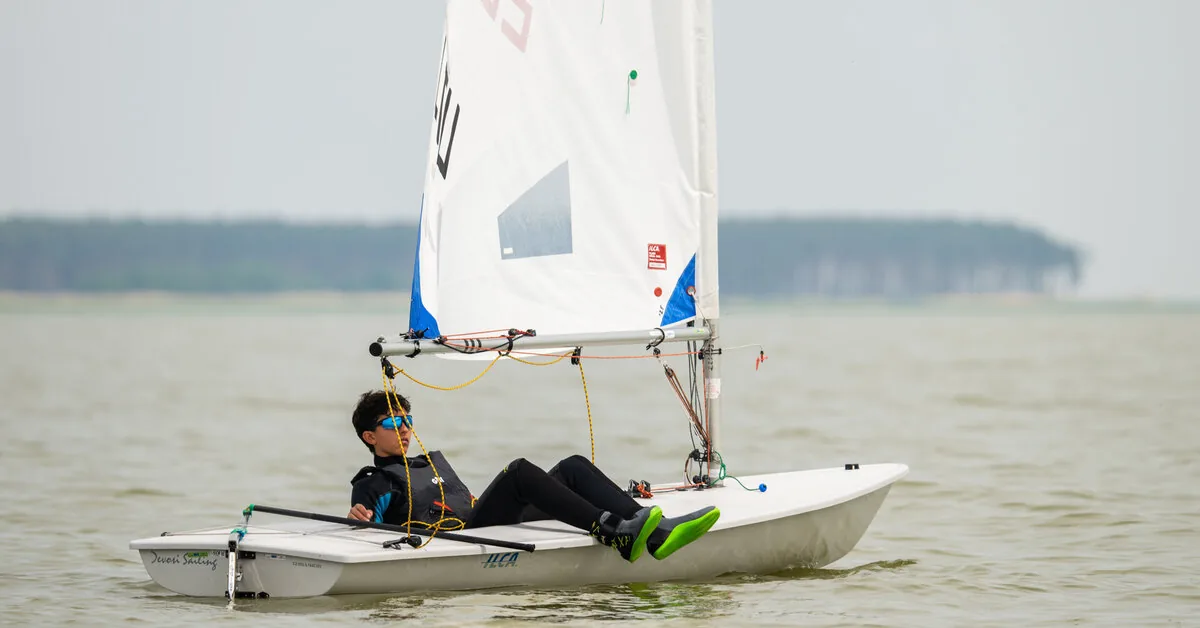
In the ILCA 4 class, sisters Saulė and Ugnė Trimonytės currently hold the first and second places. In the ILCA 6 class, Latvian sailor Henrijs Hugo Mocans is leading, while Lithuanian Rokas Rimša is in second place. In the ILCA 7 class, the leading position is also held by Latvian representative Karlis Junkers, with Lithuanian sailor Marius Antanavičius in second.
On the second day of the regatta, athletes had to face perhaps the biggest sailing challenge – unpredictable wind. In the morning, a warm southeast wind blew in the Curonian Lagoon, allowing for hopes of a smooth race day. However, as the sailors reached the water area, the situation began to change rapidly.
The wind gradually weakened until it finally almost completely died down. The judges tried to take advantage of its brief strengthenings and start the races, but conditions constantly changed. First, the start procedure was prolonged in the ILCA 4 class after an early mass start, when a large number of athletes crossed the start line too early. It soon became clear that this was just the beginning of the day’s challenges.
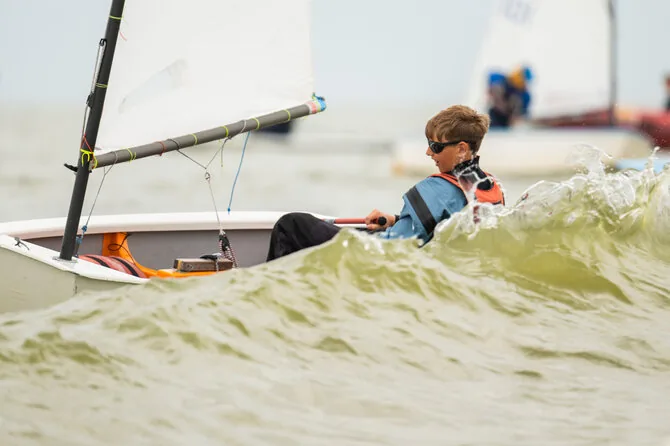
As the wind direction changed, the judges had to stop the already started races of ILCA 6 and ILCA 7 classes. Then the athletes waited on the water for more than an hour to see if the races could continue.
Finally, rain clouds and a cold west-northwest wind arrived in the Curonian Lagoon. Within a few hours, the wind direction changed by almost 180 degrees, completely altering the conditions in the area.
Read more Analysts: Russia intensifies disinformation campaign before elections in Armenia
“It seemed like we would have a fairly normal sailing day, but the Curonian Lagoon once again reminded us that conditions here can change very quickly. The wind not only died down but later shifted by almost 180 degrees. Such days require a lot of flexibility from both the athletes and the judging team,” said Antanas Juodsnukis, one of the competition organizers.
According to the organizers, it is precisely such days that best reveal the essence of sailing. Athletes not only have to compete with each other but also constantly adapt to the conditions dictated by nature, which can change the entire course of the race in a few minutes.
More than 50 sailors from Lithuania, Latvia, Estonia, Greece, and Ecuador are competing in the “EurILCA Europa Cup Lithuania 2026” stage taking place in Nida. The traditional “Nida Sailing Week” regatta, where “Optimist” class sailors start, is also taking place concurrently.
The competition will continue until Sunday, when the winners of this year’s “EurILCA Europa Cup Lithuania 2026” stage will be announced.
Read more At the Balkan summit, EU leaders urged accelerating enlargement