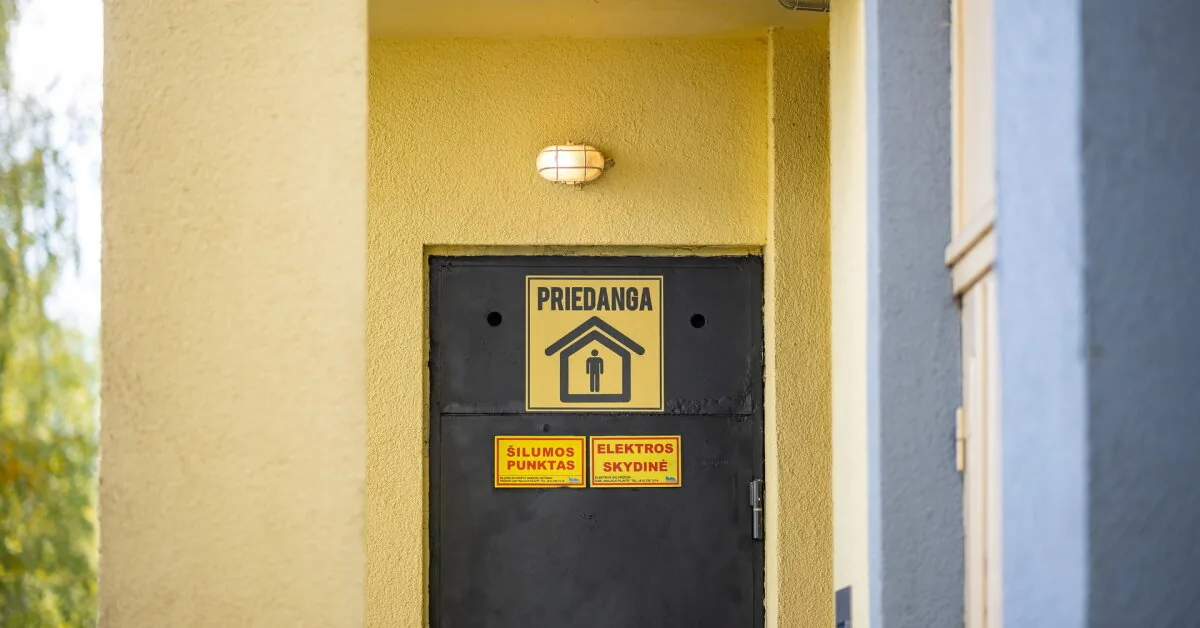
Will they be taken away or never return?
One Facebook user urged to protect their children. According to him, “Lithuanian social services are silent about it, or pretend to be ignorant. Now, possibly under the guise of drone attacks, they can take children to a safe zone from which not all may return later (language unedited – editor’s note).'”
Read more Samsung plans to invest 4 billion US dollars in a chip testing factory in Vietnam
Another internet user shared a short clip from the show “LRT forumas”, in which journalist Edmundas Jakilaitis discussed drone incidents with Renatas Požėla, head of the Fire Protection and Rescue Department (PAGD).
She interpreted the official’s words in her own way and announced: “In case of war, children will be taken away.”
Incidents that occurred in Lithuania have previously been exploited to spread fake news.
Also read: After the air alert in Vilnius – new fake news: allegedly, students are taught not to fear Ukrainian drones
Also read: Photos of a supposedly fallen drone appeared, although its movement was observed at the time
PAGD Head’s Words Distorted
First, let’s find out what the PAGD head actually said and why his words are being misinterpreted.
E. Jakilaitis spoke on the show about parents who panicked during an air alert and decided to take their children out of educational institutions. He asked how such a situation is legally regulated, as currently, an educator, even seeing that parents are not acting in the child’s best safety interests, hands over the child.
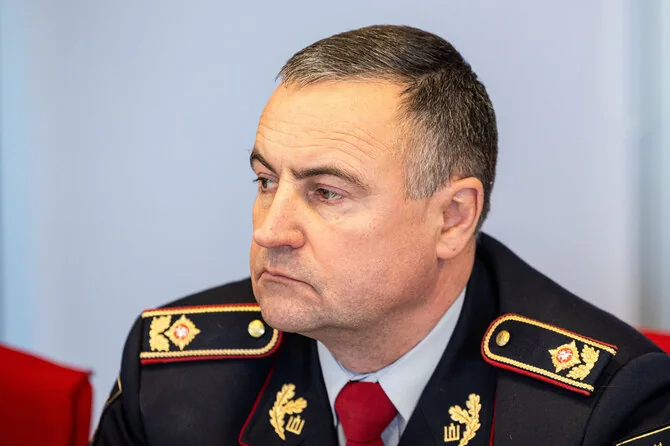
R. Požėla explained: “Having established the fact that the child is in a safer environment and this is due to the instructions of institutions, in the event of a red alert, educators or other staff certainly have every right in such a case simply not to hand over the child, having assessed the situation that the child would be transferred to a less safe environment.
We understand what would happen if the child were handed over.
Ultimately, the child would be taken to a public place, outdoors. They would likely be put into a car. A car would be used to take the child home, and thus an increased danger would already be posed to the child and the mother herself.'”
According to the department head, in situations where parents wished to pick up their child during an air alert and educators said “no,” the latter were correct.
The internet user’s interpretation that children will be taken away is incorrect. His assessment reflects the recommendations and evaluations prepared by the institution. He states that such actions would be irresponsible, and in the event of a red air alert, it is safer for children to remain in the designated shelter rather than being outside or in a car with their parents.
However, he did not say that educators or anyone else could “take away” children. The recommendations of Lithuanian institutions do not foresee that minors can be “taken away.” On the contrary, the guidelines of responsible institutions stipulate that parents can pick up their children even during an air alert.
Minister of Interior Also Agreed
During the show, the Minister of Interior, Vladislav Kondratovič, also agreed with R. Požėla’s assessment that teachers who had the opportunity to properly protect children acted correctly by not handing over children to their parents.
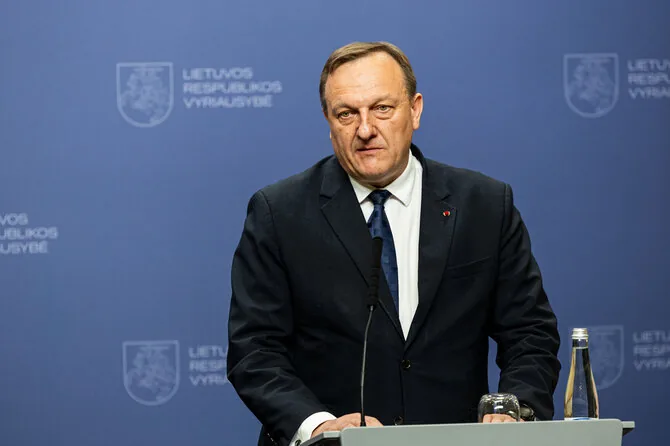
In his words, such situations are not described in civil defense laws; they most likely arise from other legal acts.
“But essentially, our laws stipulate the duty to prepare shelters, prepare premises, prepare systems, information systems, responsible persons who should and must unlock, activate, admit people, prepare, and so on,” the minister said.
Manipulations Assessed
The National Crisis Management Centre (NKVC) stated in a letter to 15min that, according to available data, there are currently no indications that these statements about the possible “taking away” of children are part of coordinated, systemic, or purposefully executed information activities.
Therefore, the center assesses this dissemination as a fragmented, isolated case arising from inaccurate interpretations.
“We note that the emergence of such narratives is often associated with crisis situations or situations of increased uncertainty, when public sensitivity to issues of security, child welfare, and state actions naturally increases. In such circumstances, even isolated false or manipulative statements can heighten anxiety, encourage unfounded interpretations, and reduce trust in institutions,” the letter to 15min states.
In this specific case, the recorded narratives allegedly correspond to typical characteristics of disinformation – sensitive topics are used (child safety), institutional statements are selectively interpreted, and unfounded, fear-inducing assumptions are created. Such narratives, even if not centrally coordinated, can be exploited in the information space to increase public anxiety or polarization.
The NKVC emphasizes that neither current legal acts nor emergency management practices provide for the “taking away” of children from parents – on the contrary, all civil defense measures are aimed at ensuring people’s lives and safety, and decisions are made based on the principles of proportionality, necessity, and the protection of the child’s interests.
The public is urged to critically evaluate information appearing on social networks, especially during crisis situations, and to rely on reliable information provided by official institutions. Reliable, consistent, and timely information is one of the most important factors in strengthening public resilience to information manipulation and ensuring information integrity.
Read more Russia, US and nuclear weapons: what to expect from Xi Jinping and Kim Jong Un’s meeting
How Should Teachers Act?
Parents leave their children with teachers every day, and during lessons, teachers assume responsibility for supervising minors – including during an air alert. Specific actions for educators have been established for this purpose. The guidelines of the Ministry of Education, Science and Sport (ŠMSM) stipulate:
Yellow alert signal: possible air danger; no dangerous objects are yet in Lithuanian territory. Employees must remain calm but consider further actions: know in advance where the nearest shelter or safe room is, monitor official information.
Red alert signal: an object is in Lithuanian airspace or there is a high probability that it will enter it and pose a threat. Upon receiving such an air alert signal, employees and students are immediately directed to shelters or other safe places specified in the institution’s emergency management plan, and must remain there until a separate announcement about the end of the danger.
Educational institutions must ensure proper communication with children’s parents (guardians): inform them that children are safe and cared for, and ask parents not to take action until a separate announcement. They also must not invite parents to pick up children until the announcement about the end of the danger has been received.
White alert signal: the air danger is over/gone. This means that shelters and safe places can be left, but it is recommended to remain vigilant and continue monitoring official information.
Children do not magically disappear in the shelter. Students return to their classrooms.
If Parents Want to Pick Up Children
ŠMSM states that children can be handed over to parents even during a red alert. The Ministry outlines what educators should do if, in such a case, parents or guardians come to school to pick up their children.
In such a case, it is necessary to invite parents to remain in a safe place within the institution until the alert signal is cancelled. If parents do not agree, it is necessary to warn them that they become personally responsible for the child’s safety when they leave the institution together.
It is also recommended to record information about the child’s pickup – note the child’s first and last name, class, and the first and last name of the parent who picked them up. During an air alert, there is no need to ask parents to sign additional forms for pickup. In such a case, it is important that parents who leave the institution have enough time to reach the family’s chosen safe place.
The school must inform parents about the relocation of students and staff to safe premises, but must not inform them about the air alert itself.
Furthermore, it is not recommended to inform parents during the process itself, as this time is designated for evacuation. Communication with parents is carried out when possible, but it is important to reduce panic and uncertainty about the children’s condition.
Inappropriate Reaction
Evaldas Tamašauskas, Head of the PAGD Civil Security Board, stated after the first drone incident, that situations where educational institution staff, during an air alert, instead of leading students to shelters, called parents and urged them to pick up their children, should be considered an inappropriate reaction.
He also emphasized that parents must clearly know that in the event of a crisis, their children will be cared for and where exactly they would be evacuated.
The official stressed that every educational institution must have a prepared emergency management plan, and the administrations of educational institutions must have action plans in place in advance for various threats and not wait until an air alert or emergency situation is declared.

What Should Be Planned in Advance
The ŠMSM stipulates that a single detailed algorithm suitable for all educational institutions is impossible due to the specific activities, premises, and other specifications of each institution. However, a general algorithm is as follows:
In the event of an air alert, all educational institutions must follow the instructions and directives of the Lithuanian Armed Forces, NKVC, PAGD, or other competent institutions.
It is important that each educational institution has designated shelters or safe places where people would hide when an air alert is declared, so that staff and students know the fastest routes to reach these shelters or safe places. For this, it is important to conduct drills in advance and test how movement actually occurs, whether all passages are unlocked, and so on.
Communication with parents must also be agreed upon in advance: who and through what information channels will inform students’ parents about the procedures performed and the students’ safety.
It is essential to stock up on water in advance.
15min verdict: lacks context. Lithuanian institutions and legal acts do not stipulate that educators or anyone else can “take away” children during an air alert or war. The comments of PAGD head R. Požėla are being misinterpreted. According to the NKVC, in this specific case, the recorded narratives correspond to typical characteristics of disinformation.
This publication was prepared by 15min in cooperation with “Meta”, aiming to stop the spread of misleading news on the social network. More about the program and its rules – here.
Read more This hasn’t happened before: Ukraine attacked 5 Russian ships with stolen grain