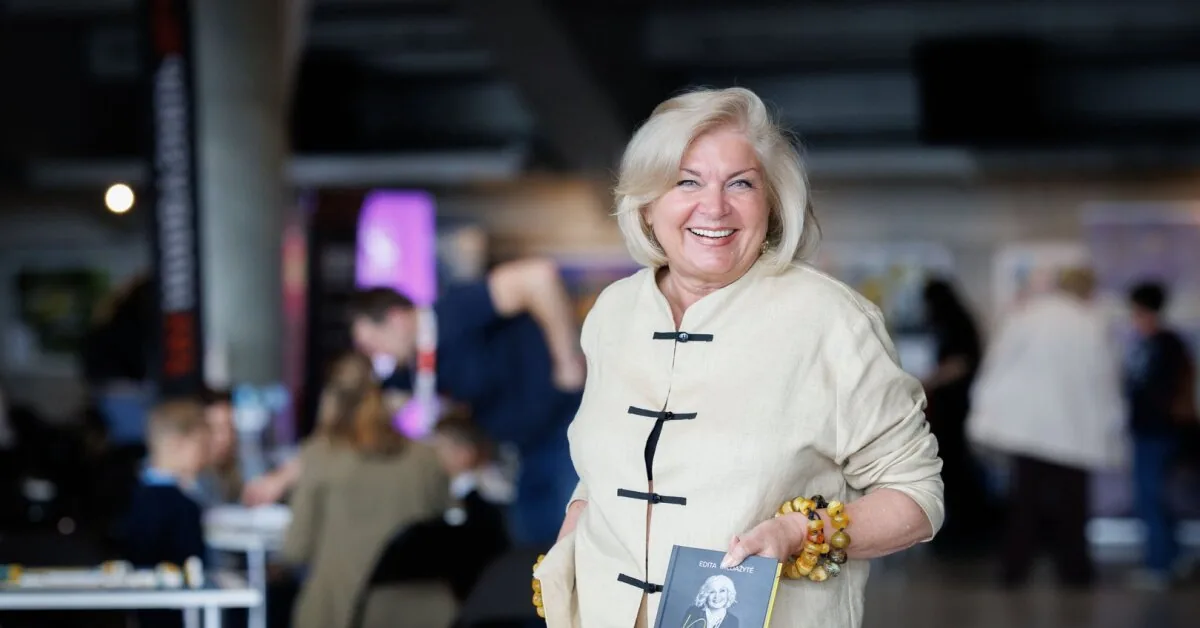









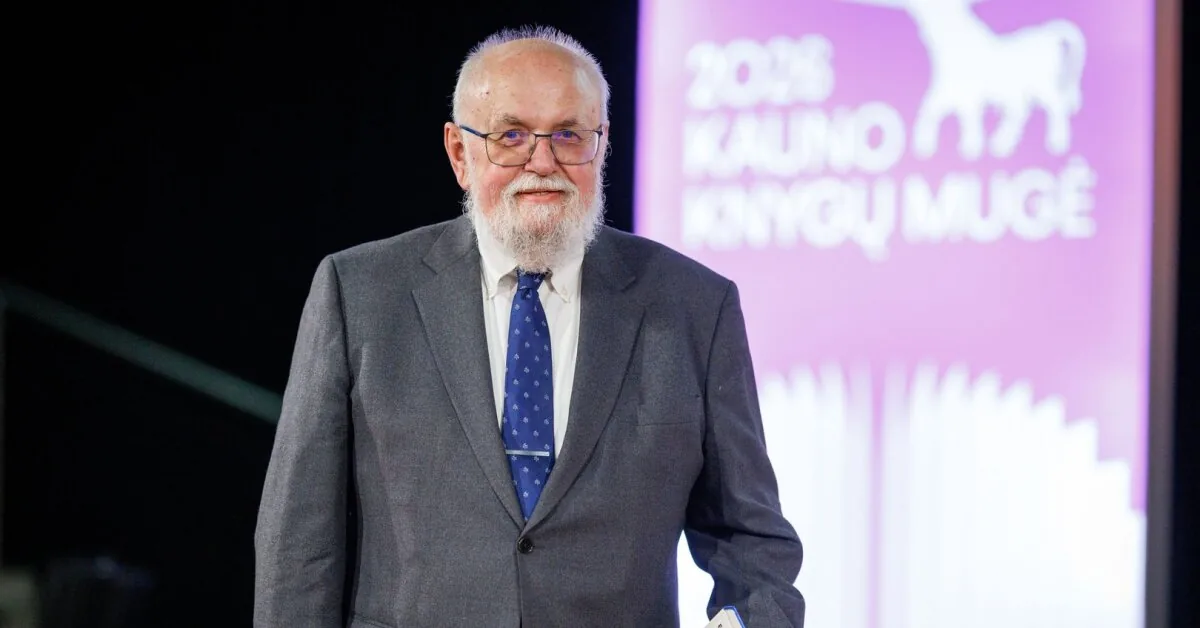
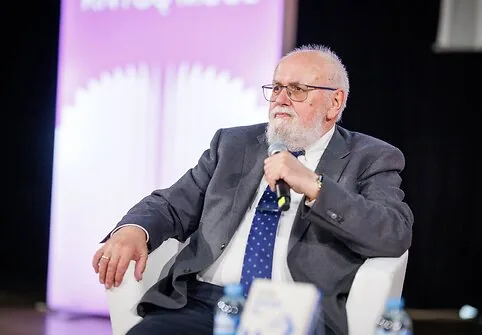
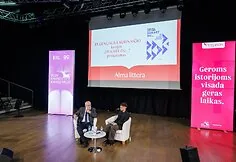
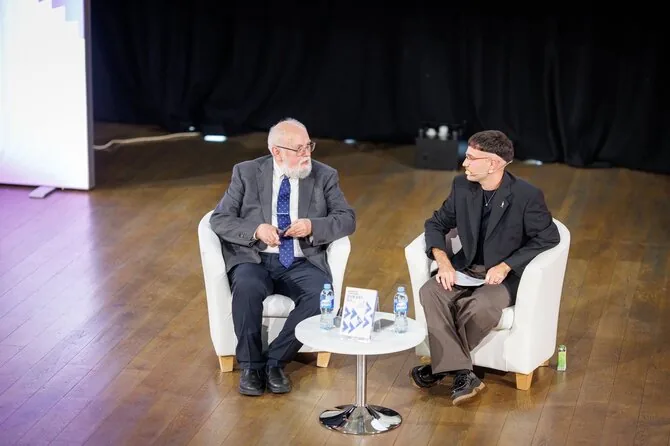
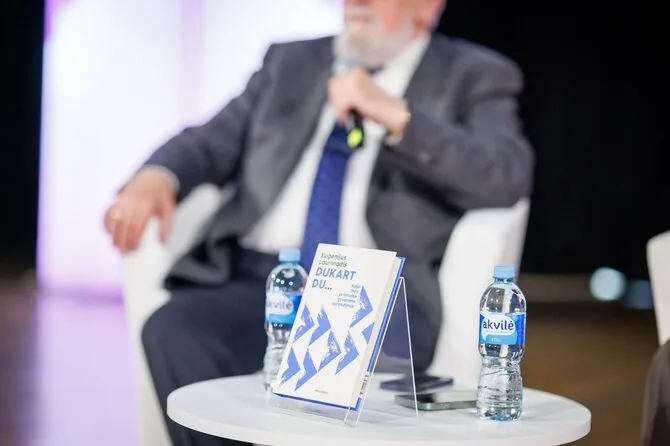
A large audience gathered for the book presentation. The conversation with the author was led by Dalius Stankevičius.
E. Laurinaitis is a psychiatrist, psychotherapist, and group therapist, an associate professor at Vilnius University and a professor at Mykolas Romeris University. He is also the president of the Lithuanian Psychotherapy Society. The author has published several books, including “A Look from the Mirror” and “Fish in Water”.
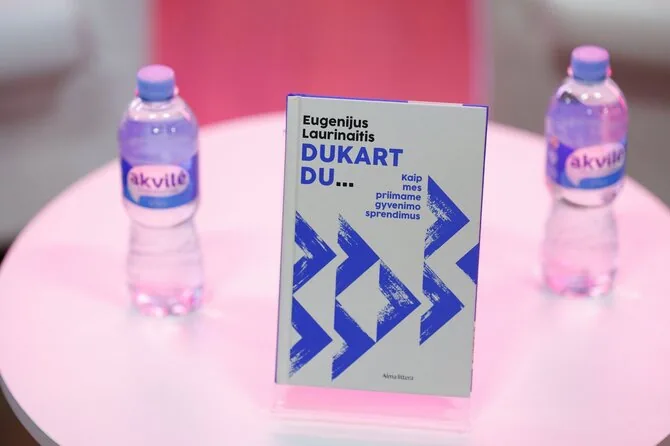
Why “Twice Two…”?
The conversation began with the question of why the new book is titled exactly “Twice Two…”. E. Laurinaitis did not hide that the title was chosen somewhat ironically and provocatively.
“People make decisions without knowing why they make them. It is a paradoxical title. No decision passes without consequences. Decisions must be made based not on the past, but looking to the future and asking not why, but for what? What will come out of that decision?” he said.
It is a paradoxical title.
According to E. Laurinaitis, that is exactly what his new book is about. “‘Twice Two…’ is a somewhat provocative title,” said the psychotherapist.
He stated that in life there is no one decision that is right for everyone. “There are no right decisions for everyone. Most of my patients want to solve the situation so that everyone is well. But in doing and deciding that, we must understand – not everyone will like it. It will never be so that everyone likes it,” said E. Laurinaitis.
Responsibility also applies when we do nothing
D. Stankevičius asked why it is important to understand the very moment of decision-making.
E. Laurinaitis answered by talking about responsibility – not only for what we choose to do, but also for what we do not do.
“The main law of life – I am responsible for everything I do. If you do not do something – you are even more responsible. For example, not helping a drowning person is also an action,” he said.
According to the psychotherapist, the past cannot be changed, so constantly returning to it and trying to rewrite life is pointless.
“We live our entire story every moment. The main law in history – you cannot change the past. You cannot redo life. You cannot ‘unsee’ or ‘ununderstand’. The past can teach us. We need to learn not from mistakes, mistakes only teach what not to do. We need to learn from successes, but mistakes should not be forgotten,” said E. Laurinaitis.
We need to learn from successes, but mistakes should not be forgotten
He also emphasized that the psychotherapist’s job is not to give advice.
“Psychotherapists do not give advice. As a psychotherapist, you help the patient understand the reasons for their actions and whether they want to repeat those mistakes or not. My job is to be a mirror that shows the patient from all sides,” he said.
“We all have only one person we can change”
Another topic of the conversation was a person’s ability to change. D. Stankevičius asked if we can change another person at all.
“We all have only one person we can change – ourselves. You cannot change another. This is a difficult and painful question for people who have spent a large part of their lives trying to change someone else,” said E. Laurinaitis.
We all have only one person we can change – ourselves.
However, trying to change oneself, he said, is not simple either.
“When changing yourself, there is one BUT, you need to tear down what stands inside you, but what to tear down? Yourself.”
E. Laurinaitis emphasized that in different situations a person can choose a different outcome, but a decision still needs to be made. “In different situations, we can choose a different outcome.”
“How can I know what is good for others? I do not know what others should do to be better. Except for one thing – something needs to be done,” he said.
Read more Extension drama revealed the second finalist of the new EuroLeague tournament
Where does helplessness come from?
The audience also got involved in the conversation. D. Stankevičius asked those who have ever felt helpless to raise their hands. About half of the people in the hall raised their hands.
E. Laurinaitis said he does not believe there are people who have never experienced helplessness.
D. Stankevičius asked what the difference is between temporary helplessness and learned helplessness.
“In childhood, we explored the world. If parents reacted with prohibitions and stopping – we learned helplessness, because then it seems better not to do anything at all,” explained the psychotherapist.
According to him, previous experiences can also influence how a person later evaluates new situations.
“Why go where there is no path? Traumas lead to fear of looking for some solutions. Fear that it will be like it was before.”

Speaking about childhood, E. Laurinaitis also touched on the topic of parental love. “If we do not receive parental love in childhood, we grow up with the feeling that there is no love, only interests,” he said.
When asked by D. Stankevičius if an adult can compensate for such love, E. Laurinaitis replied that it requires considerable effort.
“It requires effort. At least two years of receiving unconditional love, or four years of psychotherapy. Why? Because unconditional love is not for money and is received twenty-four hours a day.”
He emphasized that a person can change many things in their life, but it requires direction.
“We ourselves can change a lot, but we must be purposeful.”
Not thinking about another book yet
E. Laurinaitis said that the idea to write “Twice Two…” came quite unexpectedly while talking with editors from the publishing house “Alma littera”.
“The inspiration for the book was born while talking with the editors of ‘Alma littera’. They asked what I would write, I spoke extemporaneously and shared the idea about decisions. They replied that there was no book about that yet,” he recalled.
At the end of the meeting, the audience asked the author if he sees a successor for himself, as recently he travels less and participates less in meetings.
“Each of us is unique, so who could do this instead of me – I do not know,” answered E. Laurinaitis.
And will there be another book?
“I don’t know yet myself, I have ideas, I am well sold, the publishing house wants to have me,” E. Laurinaitis replied with a smile.