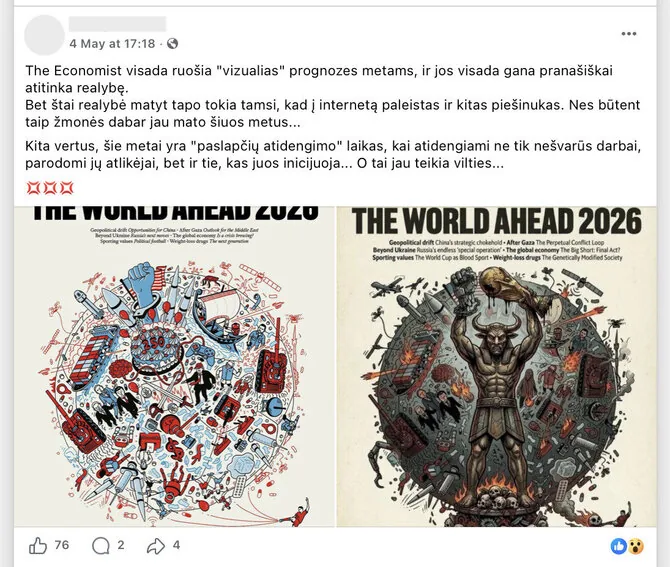
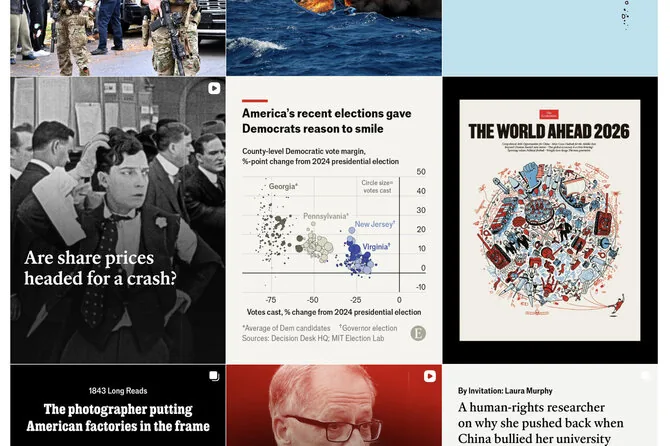
Photos of both covers were recently shared by a Facebook user. Alongside, she added this comment: “The Economist” always prepares “visual” forecasts for the year, and they always quite prophetically match reality.
But it seems reality has become so dark that another drawing was released online. Because this is how people now see this year…
On the other hand, this year is a time of “unveiling secrets,” when not only dirty deeds are revealed, their perpetrators shown, but also those who initiate them… And that already gives hope…”
In both photos, as can be understood, are covers of the weekly magazine depicting forecasts for this year. Such insights have been published by the influential British publication at the end of each year for four decades.
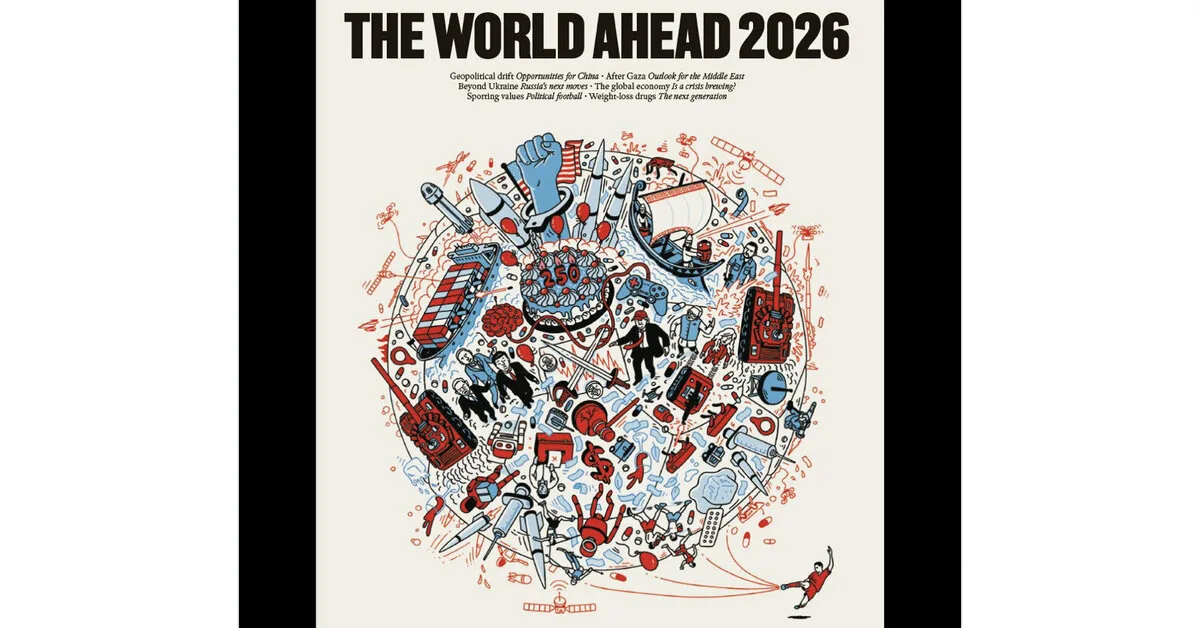
The first drawing shows tanks – a symbol of the wars shaking the world currently, several space vehicles, as preparations have long been underway for the planned “Artemis II” mission flight around the Moon in 2026.
Next to one of the tanks stands Ukrainian leader Volodymyr Zelensky. From the famous red MAGA movement cap, the US President Donald Trump can be recognized (next to him is a cake for the 250th anniversary – the number of years since the US Declaration of Independence was proclaimed this year).
Trump, still in the White House, will remain the key factor shaping world affairs in 2026.
Also visible are Indian Prime Minister Narendra Modi and Chinese leader Xi Jinping.
Among these powerful state leaders are scattered banknotes and currency symbols, robots are walking, wine is splashing in glasses, shots are fired from a cargo ship loaded with sea containers, several syringes are raised like stabs, and ice cubes are melting, symbolizing diseases constantly attacking people and the warming climate.
All seem united by sport – not only are several athletes visible, including participants of the Milan-Cortina Winter Olympics, but also a footballer cheerfully kicking such a diverse world into the air. As is known, soon the planet’s football championships will take place in Canada, the USA, and Mexico.
In the other drawing, only in gray and much gloomier, there are many similar details – the same politicians stand, space vehicles rise into the air, but flames blaze in many places, the planet is attached to a base loaded with skulls, and the whole is seemingly seized by a mythical creature – a muscular man with a devil’s face, holding the football championship trophy above his head.
Understand instantly
“The Economist”: “The honeymoon period” in Ukraine-EU relations has ended
“The Economist”: Trump is deeply stuck in Iran
“The Economist”: The turning point in the war – the initiative has shifted to Ukraine’s side
Although the image circulating online resembles a magazine cover drawing and looks eerily prophetic, it is not real – the weekly did not publish anything like this. The image was created using artificial intelligence (AI) and most likely already knowing some events of this year.
The future was not always predicted
At the end of each year, “The Economist” releases an issue whose cover displays the publication’s forecasts for the near future. These cannot be considered miraculous prophecies. The weekly constantly writes about current affairs, publishes analyses of various phenomena and events, discusses influential politicians, so it is not difficult for the editorial team to predict what to expect in the coming months.
Here are published all the magazine covers since the end of 1986 with forecasts for the following years. “Somewhat right, somewhat wrong, no conspiracies,” – this is how past future predictions were summarized.
Not only on last year’s but also on previous years’ magazines was there no drawing similar to the one shared by the mentioned Facebook user.
What cover with forecasts for this year appeared last November can be seen on the magazine’s Instagram account. The forecasts are discussed in more detail in a separate article. The drawing was very thoroughly analyzed by defense, geopolitics, and strategic communications expert Dize Kandu.
“In this year’s issue, our journalists and invited experts review perspectives in geopolitics, business, technology, and culture. Trump, still in the White House, will remain the key factor shaping world affairs in 2026,” – the weekly noted.
And Instagram users commented on the cover photo that the events depicted in the image were staged. “So they predicted war because they show rockets,” one wrote. “They didn’t predict anything, everything is planned,” another replied.
According to social media users, the drawing predicted not only new military conflicts but also a hantavirus outbreak. It is known that conspiracy seekers tend to link various things to certain events after they have occurred.
And the forecast cover covers various broad topics – politics, conflicts, economy, inflation, technology, health trends, usually without predicting specific possible events unless they are planned in advance, such as sports events or anniversaries.
The secret revealed by Google
“The Economist” cover was created by artists Andrew Rae and Elizabeth Delphin.
The first detail revealing that the “cover” with the devil is not authentic is the sharpness. The drawing itself has sharp lines, the colors, although quite uniform and gloomy, are clear. However, the title at the top – “The World Ahead 2026” and the text below (some article topics and headlines) and especially the red magazine logo are blurry, somewhat washed out.
Image search via Google Lens shows that this image was created using AI (Made with Google AI). This was also reported by the Albanian fact-checking website “Faktoje”.
The hidden “SynthID” watermark indicates that the entire image or parts of it were most likely edited or generated using Google’s artificial intelligence.
“SynthID” is a digital watermark that Google adds to all its AI-generated content. It is a small pixel-level modification. It can be used in various content (text, photos, video, or audio) and is resistant to various changes, thus remaining even after editing the image, sound, or text.
15min verdict: the photo was created by artificial intelligence. There was no such “The Economist” cover; it was created by artificial intelligence.
Publication prepared by 15min in cooperation with Meta, aiming to stop the spread of misleading news on social networks. More about the program and its rules – here.