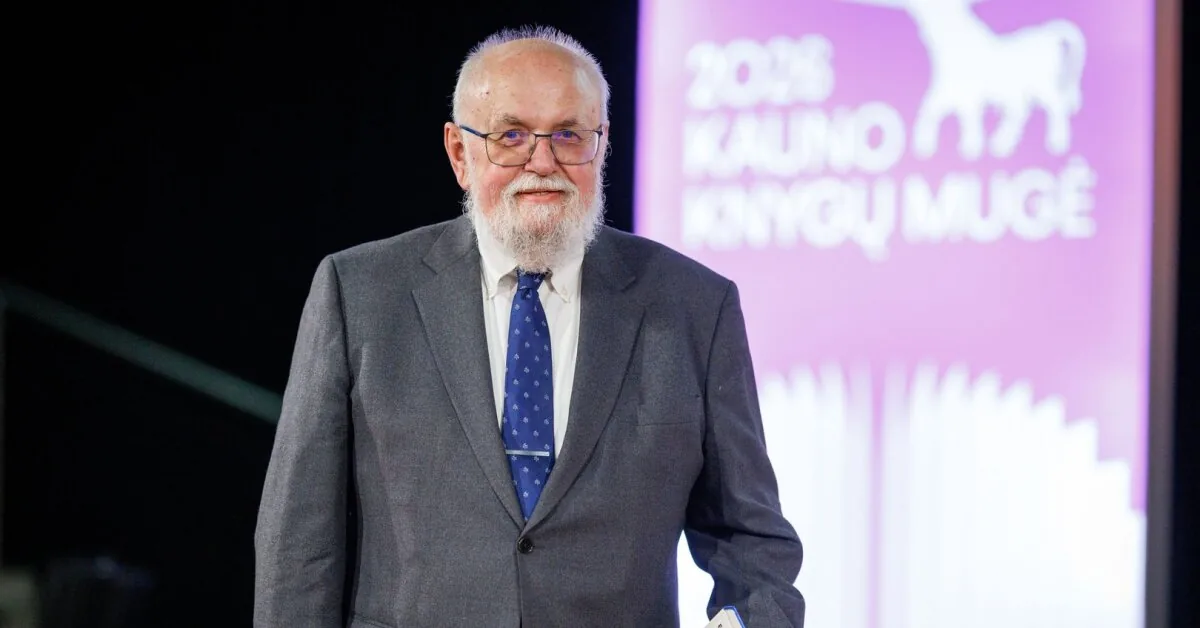
Niels Fredrik Dahl is undoubtedly one of the most significant writers in the country. In 2024, he was awarded the Nordic Council Literature Prize for his profound and moving novel about loneliness, “The Father’s Fate”.
The book in Lithuanian was published by the Lithuanian Writers’ Union Publishing House (translated from Norwegian by Alvyda Gaivenienė, cover artist – Milena Liutkutė-Grigaitienė).

“The Father’s Fate” is a powerful and profound novel about a young man’s efforts to fit into a world he does not understand. A story about the people around him and a fateful European era. A work centered on family, marked by loneliness passed down from generation to generation, revealing how difficult – or perhaps impossible – it is to come to terms with the circumstances shaping a person’s life.
“I search for you everywhere.” This simple sentence by the author summarizes the entire work. It is spoken by the narrator, who is also the book’s author. It is a longing-filled investigation of a father who said goodbye to this world fourteen years ago, leaving very few tangible traces.
A few photos, letters, and drawings. Some separate fragments of the story. Although some of the narrator’s memories of his father are warm, they too slip away from memory. The father – who was he? This is a novel belonging to both father and son. Using fiction, the son tries to piece together the scattered parts into a whole, those “small hard pieces rattling inside me.”
This is a novel belonging to both father and son.
Before the readers’ eyes emerges the portrait of a lonely boy. He spends his childhood in Alexandria, Egypt, where his authoritarian father, simply called the Judge in the novel, is assigned to work in the very cradle of colonialism.
Mother Elena is sensitive, nervous, and the boy, Jonas, partly inherited her temperament. At thirteen, he is sent away from home because the Judge does not trust Egyptian schools. Thus, Jonas first ends up in Oslo, with a couple still grieving the loss of their son, and later in a boarding school in Geneva.
From the very beginning, it is clear that the boy’s most important companion is loneliness. It is immense and all-encompassing, insurmountable. He does not fit in anywhere, does not feel at home anywhere.
In Geneva, he finally finds two friends – David and Paolo. Jonas falls in love with Paolo, but she chooses David. Both his friends increasingly worry about what Jonas does not yet fully understand. They are Jewish, and it is the 1930s in Europe, so threatening signs can be seen everywhere.
The story covers not only the fate of a boy pursued by loneliness but also an entire fateful era: World War II in Europe and Norway’s role in it, colonialism, and the moods it shapes.
The narrator knows he can treat his father’s story as he wishes – such are the rules of literature.
The narrator knows he can treat his father’s story as he wishes – such are the rules of literature. But two things drive him forward: longing for his father and the desire to know how things really were.
Probably many of us, upon reaching a certain age, begin to search for traces of our past. But is it really possible to understand “how things really were”?
Read more ES read Ukraine to buy US Patriot missiles with loan funds
Prepared based on a book review published by “Expressen”. Author – Annina Rabe.