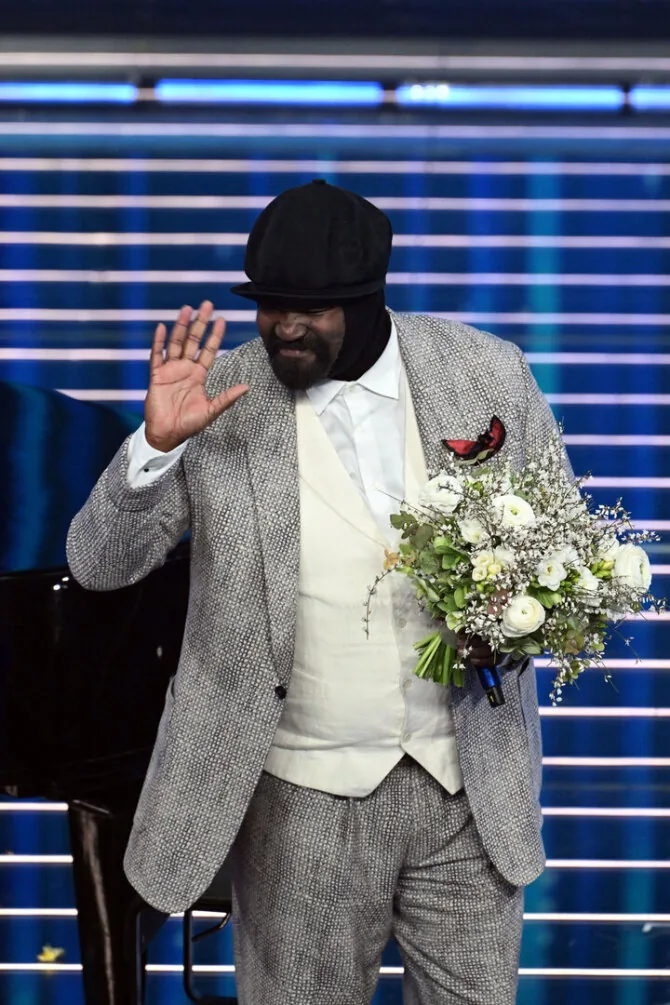
On July 15th, G. Porter will hold his only concert of the year in Lithuania in the Great Courtyard of the Palace of the Grand Dukes. One of the brightest voices of contemporary jazz and soul returns to Vilnius already having his own connection here. In a conversation with music creator Laura Kešytė, he talks about a new creative stage, the upcoming concert, creating on the road, and Lithuania, which has become a special place for him in Europe.

L.Kešytė: Tell us about the new creative stage. What themes and moods are coming into your music now?
G.Porteris: A lot of things I am carrying inside me now come into this music: the time after the pandemic, the feeling of rebirth, the political strangeness in the world, personal losses. After the pandemic, I lost my brother and I have not yet fully expressed what this loss means to me. But that does not mean the album will be about sadness. On the contrary, I want to talk about the desire for life, energy, and the passion he had. I might not even say his name or the word “brother,” but he will definitely be in this music.
The album will also feature African rhythms, as I collaborated with several young African musicians. There will also be what I always do: diving into emotions, searching for poetry, thoughts about the weaker one, the person whose voice often remains on the sidelines. And, of course, love: its highs, lows, romantic love, which I also want to explore this time.
L.Kešytė: In Lithuania, you can be met not only during concerts. What is your relationship with our country? Has Lithuania perhaps already become a second home through these meetings?
G.Porteris: In a way, I would like it to be so. I spend about two hundred days a year on the road, so it is very good to have a place where I can regain strength. I have friends here, I can see them and at least briefly return to a calmer, more human rhythm. Lithuania is a very special place for me in Europe. The people here are special. I say this not out of politeness, but because I feel it that way.

L.Kešytė: What program are you bringing to Vilnius this summer? Will listeners want to move along with the music, or rather immerse themselves in a contemplative, almost metaphysical state?
G.Porteris: My music must have both a spiritual, metaphysical dimension and rhythm, a “groove.” I want the listener to feel the music with their body but also find something grander in it. When these things come together in a concert, I feel that I am doing what I want to do.
Read more Sad news for Grigonius from «Panathinaikos»
Each evening is a bit different. I am like a DJ choosing from my songs, and they have long lived with us, so they can change: expand, gain new nuances, turn into improvisation. The audience is also very important: what people feel that evening, what is in the air, what they need emotionally, sometimes even politically. The season, the sunset, and the atmosphere of the evening itself also become important.
L.Kešytė: Listening to your early work “On My Way to Harlem,” I thought about Lithuania and its very different jazz history. If Lithuania were one of your songs, which one would it be?
G.Porteris: “A Consequence of Love.” I know Lithuania’s history. It is a special story, a struggle for beauty, love, your country, and the right to be who you are. Jazz can often be a litmus test for freedom. If a person or nation is open enough to accept this improvisational, emotional music, it means they are already on the path to freedom. In a way, I would like this to be fully true in my own country as well.
L.Kešytė: When do you find time to write music? Maybe on planes, trains, travels?
G.Porteris: I create even more while traveling. I wrote most of the album “Liquid Spirit” while moving around Europe: on planes, trains, buses, cars, sometimes even riding a bike. Something about that movement, maybe the passing scenes, awakens memory and a dreamy state in my mind.
L.Kešytė: And when an idea comes, how do you preserve it?
G.Porteris: I write. I have several notebooks, pieces of paper, voice recordings on my phone. When it’s time to finish a song, I have to bring everything together: one line might be in one notebook, another thought in another, something else on the phone. These are constant small fragments of music.
Before recording the album “Liquid Spirit,” I had many song ideas on my phone, but I lost it and almost lost the entire album. This album became an attempt to remember again what I had lost. Maybe those songs had to live in my head once more to be born exactly like that. Sometimes the same title remained, but other words, another feeling appeared. It reminded me that creativity is a flowing river. It can slip away, but if you stay open to it, it keeps flowing.
Read more Gyčio Volkavičius and his second wife Novelyn’s daughter ended up in the hospital