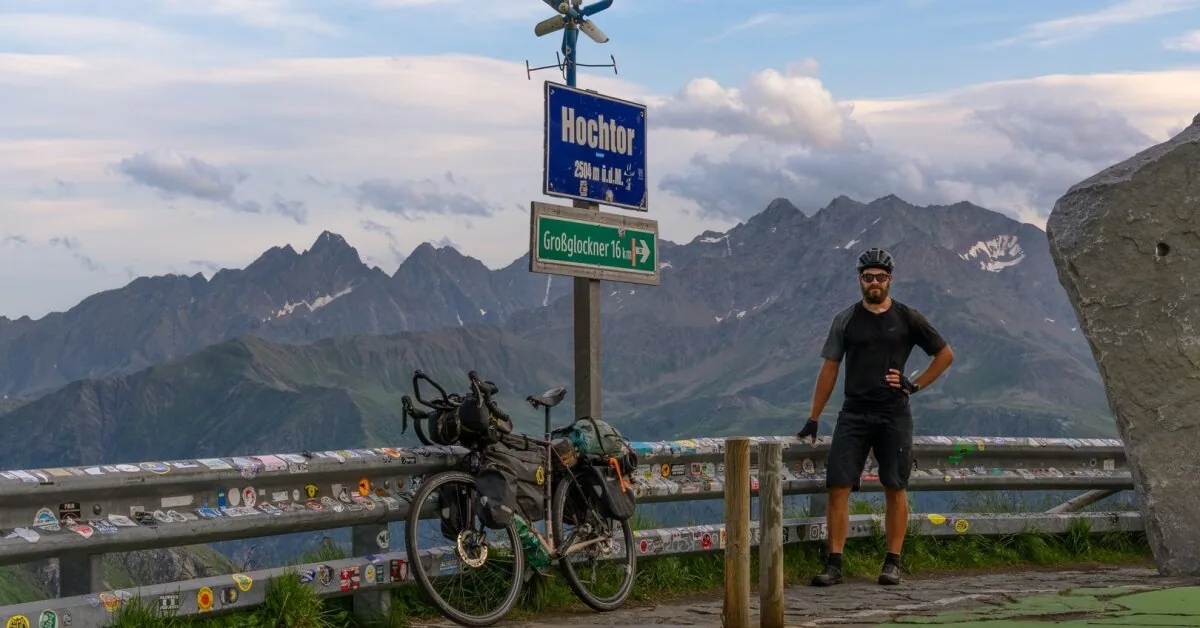
Laimonas, who has cycled about 120,000 kilometers in his life, talks about such a life surprisingly simply – the bicycle has long ceased to be a leisure activity for him. It is a way of living, seeing the world, and for now – not stopping.
Read more Who won the debut «Mitjet Baltics» championship?
It all started with one sentence about Cuba
Laimonas was born and raised in Plungė. In childhood, the bicycle was as usual to him as to many children – he rode it around the neighborhood, and after cycling just a kilometer from home, he already felt like he had reached the edge of the world.
Later he went to study law in Kaunas, but around 2016 a job appeared in his life at a bicycle shop. At that time, he often rode through Panemunė forest, the surroundings of Pažaislis, and the trip from Kaunas to Birštonas and back already seemed a serious distance.
There is some inner thing here. You don’t quite understand where it comes from.
When asked exactly when the desire to ride further appeared, Laimonas has no clear answer: “When people ask me how I ‘got hooked,’ I think it’s some inner thing. You don’t quite understand where it comes from. It’s similar for me with photography and filming – I just like it. You feel it, look around, see beautiful surroundings. It calms me. The cycling itself is a very good feeling for me.”

However, he remembers one specific day very well when a customer came into the shop looking for very reliable bicycle tires. Laimonas asked why they were needed and heard the answer – the man and his friend were preparing to travel by bicycle around Cuba.
“At that moment, something just clicked in my head. I thought: it would be interesting for me too to take a bike, a tent, and go to another country. I was about 24 years old then,” recalls Laimonas.





He barely fit in the first tent
Soon he had the opportunity to go work in Iceland for the summer. A classmate offered Laimonas a seasonal job – painting lines on roads and parking lots in white.
Laimonas spent three summers in Iceland. The work was hard, but the earnings allowed him to save enough for living in Lithuania and for what was already drawing him more – traveling.
After the second summer, as he tells, he could afford to buy a good road bike and decided with a friend to try the first serious trip – cycling from Kaunas to Gdansk and back.
He had almost no experience. Today, looking through the photos of that trip, Laimonas laughs noticing many mistakes: improperly packed bags, items touching the rear wheel, and a tent that was quite mismatched to his height.

“I only knew that I needed to carry as little as possible – just what’s essential to survive. I bought a fairly small tunnel tent. I’m tall, so I couldn’t even sit up in it or fit properly. The first night I even slept outside because it was too cramped,” the man laughs.
In two weeks, the friends covered about 1200 kilometers. Navigation, as he recalls, was also different then than today: “We didn’t have internet. You see your location on an offline map and have to watch road signs. That trip reminded me of times with paper maps. Now the Garmin app shows exactly where to turn, but then you had to orient yourself more.”
Italy, the Alps, and an ever farther road
After Gdansk, Laimonas didn’t stop. With the same friend, he took a train to Wroclaw, then cycled through Prague, Vienna, Bratislava, Zakopane. Later he flew alone to Italy and cycled for about a month from Milan southwards – through Rome, Naples, Mount Etna to Palermo.
Listening to Laimonas’s story, one very down-to-earth question kept coming up – how does a person who spends so much time on the road make a living? The man from Plungė says he lived for a while off savings earned in Iceland, later worked in construction in Denmark, and thus saved money for new trips. One winter he cycled from Lithuania to visit his mother and brother living in Denmark – reaching them through Poland and Germany in twelve days.
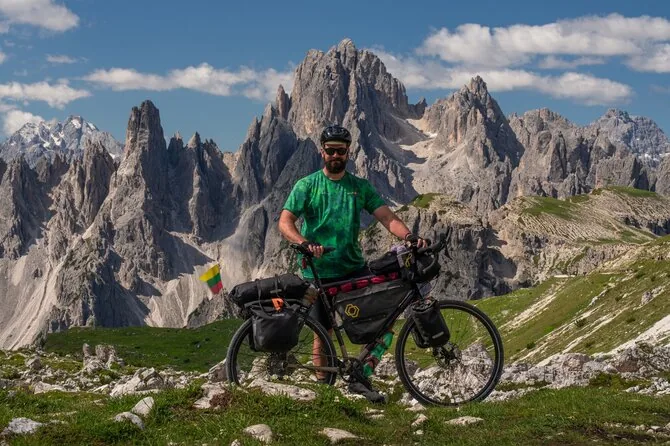
After so many kilometers, one might get the impression that long days on the bike have become an easily manageable routine for Laimonas. But he himself says that physical fatigue doesn’t disappear, it’s just perceived differently.
“If you have to pedal uphill for three or four hours in the Alps, of course, it’s hard. You get tired and you know it. But you don’t quit the road or turn back because I like it. Physically it’s hard, but emotionally – not. Because you enjoy the views,” he smiles.
People who haven’t experienced such trips often confess to Laimonas: “I couldn’t do that.” But he looks at it simply – the difference is that pedaling itself gives him pleasure, so even the hardest days on the road don’t take away the desire to pedal.
A call to a friend saved him at the hardest moment
Still, even Laimonas had a moment when he doubted whether this lifestyle still brought joy. At that time, he was pedaling through the Swiss Alps – a place that seems to offer only breathtaking views to enjoy.
There hasn’t been a morning when I woke up in the tent and doubted whether I want to keep pedaling.
But instead of joy, Laimonas was overwhelmed by doubts, so he called a friend: “The thought came: maybe I don’t like traveling by bike anymore? We talked and I calmed down. Now I understand why I thought that. Such thoughts come when I’m very tired. Heat, cold, fatigue add up.”
Over the year, he learned to recognize when it’s no longer desires speaking but a tired body. In such cases, he says, serious decisions shouldn’t be made. Sometimes it’s enough to stop, take a shower, find a small hotel, lie in a proper bed, and eat well.
“I have a rule: I get up in the morning and think whether I want to continue traveling. And there hasn’t been a single morning when I woke up in the tent and doubted whether I want to keep pedaling,” admits Laimonas.

The most important thing – a dry sleeping bag
There is romance in long trips, but life in a tent quickly reminds you of very practical things. According to Laimonas, in Scandinavia it can rain for days without stopping, mosquitoes attack in some places, in others you have to look for drinking water, and in the mountains in the evening you also have to think long about where to find at least a somewhat flat place for the tent.
“I prefer warmth to cold and dampness. I got quite a lot of rain in Scandinavia. Sometimes you’re constantly wet, but the most important thing is to have a dry sleeping bag and dry clothes to change into. Eventually, you still get into the sleeping bag and warm up,” the traveler says.
Experience also came through mistakes – there is a soaked backpack, damaged photography equipment. Another vital thing is drinking water. In Scandinavia, Laimonas carries a water filter; in the Norwegian mountains, he has drunk directly from springs. But when traveling to Asia, he says, a more serious system is needed that can clean not only bacteria but other pollutants as well.
He always carries a first aid kit. Although there have been falls, serious accidents have so far been avoided.

Boars and bear maps
As the cyclist says, sometimes more worry is caused not by the road but by what moves around the tent after dark. Laimonas says that deer have passed near the tent, and he has heard boar grunting at night more than once.
“Boars are constantly nearby. They can be dangerous if they are big and you scare them. I have seen really big ones, with tusks so big that you understand it’s better not to approach them. If a boar got scared of something, I think it could attack,” the man says.
Even more caution was needed in Romania, where bears are encountered much more often. There, before choosing a place to stay or a route, Laimonas always checked special bear distribution maps.
“They are marked with colors: green means bears only occasionally pass through, yellow means they live there permanently, and red means their concentration is higher and people are already advised not to walk there. So while traveling, I always checked to avoid the red zone. A bear is not a boar,” Laimonas smiles.
Still, he emphasizes that wild animals should not be demonized unnecessarily. The most important thing, according to him, is to follow basic rules: not to leave food near the tent and not to provoke animals.
“In Scandinavia, bears usually avoid people; in Romania, the chance of meeting them is higher. But animals don’t attack just for no reason. You just need to understand where you are and act accordingly,” explains the traveler.
After so much time on the road, Laimonas has learned to look at such things quite calmly. For him, it’s not so much a list of dangers as another rule of nature to which one must adapt.
“I learned to accept things as they are. After all, this is nature, and I am part of it too. People are very used to comfortable living and react sensitively when something is not to their liking – cold, rain, no comfort. But you can’t change anything. Either you accept it, or you make a decision – stop, get a room, do something, and not just grumble that it’s bad,” Laimonas sums up his attitude.
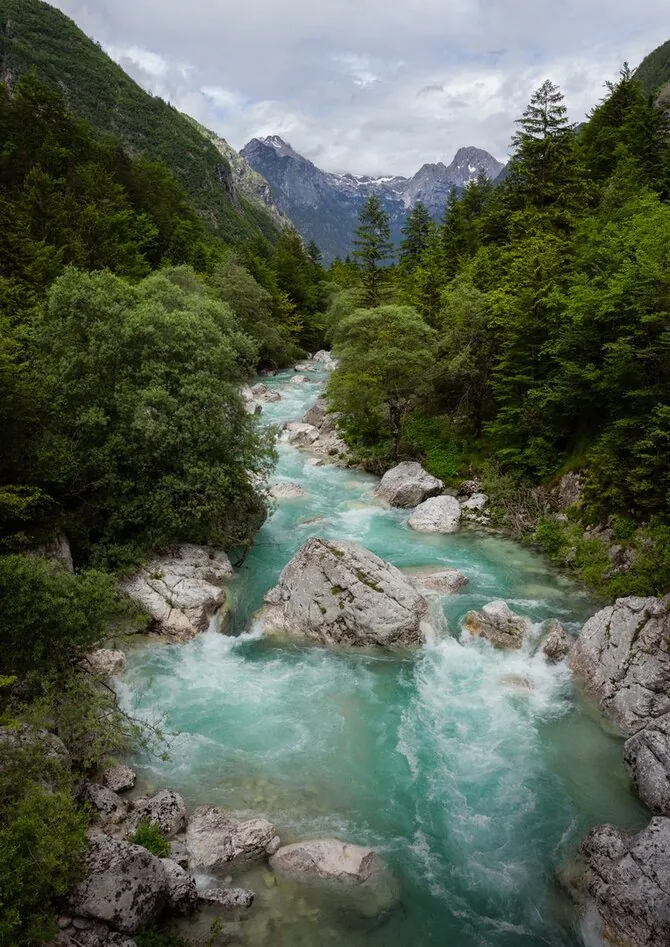
A ritual without which the day does not start
Although in the first trips Laimonas tried to be as minimalist as possible, over the years the amount of stuff on the bike has not decreased but increased. One reason is photography and filming.
The camera has been traveling with him for a long time, but recently video has increasingly replaced photography. Filming and editing have become another area where Laimonas constantly wants to learn.
“Now the image interests me even more than photography. I don’t like photographing myself. I take photos where I think I would really want to print that shot. But filming captures emotion. There are so many things you want to say, so much to learn,” he says.
Laimonas also plans to make a film about his current trip. And among the various travel items on the bike, there is always room for one more – very important. “In the morning, I really like to make a real espresso. So I always carry a special tourist espresso maker. Mmm… what a good feeling and that coffee aroma,” Laimonas smiles.
Food on the road is much simpler for him: oatmeal with nut butter or jam, red lentils, beans, bread, fruit. Sweets also come in handy while pedaling. After a few days in the rain, even tastier food or a warm bed becomes a small event.
Nordkapp – the “summit” for cyclists
Recently living and working in Denmark, Laimonas started his current – longest – trip from there. First, he reached Nordkapp – a harsh cape in northern Norway, which has become a symbolic goal for many long-distance cyclists.
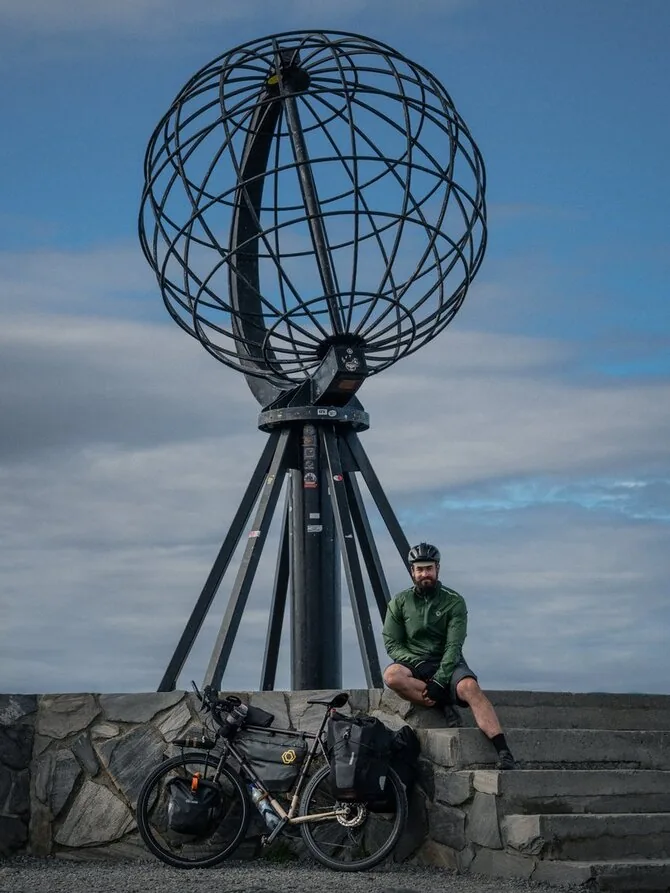
Laimonas compares it to summits that mountaineers have on their lists: “In the world of cyclists, you need to have Nordkapp. It’s like for mountaineers who want to reach the great summits. For a cyclist, Nordkapp is one of those places.”
But after reaching it, Laimonas did not end his trip. From northern Norway, he headed back down and reached Lithuania. He stopped briefly, visited relatives, but still considers his current route as one single trip. His direction further is south.
As you read this story, Laimonas is already far from Lithuania, and his route has changed a bit after our conversation. Now he plans to travel to Moldova, from there through the Balkans to Albania, and then take a ferry to Italy. From Italy, another ferry will take him to Spain, where one of the most enticing stages of this trip awaits him – the Pyrenees.
“Sometimes it’s hard to find a place for the tent in the mountains. You start thinking about where I will sleep today, as if giving a task to your brain, and eventually, you still find a place. Over the years, there has always been a place,” the cyclist smiles.
Then he will cross the Strait of Gibraltar to Morocco, where the famous Atlas Mountains await. This time, he does not plan to cross Africa by bike – such a stage, he says, would require much more serious preparation.
From Morocco, Laimonas plans to return to Spain and then fly to Bangkok. He plans to spend the winter in Southeast Asia – cycling through Thailand, Laos, Vietnam, Cambodia, and more.
But, as he says, the route is not set in stone: “Where it’s comfortable, where it’s cheaper, where it’s interesting, that’s where I will pedal.” According to his calculations, his savings should last about a year or a year and a half. And how long the trip will actually last, the road itself will show.

“One day I will cycle around the world”
On Laimonas’s social networks, you can already read a sentence: “One day I will cycle around the world.” He now smiles – when he wrote it, he didn’t mean that one day he would get on a bike and follow a strict route around the globe.
“What does it even mean to cycle around the world – through all continents, along the equator? I rather meant that I will go out into the world. Maybe during my life, I will travel all countries. Or at least most of them,” Laimonas reflects.
Europe is almost fully cycled. In the future, he is very attracted by North and South America. In his mind, there is also a much bolder African route – to start someday in Cape Town and go up the eastern part of the continent.
Where he will want to return after all these trips – to Lithuania, Denmark, or somewhere else – Laimonas does not know today. And it seems he doesn’t really need an answer yet.
“A friend keeps teasing me: maybe you’ll find a love and those trips will end. But what will happen next, I don’t know. This is the stage of my life now,” the traveler smiles.
Read more Did Ursula von der Leyen really announce the desire to take away Europeans’ savings?