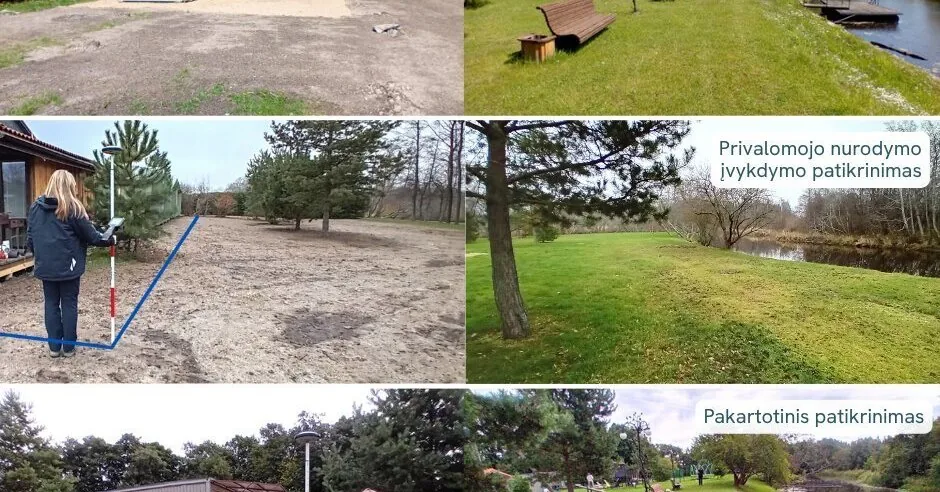
During the inspection, it was found that outside the boundaries of a private land plot, without the consent of the state land trustee, four container houses with a wooden terrace were built, personal belongings intended for recreation were kept, benches, trash bins, and lamps were installed. A raft of about 25 sq. m was installed in the Šventoji River.
Read more Trump will not like it: a vital cargo from Russia to Iran
During a previous inspection, about 274 sq. m of illegally occupied state land was found in this location. At that time, a mandatory order was issued to the responsible person, which was fulfilled – the objects were removed, the territory was cleared, and VTPSI confirmed that it had carried out an inspection of the execution of the mandatory order. However, compliance with legal requirements did not last long – upon receiving new information, VTPSI checked the territory again and found that the state land was occupied again.
Based on the information provided by the Palanga City Municipality Administration, VTPSI also checked the use of the adjacent private land plot. It was found that in the Real Estate Register, its use is registered as an area for single-family and two-family residential buildings, but in fact, the plot is used not according to this use.
A new mandatory order was issued to the responsible person, and a 25 working day deadline was set to eliminate the violations.
Read more A touching letter about the priest leaving Lithuania: «The community must not remain silent»
According to Article 110, Part 2 of the Code of Administrative Offenses of the Republic of Lithuania, for repeated unauthorized occupation of state land, an administrative offense report may be drawn up against the person and a fine of 560 to 1,200 euros may be imposed.
VTPSI reminds: compliance with the mandatory order is not a temporary adherence to requirements until the inspection. After removing the identified violations, the obligation to comply with legal acts does not disappear anywhere. State land can only be used on the grounds established by legal acts – managing an adjacent private land plot does not automatically grant the right to occupy or use the adjacent state land. If it is occupied again without authorization, the requirement to clear the territory is not the only measure – stricter administrative responsibility is provided by legal acts for repeated violations.
Read more «New European Maldives»: why are travelers flocking to the country enticing with cheap pleasures?