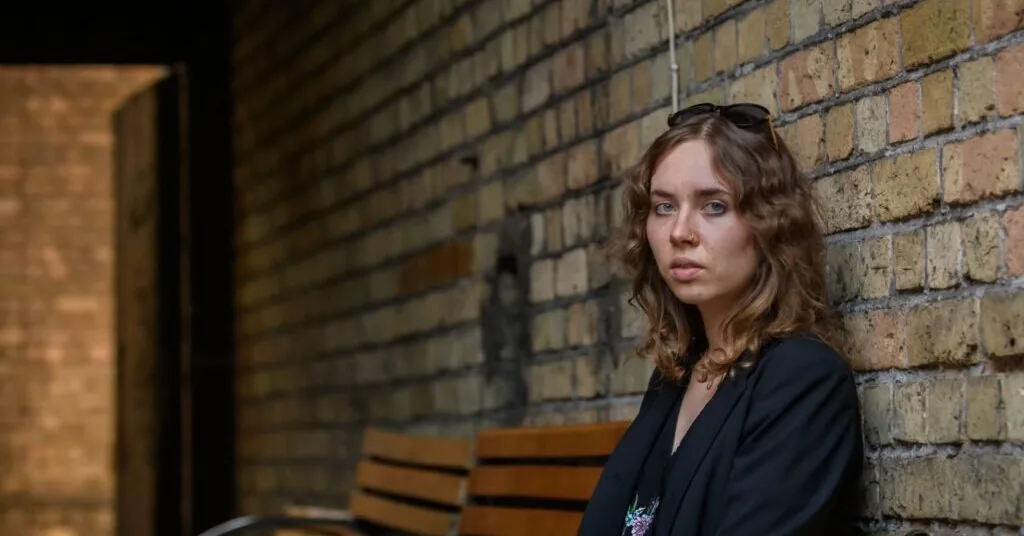
„When you are true, you strongly risk not being liked by someone,“ says the poet, admitting that in everyday life it is important for her to fit in and be liked, but in poetry she allows another – more rebellious – side of herself to express itself.
Read more Minister: decisions regarding language in municipalities should be individual
Born in Riga in 1998 and raised in a village near the Pededze River, the poet initially chose biology studies at the University of Latvia, later studied culture and arts at the Latvian Academy of Culture, as well as sociology and political science in Iceland and English literature in Norway. Since 2020, her poetry and critical texts have been published in the Latvian press. Her first poetry collection “Structure” (Punctum), published in 2024, won the Ojārs Vācietis Prize and was nominated for the Latvian Literature Annual Award (LALIGABA) for best debut.
From September 23–27, Līva Marta Roze is expected as a guest at the international literature festival “Poetic Druskininkai Autumn,” which will take place in Vilnius and Druskininkai. We talk with the author about the formation of her poetic voice, the impact of different experiences on creativity, the body, memory, and inner chaos.
– You were born in Riga but grew up in a village near the Pededze River, and later returned to Riga to study. You have said that the city and traveling by public transport help you write, while the forest allows you to calm down and “silence your thoughts.” How do these two different environments affect your creativity?
The city’s hustle is important to me so that the creative process can “get moving”
– I really need both of these environments to feel good – both as a person and as a writer. The city’s hustle is important to me so that the creative process can “get moving,” so I can exchange ideas and energy with friends and colleagues. The silence and solitude of the countryside or nature are necessary for me to concentrate, accomplish something, and recharge my inner battery.
– Soon you will have another trip – this time to Lithuania. In September, we will meet at the “Poetic Druskininkai Autumn.” Lithuanian readers have already had the opportunity to get acquainted with your work through translations in the cultural press. Is it important to you how your poetry sounds and is read in the context of another Baltic country?
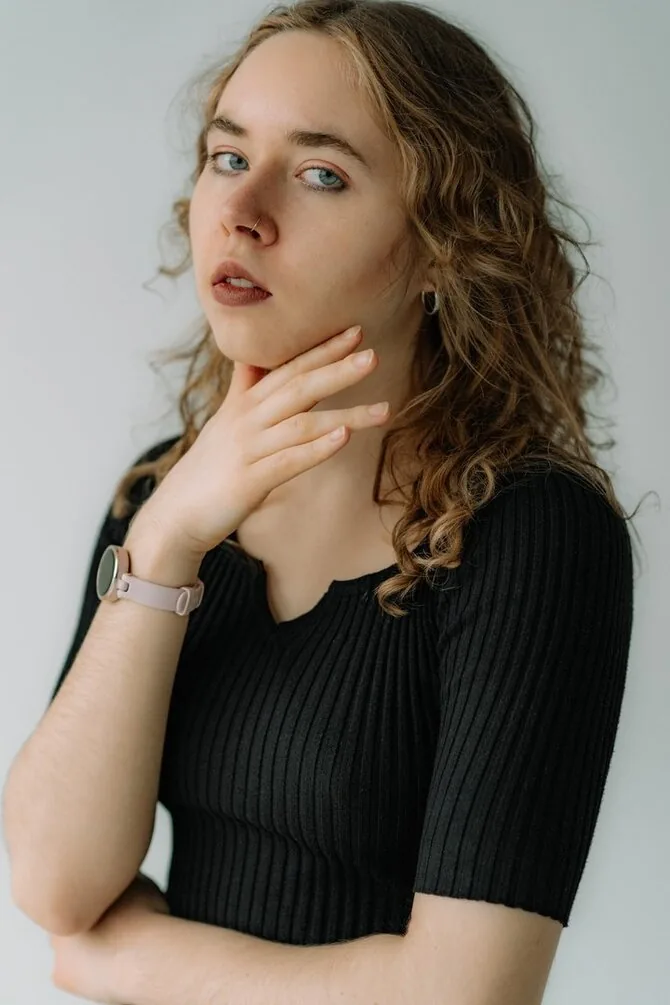
– To be honest – I don’t really think about how my poetry sounds in another context. Let the literary researchers puzzle over that. If my poetry resonates with someone – that’s very nice. If not – well, that’s okay too. Speaking about the relationships among Baltic poets, I was once in love with a young Lithuanian poet. But now we no longer talk. (smiles)
– Does such a thing as Baltic poetry exist at all? If so, what connects it?
– Not much in everyday life. However, I once participated in the project “Circa Seven Celsius,” dedicated to young writers from the Baltic countries. I also recently wrote a review about a contemporary Estonian poetry anthology published in Latvia – while reading, I really felt a connection with its themes and Estonian mode of expression.
– The title of your debut poetry book, which won the Ojārs Vācietis Prize, is “Structure” (Punctum). However, reading your poems gives almost the opposite impression: they contain many unexpected associations, memory jumps, random details, and chaos. Is structure in poetry a way to control that chaos, to find some order in it?
– The book’s title came about quite by chance, but I really am a person for whom structure is very important. Despite that, or perhaps because of it – chaos truly reigns in my inner world. As long as I can remember, I was simply addicted to the illusion that I control my emotions, reactions, and life in general. But something unexpected and uncontrollable always happens, and that illusion slips away. To cope with the mess, I suffer and write poems.
– Your poetry contains many everyday details, randomly met people. It seems that a poem can start from something completely simple, seemingly insignificant. How do you recognize which everyday detail can turn into a poem?
– I just feel it. I am overwhelmed by a very specific feeling, and then I have to write everything down as quickly as possible to see where it leads. But I cannot summon that feeling myself. It just takes over me, and I am grateful when it happens.
– In a poem published in the festival almanac, “Middle,” you return several times to the question “who will remember now?”, and the memory is accompanied by doubt: “who brought those cigars? who will remember now,” “whose vape was that? who will remember now” (translated by Dominykas Norkūnas). Yet you precisely reconstruct one night – the pool, cigarettes, a trip to the missile base, Lenin’s head sculpture, a stranger’s apartment, and chickenpox the next morning. When writing, do you try to preserve the past, or are you more interested in how memory distorts, fragments, and reconstructs it?
– Even when I write about real past events, the text is still edited: interpreted, supplemented with fantasies. That’s why it is a poem, not a diary entry. And no one will ever know which detail is completely true and which is altered. That’s exactly what I like about poetry. On one hand, I write the story of my life. On the other hand – I show the reader only what I consider worth showing, and only in the way I want to show it.
The desire to distance myself from my thoughts and feelings is part of my attempt to control inner chaos
– In another poem you write: “I never remember important things / a thought is just a thought / a feeling just a feeling / and an action just an action.” Yet the text itself is full of unexpectedly emerging memories. Is the attempt to distance yourself from thoughts and feelings really possible?
– The desire to distance myself from my thoughts and feelings is part of my attempt to control inner chaos. And, of course, it usually doesn’t work. (laughs) Here you have all those memories rising to the surface.
Read more In Nasrėnai – a two-day Lithuanian barn theatre festival
– In your poems, you often return to adolescence, along with specific signs of that era. For example, in a poem about dresses, you remember dancing to “Modern Talking.” What were you like in adolescence? What did you read, what films did you watch, what were you interested in? Do you feel those years somehow shaped your poetic voice?
– I always find it a bit difficult to answer questions like “what were you / what are you,” because I feel that many different versions of myself exist simultaneously. And the version that surfaces often depends a lot on the people who are around at the time.
However, in adolescence, I was definitely much more cynical and gloomy. Although I had not yet read “Rye Grass by the Abyss,” I was still “something like that.” Since I did well at school, I could afford to be cynical and rebellious without major consequences. I had great classmates, but I mostly spent time with boys: I dressed differently from most girls, which in a small town was almost a social suicide. (smiles) I had a small fun group of friends and was madly in love with one guy, but still sometimes felt lonely.
I often spent afternoons in the park, reading Tolstoy or just wandering. At that time, I also wrote my first poems, so some kind of formation of my poetic voice definitely happened then.
– You are a poet of the younger generation. Do you notice what themes connect your peers who write? What concerns young Latvian poets the most today?
– I think there has been a huge shift from postmodern irony and cynicism towards sincerity and vulnerability. In poetry, it is now “allowed” to be vulnerable: to show where it hurts, to talk about traumatic experiences.
Writing poetry can heal, and sharing your story can help another feel less alone. And I think this attitude is very natural for the younger generation. It is not just a trend but a different way of life.
– You studied quite different fields – from biology to sociology, political science, and English literature. What were you looking for in each of these areas, and what did you “bring” into poetry from them? Do these two educational directions (scientific and humanitarian) influence how you view people and the world?
– Well, I did well in all subjects at school except physical education and economics, and I studied literature and biology exceptionally well. Also, I come from a family of biologists, although there were various kinds of people in our home.
After finishing school, I went to study biology because it seemed something safe and familiar, and I liked it. But I didn’t feel happy. So I finished my studies and immediately after that enrolled in the Latvian Academy of Culture. From the outside, it might seem that I deliberately made things difficult and chose the most complicated life path, but I don’t regret any of my decisions. All the accumulated experience enriches me both as a person and as a writer. My early poems are full of biological references that I no longer understand today, but at the time it was the language that was the most natural and easiest way to express myself.
Limiting myself to one specific field would be boring. It may sound pretentious, but my ideal is a “Renaissance person” – a person well-educated in various fields.
– In one of your poems you write about “people in white shoes” – those who speak “the language of quiet normality / healthiness / self-sufficiency and self-reliance.” You also write: “between them and me yawns a gap / that I will never overcome.” What does this “normality” mean to you? Do you think poetry allows speaking from the side of the gap, from where it is not necessary to pretend that everything is fine?
– I feel that I have desperately sought that “normality” in my life more than once, but now I am mature enough to understand that it is a futile thing. When you finally stop seeking it and accept yourself as you are (yes, I know, it sounds banal), it liberates you. As long as I can remember, I have always found it difficult to understand certain social signals, to perform seemingly simple tasks. Sometimes I can be pathologically shy, and then suddenly relax, say the wrong thing, or appear too intense. (laughs)
Poetry has undoubtedly become a space for me where I can safely express myself as I am. It is a place where my intensity and strangeness are not condemned but, on the contrary, even appreciated. Through literature, I found my people. Many great friends and acquaintances who are even stranger than me!
– In your poetry, the body is concrete and earthly – sweating, desiring, sick, unshaven, sometimes causing discomfort. In a poem about shopping you write: “suddenly I felt / that there is no essential difference / between me and the meat piled on the counter.” What interests you most when writing about the body?
– Honestly, I don’t even know. Writing about bodily experiences is just as natural to me as writing about matters of the mind or spirit.
Western civilization (sorry for using a questionable dichotomy again) due to Christianity and Ancient Greek philosophy has especially focused on the mind and spirit. Bodily experiences were considered dirty or unimportant. To me, that seems simply ridiculous, although I have not consciously started to fight it. I simply don’t care. I just write about what seems important to me. And how could the body be unimportant if without the body we could not be alive at all?
– You write openly about sexuality, shame, loneliness, mental difficulties. Yet the poetic subject rarely sounds as if it wants to justify itself. Is it important for you to leave room in poetry for the uncomfortable, contradictory, not always sympathetic side of yourself?
– I mentioned that poetry is a space for me where I can be my truest self. And being true means being uncomfortable and contradictory. After all, when you are true, you strongly risk not being liked by someone.
In everyday life, it is actually quite important to me whether people like me or not. I want to fit in, I want to be liked. That is a superficial layer of my personality.
But deeper inside me lives the rebellious part. These two sides of me find it hard to coexist, but in the end, we reached a compromise: I allow the rebellious part to express itself in my poetry. So far, it’s going quite well.
– In one of your poems, orange juice becomes a true “elixir of life” – you write that “every drop is important,” and finally admit that “pure orange juice flows through your veins.” After this poem, have people already started treating you to orange juice? Or has the addiction not yet been properly appreciated?
– I would say that this addiction is still almost unnoticed and not properly appreciated. (laughs) My family knows about it and always buys orange juice when I am sick or when they want to cheer me up. This strange addiction has accompanied me as long as I can remember.
– This year’s theme of “Poetic Druskininkai Autumn” is “Poetry rituals.” What do you first think of when you hear this combination of words?
– To be honest – nothing. True, I have to prepare a short talk on this topic for the festival, but so far I have no idea what the hell I will talk about. I generally don’t like talking about poetry because I usually don’t even understand it myself. I like writing it, and that’s it. No pretentious babble.
Read more On Tuesday, fuel prices increased: where to find cheaper petrol and diesel?