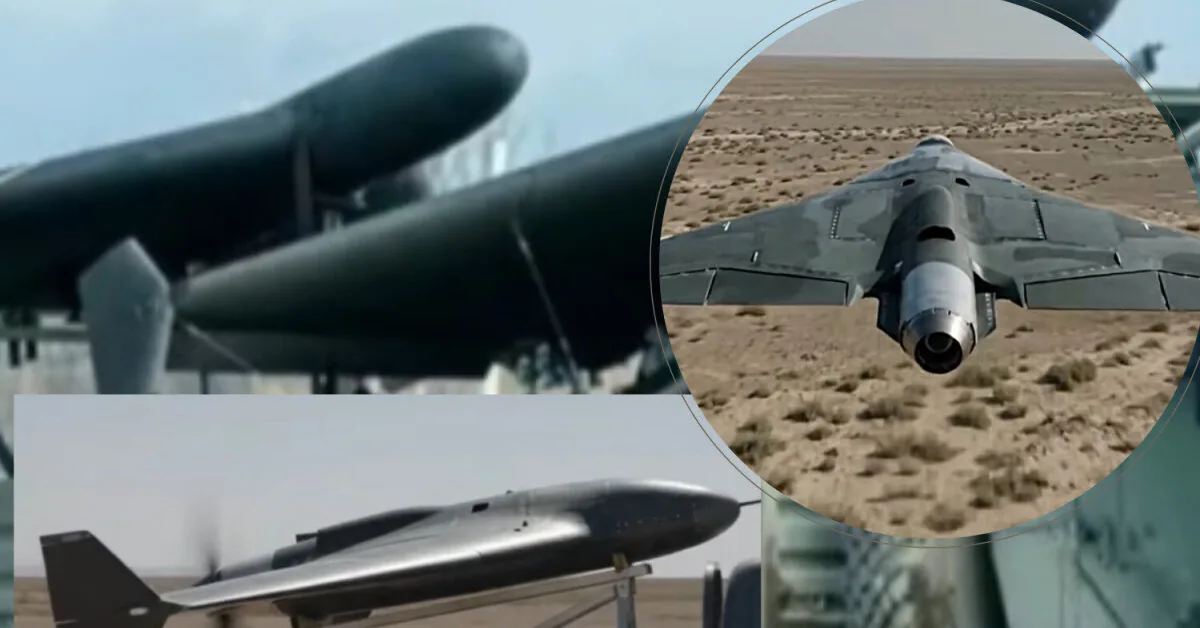
The authors, based on leaked documents and satellite images, discovered up to 10 new Russian bases with recently installed launch pads for the most advanced Russian drones. These are the “Geran-4” and “Geran-5” – jet-powered “Shaheds.” It is noted that the “Geran-5” drone has a 90 kg warhead, and the declared strike range of this drone is about 1000 kilometers.
“The Telegraph” clarified that some of these bases are already being used by Russia for strikes against Ukraine, and the short distance to the Ukrainian border creates favorable conditions for massive air attacks, during which Russia tries to break through the “weakened Kyiv air defense.”
“Warsaw could also be hit”
As the authors of the investigation note, 7 out of 10 bases were used in recent massive attacks on the Ukrainian capital. At the same time, these same bases “pose a long-term threat” to several NATO countries that are within the range of such strikes.
The newspaper’s published graphic shows that these include Turkey, Poland, Latvia, Lithuania, Estonia, Finland, Romania, Bulgaria, and partially even Greece, Hungary, Slovakia, and other Alliance countries.
Based on analysts, the authors warned that in the event of a war against Europe, Russia could use its drone capabilities against NATO countries, and in such a case, major cities like Warsaw could also face drone strikes.
“European and US intelligence officials believe that Russia is considering staging an armed provocation on Polish territory, missile or drone attacks on critical infrastructure, or attacks under a ‘false flag,’ for which Ukraine would be blamed,” the “The Telegraph” article states.
“Brewing” jet drones
Leaked documents and satellite images allowed researchers to identify at least 59 new drone launch facilities with rails – mechanical guidance tracks used for the takeoff of fixed-wing drones when traditional runways are abandoned – along the Russian border with Belarus and Ukraine.
These launch platforms are like those at the Halino military airfield in the Kursk region, as well as in the vicinity of the villages of Asovitsa and Aleshoko in the Bryansk region.
“The Telegraph” compared satellite images of these locations taken last summer and this summer.
It is visible that some of these launch pads were installed in “repurposed” military bases and civilian airports, while some additional pads were set up by Russia in rural areas, the article explains.
Read more Car service center – mass intruder attack: damage being assessed, police are working
Photos analyzed by the drone intelligence company “DroneSec” revealed that about 20 of the recently installed pads have extended launch rail tracks, meaning they can launch the latest Russian long-range strike drones.
Researchers reminded that Moscow is rapidly modernizing “Shahed”-type drones, and the use of new variations of these attack drones from the mentioned bases “would allow Putin to strike the Polish capital.”
“Currently, there are no signs that Russia plans such an attack, but NATO leaders are preparing for a future conflict,” the article states.
“The Telegraph” noted that the analyzed satellite images showed a significant increase in the number of so-called “kamikaze” drones in Russia’s arsenal. One of the bases has enough space to hold over 1000 such drones at once.
Additional launch platforms are being built at several other important sites, which, according to the article’s authors, indicates Russia’s intent to only strengthen the threat posed by drones.
As “The Telegraph” found out, these bases are supplied from several factories across Russia, including the special economic zone in Alabuga – the largest Russian drone factory, producing up to 6000 units per year.
Mike Monnik, CEO and founder of the analysis company “DroneSec,” who examined the satellite images obtained by the publication, concluded that the Kremlin has “significantly expanded” its drone network to “attack Ukraine and keep NATO countries under the shadow of such strike threats.”
According to him, the expansion of launch pads shows “how Russia has increased its capability to launch more drones while using technologies that complicate the interception of such drones.”
“Together, these two factors allow increasing the total number of unmanned aviation systems Russia can use for strikes against Ukraine and increase the difficulties faced by Ukrainian forces trying to intercept newer Russian drones,” Monnik summarized.
Read more A new „Lidl“ campaign „Unexpectedly Created Career“ starts: invites to join the team