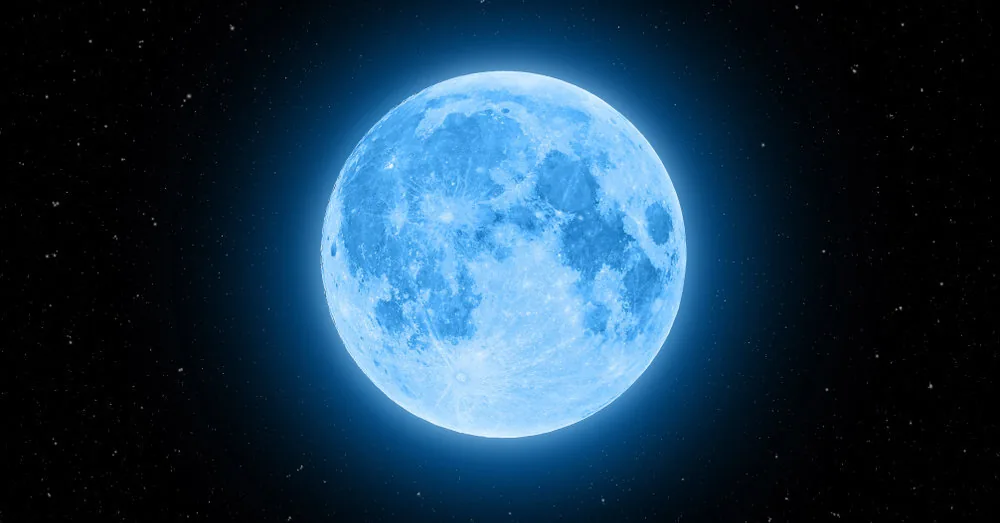
This is not just a Blue Moon – a rare phenomenon of a second full moon within one calendar month, occurring every few years. This time, the full moon will also coincide with the apogee – the farthest point of the Moon in its elliptical orbit around the Earth.
Read more «Italian remains the leader of the ‘Tour of Lithuania’, best Lithuanian – in 6th position»
The May full moon is traditionally also called the Flower Moon – this name was given by the old American publication “Farmer’s Almanac”. Usually, this name is not applied to the Blue Moon, but nothing prevents attributing a bit of the Flower Moon mood to this exceptional full moon.
Being about 406 thousand kilometers away from the Earth, this full moon will be the most distant of the three micromoons occurring in 2026. This means that this Moon will appear the smallest in the sky this year – and indeed until 2028.
The next Blue micromoon will appear in the sky no earlier than July 2053.
Micromoons and their much more attention-grabbing “relatives” supermoons are a natural consequence of the slightly oval orbit of the Moon. Since the orbit is not a perfect circle, each revolution has a point where the Moon is closest to the Earth – called perigee, and a point where it is farthest – called apogee.
The average distance of the Moon from the Earth is about 384.4 thousand kilometers, but the distances of perigee and apogee constantly vary slightly. This happens because the Moon’s orbit is not completely stable – it is influenced by the Sun’s gravity and the gradually changing relationship between the Earth and the Moon.
Moreover, the Moon’s orbit constantly changes slightly – its oval trajectory is not exactly the same each time. Because of this, the timing of perigees and apogees does not fully coincide with the lunar cycle, so usually we see only two or three full micromoons and three or four full supermoons per year.
To make things even more confusing, there is no official definition of supermoon and micromoon, so whether a full moon is considered a micromoon or a supermoon depends on the criteria used.
The Norwegian internet company “Time and Date”, specializing in astronomical event information, considers a micromoon to be a full moon at least 405 thousand kilometers from the Earth’s center.
Meanwhile, astrophysicist and eclipse specialist Fred Espenak from the “Astropixels” website uses a more flexible definition – according to him, a micromoon is a Moon “within 90% of its greatest distance from the Earth in a given orbit”. This explanation better accounts for the constantly changing apogee and perigee distances.
Meanwhile, the concept of the Blue Moon is much clearer and more standardized.
It is not a Moon that actually appears blue in color – it is a phenomenon arising because the lunar month, also called the synodic month, and the calendar month do not quite match. The synodic month lasts 29.53 days, while the calendar month usually has 30 or 31 days.
Because of this, the date of the full moon in the calendar month shifts slightly each time. Once every two or three years, it occurs early enough in the month for another full moon to happen at the end of the same month.
Read more Eglė Jackaitė introduced her new boyfriend for the first time