Laurynas Katkus, a member of the competition jury, writer, and translator, says that the essay genre is very rewarding because it best helps to reveal changes in the cultural atmosphere. And there are quite a few of those changes to see.
Read more The case of Audrius Saulynas’ «checks» handed over to the juvenile court
“Not only the topics change, but also how the authors interpret them, the way they explore them, and sometimes what hopes they nurture. Ten years ago, our competition was probably the only one dedicated to the younger generation of essayists. Today, this field has expanded, and there are many more opportunities to write, publish, and be noticed,” says L. Katkus.
The speaker says that over 10 years of the essay competition, 30 young authors have sat at the laureates’ table, many of whom we now often see in cultural and academic activities and read their texts in the media.
This year, 12 works were submitted to the Thomas Mann Festival essay competition, showing that the competition interests both humanities and social sciences students. Students of philosophy, history, philology, law, and other fields sent their works responding to the festival theme “Emerging Time. Hope.”
Competition jury member, semiotician, and art historian Gintautė Žemaitytė notes that from the genre perspective, all essays fell into two groups.
“These are more academic, analytical essays that use philosophers’ ideas to analyze hope as a phenomenon, and literary, even confessional-type works based on personal experience. They take a completely different path: philosophical or cultural references, if present, become a springboard for reflecting on personal experiences, hopes take on concrete, existentially important events or states, and the writing itself often becomes therapy,” says G. Žemaitytė, adding that most texts could become excellent literary miniatures reflecting the current generation of students’ relationship with themselves, society, and writing.
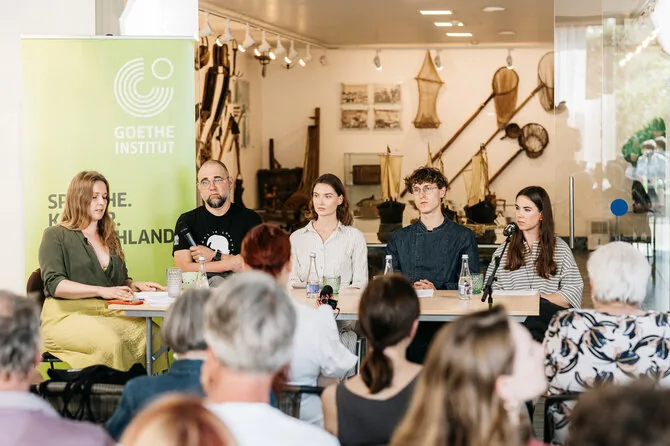
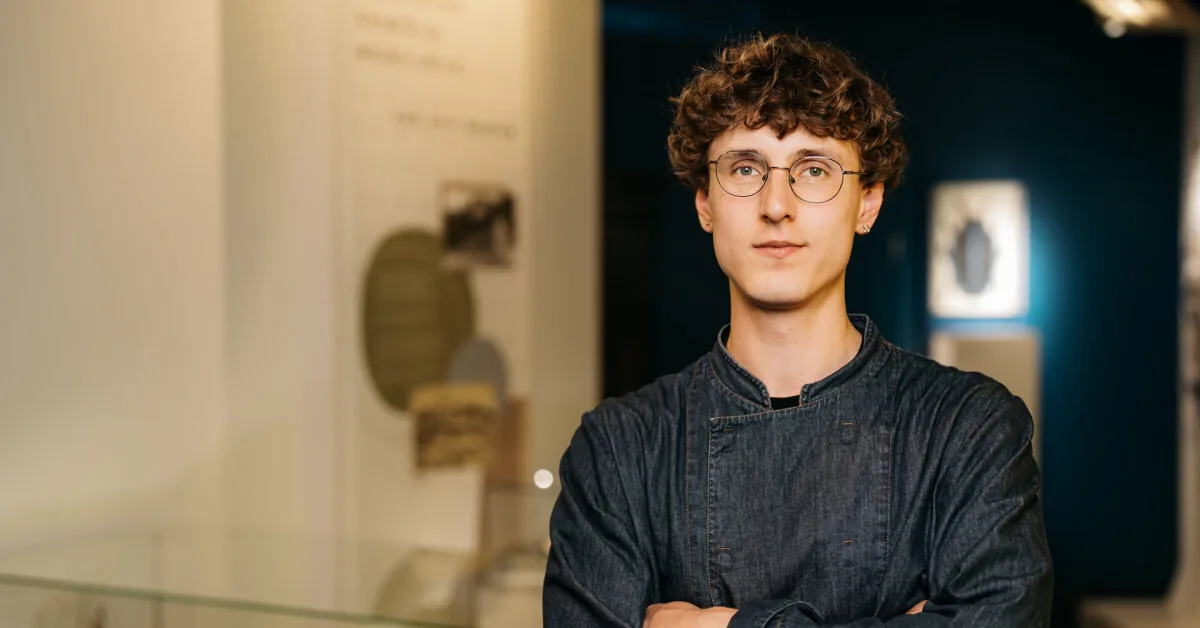
On July 16, festival guests at the Curonian Spit History Museum could meet three competition laureates whose texts were recognized as the best. These are Gabrielė Brazaitytė, studying applied linguistics at Vilnius University, Kaunas University of Technology language technologies and translation student Urtė Baltrušytė, and Vytautas Magnus University psychology student Simonas Surdokas. It was S. Surdokas’s essay among the three laureates that was recognized as the best and awarded for the playfulness of magical imagination.
We invite you to get acquainted with S. Surdokas’s essay.
The Telekinesis Method, or How to Move Souls with Thoughts
Simonas Surdokas
The world is twofold for a person because the person’s attitude is twofold.
Martin Buber, “The Principle of Dialogue I. I and Thou”
A child feels absolute union with the world only once in their life. They stack a couple of red blocks into a skyscraper or mercilessly twist off a doll’s arm, and here – in their miniature consciousness, the possibility to create shines for the first time. A primitive intention, which moments ago was formless and waiting, takes shape before their eyes, and a wave of satisfaction flows down their cheeks and the back of their head. They feel the power of consciousness embodied in small hands, fulfilled in a big world.
But everything is simple as long as we try to bend reality only as much as we can bend our bodies. To push something with fingers and kick with a foot. And behind those two small eyes, perhaps ambitious space projects begin to shine. Unfortunately. The second desire, although huge, will not bring life to a plush elephant on the sofa – it deflates, and in its place comes the sadness of defeat.
Creation is the feeling that the body extends beyond the fingertips, and we seek that feeling for the rest of our lives.
When I was about eight, I learned that supernatural powers are passed down from generation to generation. Of course, I hurried to call my mother. No, she answered irritably, we don’t have witches in the family, don’t meddle. I understood, okay – I hung up the phone without worry and jumped back to the stove because I knew the flame would soon shoot up to the ceiling and leave a burnt circle if I recited the spells correctly from a poorly designed internet portal. “Climb the flames up / Carry the smoke away / Crows will return as coals” and similar nonsense.
Only later did I realize I was a naive fool. On another portal, I read that the first step is to develop psychic powers. And without a certain device, nothing decent can be done: you need to stick a toothpick into an eraser and balance a shiny foil hat on the tip – voila. Then you embrace the fragile construction with your palms (but don’t touch it!) and visualize energy vortices until the paper spins clockwise. When you learn to spin it counterclockwise, and when that becomes too easy – cover the device with a glass so the draft doesn’t blow, and start the real work.
My encounter with mystical practices repeated much later in life when I was dating a girl, truly charming and cheerful, but somewhat frightening to me because of her spiritualist beliefs. “I sent you good energy,” she said trembling when I sternly asked what efforts she had put into our relationship. I got angry. By that logic, you can say whatever you want. “You know, passing by the flower market, I thought I would really, really like to buy you flowers!” Well, where are the flowers, lazybones? None. It’s just a silent intention, born and sadly died in indecisive thoughts, however beautiful and sincere. I believe that girl was not lying when she said she sent me energy. But I was not lying when I said I did not feel the energy. It was talking without understanding. We sat on the same bench, infinitely apart.
Probably I didn’t understand her as much as the foil shell on the toothpick didn’t understand me. Maybe it’s clear why it obeyed my will only as long as it was not protected by a glass dome. On the other hand, the fire heard me perfectly. Heard too much and too well. Without a clear intention, not even knowing what I hoped from the fire, I said the same and always different things in a hundred ways. The fire probably didn’t move because it didn’t know which command to obey.
Such an intention without words is worth no more than words without intention. But combine the best of both, give the lost word direction, and you get an address. Not trying to command with a meaningless, random spell, but not leaving the intention only inside, to guesswork. Address the vulnerable, the open. Ask a question without imposing an answer – let the Other open
as they are. Maybe I myself should have disarmed and told that girl: “You know, I want you very much, but I’m afraid I will never hear your efforts.” And I just snorted.
Read more JAV tightens visa rules for students and journalists
At the same time, it is an address acknowledging one’s limitations in the presence of the Other. It is the same insurmountable boundary, constantly reminding us that we are not omnipotent.
When I myself feel slightly powerless, as if the world does not obey me and I no longer communicate with it, I turn on Tarkovsky’s 1979 “Stalker.” It is a film where the boundary between unified and separate existence in the world becomes not frightening but, on the contrary, very clear. We meet the characters in a village where a meteorite fell 20 years ago. An otherworldly being has spread around the perimeter, forming a space called the Zone, and at its center, it is said, is a room that fulfills the deepest, essential wish, sometimes unknown even to the person. But the Zone is dangerous, misleading, constantly changing. Sacred. Inexperienced and lonely travelers disappear there. They need a guide who has mastered the mystical labyrinth – the Stalker.
The difference between unified and separate existence is revealed through the director’s color decisions. Part of the film you are forced to watch gray stagnant puddles, black and white bottles on shelves; witness a world where even fire is somehow half-dead. But for three minutes, hypnotically thundering on rails with three companions, you enter the Zone. You feel the clamps on your throat loosen and you can breathe again. In the brass fog, the leaves of horseradish turn blue, brown moss curls on wet stones, and finally, the eyes ripple blue again. The dissonance between the image of consciousness and reality disappears.
Still, you are in unity only by sight, not by action – the space surrounding the village in the film is more hostile than friendly to us. It is like an emotional being, unpredictable. Insult a person and you get a slap, insult the Zone – you die. Reacting as a person, it cannot be conquered like an object. Although to the Stalker’s companions (the Writer and the Professor) the Zone is Buber’s It, to the Stalker it is Thou. It is the same difference we usually understand as the difference between an object and a person.
That is why I cannot help but marvel at the ritualism of the character and the space. The relationship between the Stalker and the Zone is human, full of respect and intimacy, with hints of worship; sometimes it seems that the main character will burst into tears from all the greatness flowing into and through him in the green fields. He listens carefully, walks systematically, cautiously, and slowly. He is at home.
Still, there is no equality. The Zone does not answer the Stalker.
Then my eyes turn to the character’s daughter. Perhaps the cells of the Zone’s guides are charged with mystical energy, I don’t know, but their children are born carrying a piece of the cosmos within them. They themselves see the world as colorful and unfolding as it is. In such a world, they act differently. In the last scene of the film, the Monkey, the Stalker’s daughter, wrapped in a yellow lace scarf, with her cheek pressed to the table and staring at three glasses… she moves from her place.
The action performed by the girl was not just telekinesis. Just as the Stalker’s relationship with the Zone is almost a personal I-Thou, so the girl’s relationship with the rest of the world is no longer I-It. To say that it is simply commanding objects to move using mental powers is not quite accurate. Being in unity, she relates to objects as to people. The same scene can be interpreted as an address to the world in a new equal relationship. And as the response of that object moving – a dialogue.
But we will not be able to imitate the Monkey. We cannot enter into a human relationship with the world for the same reason the Stalker lacks just a little but still lacks it. Almost every attempt hits an insurmountable wall through which objects do not hear us, and we do not hear them. The world does not answer us. Just imagine how interesting it would be if the price of some ottoman at a flea market was determined not by how worn and vintage it is, but by the story it would tell in the evenings in a new home. Unfortunately. It is not alive. Scream, shout, tear, beg, you will only get silence.
Now let’s try this: maybe I don’t want to see the world as colorful at all. I don’t care that humanity has learned to move objects with thoughts, and I don’t need to bend reality as it refuses to bend. The distance between me and the world is mutual: not only is it incomprehensible to me. I myself have the luxury of being so to it.
This is fierce self-defense when, anticipating the incomprehensible, hostile world, you say: “I will be just like you.” Then you try to compensate for loneliness with a close relationship with another person. But even that is only a temporary dose of empathy. The harsh world of objects is the being surrounding us; we are in it. And a person is short, sometimes longer, but essentially only a nearby presence of the Other. We can be with them, but not in them. But even then, you cannot endure long – you cannot forever only be nearby. The understanding comes that frowning, you will not principledly separate yourself from the world. Because you have to be somewhere.
The Stalker’s presence in the Zone is his way of reducing the gap between himself and the world. Navigating labyrinths, leading others through them, feeling the Zone with his whole being (but not knowing it), he realizes himself. In such unity, his body seems to extend beyond the fingertips.
To look at the world as the film character does is to choose the Attitude of Hope. Not just to expect that those colors will come by themselves, not to turn away from the world angrily crossing your arms over your chest, but, on the contrary, to remain in relationship – even when it is stubborn and pretends to be incomprehensible.
Any object you or I see is already complete. Neither spells move the flame, nor inner desires spin vortices. Objects no longer need that; they close like mollusks. But an object called a work of art hears you. It awakens, opens a small pocket into which you can put a piece of yourself. By creating, you project your Self into a new Thou. The work and the creator are like a key and a lock, fitting only each other – it is a realized union between intention and form, between you and the world. It is then that you experience unity when the image of consciousness coincides with the image of reality.
The world full of art is not the same as the world full of objects. Works address you, and you address others with works.
Read more The new Prime Minister of Ukraine rushed to address the $690 million issue
Then you realize that you can move souls with thoughts.
Organizer – Thomas Mann Cultural Center
In cooperation with the Goethe Institute in Vilnius