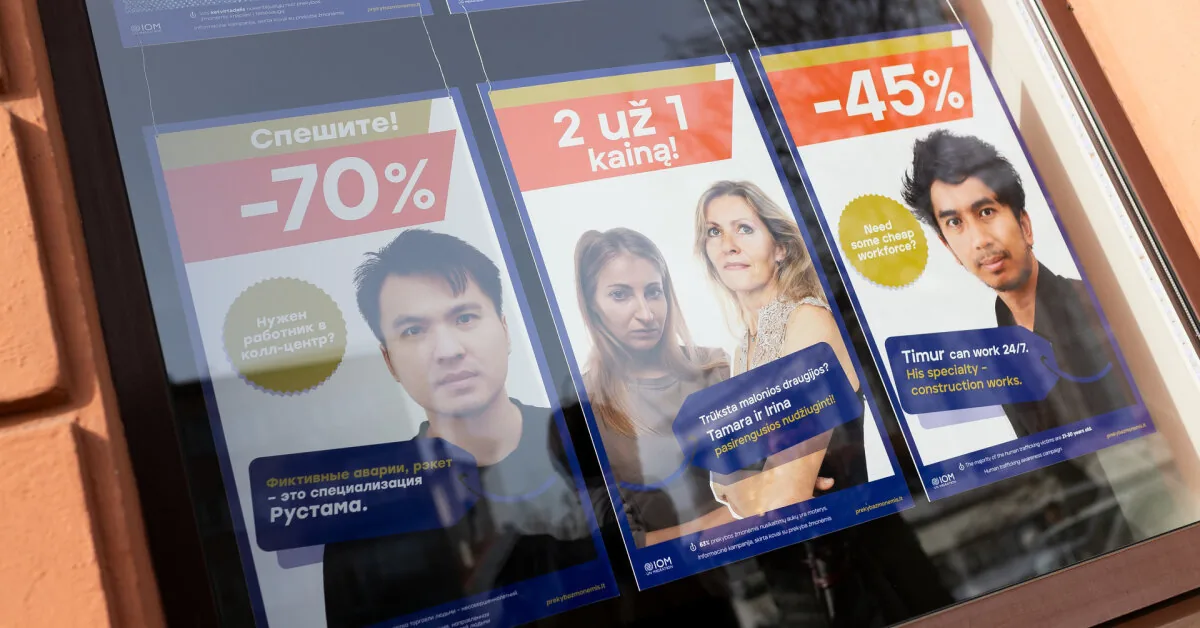
The overview prepared by the Seimas Ombudsman’s Office on the Fight against Human Trafficking in the Republic of Lithuania in 2025 reveals that last year the number of officially identified victims of human trafficking nearly tripled, but victim identification remains challenging, and significant gaps continue to be found in victim assistance provision and human trafficking prevention.
Read more Syrskis reacted to Fedorov’s dismissal
The number of human trafficking victims in Lithuania nearly tripled
In 2025, during pre-trial investigations, 62 persons were recognized as victims of human trafficking in Lithuania – the highest number in 6 years and almost three times more than in 2024 (22). All these persons were exploited in Lithuania, of whom 7 were also exploited in Poland and Hungary.
Of the 62 persons, 49 were men, 12 women, and 1 child. The majority of victims were third-country nationals – citizens of Sri Lanka, Uzbekistan, the Philippines, Kyrgyzstan, etc. – most of whom suffered exploitation for forced labor in the transport and construction sectors and manufacturing companies; 2 women were sexually exploited. Five Lithuanians were also recognized as victims: 1 was exploited for criminal activities involving drug distribution through parcel lockers, 1 for forced labor, and 3 for services, including begging.
Last year, 13 new pre-trial investigations into human trafficking were initiated, and the total number of ongoing pre-trial investigations increased from 26 in 2024 to 37. The overview notes that more and more pre-trial investigations are being initiated concerning the exploitation of persons under 29 years old and other vulnerable individuals for criminal activities, including theft and distribution of narcotic and psychotropic substances in European Union countries. One pre-trial investigation was launched to determine whether a woman was exploited for surrogacy.
In cases related to human trafficking and exploitation, 11 individuals (2 women and 9 men) and 1 legal entity were convicted.
Persons were drawn into exploitation situations in various ways – most often through personal contacts, intermediaries recruiting for service-providing companies, and social networks. The most common methods of breaking victims’ will were deception and exploiting their vulnerability, while in some cases physical and psychological violence and threats were applied.
Although officially only 2 women suffered from sexual exploitation, the General Prosecutor’s Office notes an increase in cases of sexual exploitation of foreigners who, after receiving a temporary residence permit in Lithuania, are later exploited for prostitution in Lithuania or transported to other EU countries for the same purpose. It is likely that due to Lithuania’s economic and geopolitical situation, this trend will persist in the near future.
Manipulation of labor law and migration mechanisms
Data from various institutions show that human traffickers’ methods are becoming more subtle – legal migration mechanisms are increasingly used, such as employment agencies or subcontracting. Persons are given misleading information about their legal status, manipulation of complex migration procedures and document forgery is employed to keep victims in a state of legal uncertainty and dependence on the employer.
In the transport sector, where many foreigners work, working hours, overtime, and night work are often unrecorded, requirements regarding work and rest time are not followed, and employees are allegedly sent on unpaid leave at their request, thus avoiding payment of wages to employees and taxes to the state.
Companies operating in Lithuania seek employees abroad who do not speak Lithuanian, lack sufficient knowledge about their rights, and do not trust government institutions. All this increases their vulnerability and reduces the likelihood that victims will seek help. Experts believe that cross-border employee exploitation schemes are likely to expand in the future.
In total, 344 persons were identified in 2025 who worked illegally or conducted undeclared self-employment activities in Lithuania. According to the State Labour Inspectorate, foreigners harmed by employers in Lithuania generally do not consider themselves victims of exploitation or human trafficking and treat their situation as labor law violations.
Lack of qualified specialists and assistance for human trafficking victims
Seimas Ombudswoman Dr. Erika Leonaitė emphasizes that investigations of human trafficking and forced labor exploitation crimes are very complex because many circumstances must be proven – the victim’s will being broken, control being gained, exploitation of vulnerability, etc.
“At least partial specialization of police investigators and judges handling human trafficking cases is necessary to establish clear practice and effectively conduct investigations of these crimes. Exploiters’ tactics and recruitment methods change, so challenges arise when a pre-trial investigation must be conducted by an investigator working with such a crime for the first time. Specialization of officers is also necessary to properly inform victims, as practice shows that they are often not provided with essential information,” says E. Leonaitė.
Read more At Vilnius Airport – Evacuation of DHL employees unrelated to shipments or flights
Although various trainings and other activities to strengthen competencies in the field of human trafficking were organized in 2025, specialists still lack knowledge about different forms of human trafficking and how to identify victims; they are not familiar with the latest trends, so victims are often identified too late. A lack of continuous training for specialists is also noticeable.
The State Labour Inspectorate, pre-trial investigation institutions, and courts lack specialists, investigators, prosecutors, and judges specializing specifically in human trafficking, which complicates recognizing this crime and distinguishing it from other offenses. Therefore, there are cases where persons exploited for criminal activities are prosecuted because they were not identified as human trafficking victims during the pre-trial investigation. Exploitation for forced labor sometimes remains unidentified as it is only considered a labor law violation.
The overview notes that allocating more resources to pre-trial investigation institutions for handling human trafficking cases would make investigations more effective and identify even more victims of this crime. There is also a recognized need to provide additional and targeted funding to the State Labour Inspectorate to ensure sufficient human and administrative resources to combat human trafficking when persons are exploited for labor and services. Raising investigators’ and judges’ competencies in this field and at least partial specialization would also significantly contribute to an effective response to human trafficking crimes.
Since a large part of human trafficking remains unnoticed, the organization of assistance to victims also suffers.
According to non-governmental organizations providing assistance, law enforcement officers do not sufficiently refer victims to them. Usually, persons recognized as victims of human trafficking receive information about their rights and possibilities to get help limited to a general notice in Lithuanian, but specialized information is not provided. Moreover, human trafficking victims are not given the General Prosecutor’s approved annex to the victim’s rights explanation protocol in a language they understand. This suggests that currently, the right of all human trafficking victims to be fully informed about their rights and possibilities to receive assistance is not ensured.
The main challenge in ensuring effective human trafficking prevention remains insufficient inter-institutional cooperation and coordination of actions in this area. This problem is especially evident when assessing cooperation between institutions, municipalities, and non-governmental organizations – in 2025, information sharing was insufficient, and actions were not properly coordinated.
“Some municipalities still do not identify human trafficking as a relevant problem for them, so they do not see the need to cooperate or take preventive actions. However, last year non-governmental organizations provided assistance to victims of human trafficking in all Lithuanian counties and see a great need for inter-institutional cooperation. Therefore, even if it seems that human trafficking does not occur in a municipality, it is necessary to develop dialogue with pre-trial investigation institutions, non-governmental organizations, and trade unions also at the county level. For victims to report exploitation, they must not only know where to turn but also be sure they will receive the necessary help and protection,” says Seimas Ombudswoman Dr. Jolita Miliuvienė.
The Seimas Ombudswoman points out that human trafficking coordination commissions have been established in less than one-third of municipalities, and only six of them publicly disclose information about the activities of such commissions.
Responsible entities are recommended to cooperate and enhance competencies
The Seimas Ombudswoman presented recommendations to the Government, ministries, the General Prosecutor’s Office, the Police Department, municipalities, and other responsible entities to strengthen the fight against human trafficking, develop inter-institutional cooperation, and increase specialization of pre-trial investigation officers, judges, and other specialists in the field of human trafficking.
The recommendations focus heavily on the need to improve the data collection, accumulation, and processing mechanism, which should help ensure that all institutions have uniform information and can make decisions based on accurate data.
A list of NGOs providing assistance to victims of human trafficking is available on the website of the Ministry of Social Security and Labour.