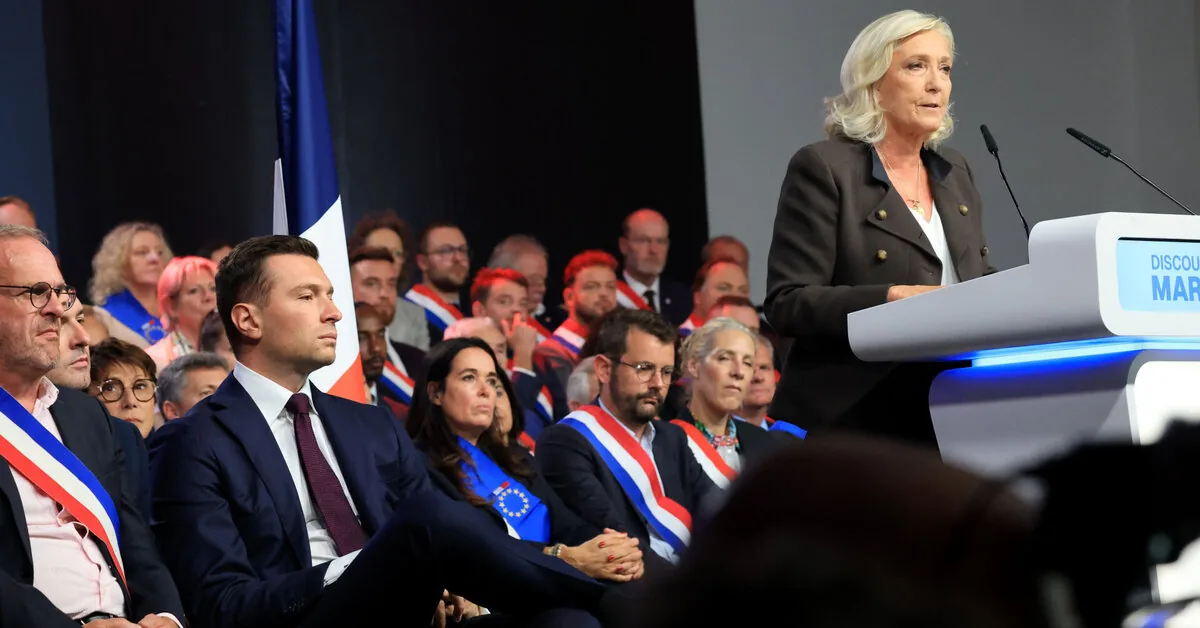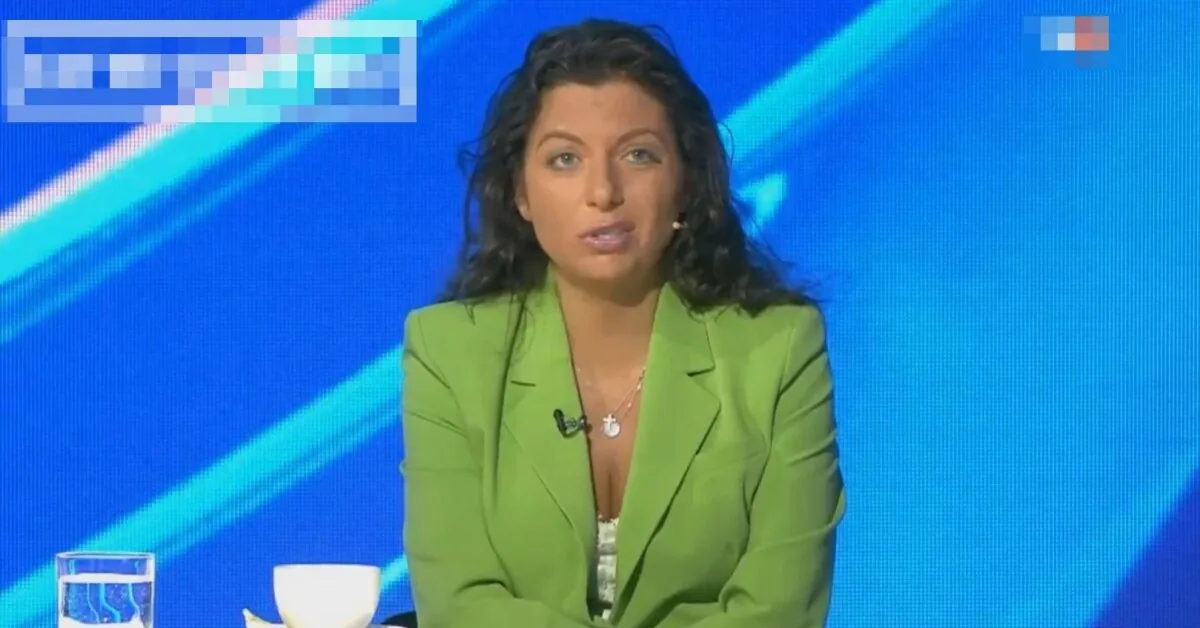
The statement was made in Margarita Simonyan’s interview with Roger Köppeli, the editor-in-chief of the Swiss weekly “Die Weltwoche”.
Read more Dunojus revealed new treasures: no one expected to see this legendary ship anymore
The entire conversation pleased the propagandist – the interview was even published on RT, which she controls, on July 8, 2026. It began to spread on social networks a bit later – in mid-August.
This is how M. Simonyan responded to the question about Russia’s responsibility:
“Sometimes I feel that you in Europe have really all gone a bit crazy. Please tell me, in these five years has a single Russian missile flown anywhere into Europe? No. Please tell me, has a single Russian tank gone anywhere into Europe? No. Let me finish. Has a single Russian combat aircraft flown anywhere into Europe? No.
And how many European missiles, tanks, and aircraft have flown, gone, and flown into Russia during this entire time? Thousands. And after all this, you ask me about Russia’s responsibility. Is Russia responsible? Russia has not touched Europe with a finger. It is Europe that sends us its tanks, aircraft, missiles, drones, causes transport collapse, fuel crisis, and everything else. We have done nothing so far.
And after all this, you ask about our responsibility. It’s like saying: there are twenty people beating one person. What is his responsibility for not pulling out the pistol, which, by the way, he has, and not shooting them all? What is his responsibility for still suffering while being beaten and not wanting to shoot them all yet?
We have no more responsibility to you. You have been hitting us with your missiles, tanks, aircraft, your intelligence, and everything else for five years. You are destroying Russia. We have not done even that much to Europe yet.”
Not a Random Western Journalist
Essentially, this part of the interview can be considered the axis of the entire conversation – perhaps even the main reason why it happened at all. Recently, spreading Russian narratives to Western audiences has not been so easy, and speaking with a truly independent media representative, M. Simonyan could hardly expect to avoid uncomfortable or critical questions. However, the interlocutor of this conversation was also not chosen by chance.
Roger Köppeli is a Swiss journalist, editor-in-chief and owner of the weekly “Die Weltwoche”, previously heading the German daily “Die Welt” and working in the Swiss parliament.
After Russia’s invasion of Ukraine, he traveled to Moscow several times, communicated with Vladimir Solovyov, criticized Western sanctions, and provided commentary to RT. At the end of 2025, Switzerland even began to consider whether R. Köppeli could face EU sanctions for spreading pro-Russian narratives.
The accusations made by M. Simonyan against the West during the interview are not a random emotional outburst. Her arguments echo broader narratives constantly repeated in the Russian information space: Russia is portrayed as a defending and constantly provoked party, and responsibility for the war and its escalation is shifted to the West.
That is why this statement is worth breaking down in more detail – several propaganda argumentation techniques operate simultaneously within it.
Selective Fact-Picking (cherry picking) and Misleading Context Presentation
The claim that “not a single Russian missile flew into Europe” is technically accurate because Russia has so far not dared to directly attack Europe.
However, M. Simonyan consciously ignores a crucial fact: since 2022, Russia has been conducting a large-scale invasion of Ukraine – a sovereign European state, which geographically is part of Europe and has had EU candidate status since June 2022.
The manipulation here lies not in a false fact but in a selectively chosen definition that removes an essential circumstance from the overall picture.
This propaganda technique, where selective fact-picking is performed, is called “cherry picking” in English, presuming that the speaker selects only the facts that suit them and confirm their truth from the broader context.

It is important that this propaganda technique does not necessarily rely on lies. On the contrary – individual facts can be entirely accurate. Manipulation begins when only what is useful for the desired conclusion is selected from the whole picture, while inconvenient details, contradictory facts, or broader context are simply left out of frame.
Researchers classify this method as information selection manipulation: the audience is shown one side of reality while historical circumstances, systemic causes, or other outcomes that could change the impression are omitted. This method is actively used by Russian propaganda sources.
That is why such a narrative works – it sounds logical and is based on facts, but the person sees not the whole picture, only a carefully selected fragment of it.
Turning the Victim into the Aggressor
During the interview, another technique favored by Russian propagandists was used – the so-called DARVO scheme (Deny, Attack, Reverse Victim and Offender).
This term was proposed in the late 20th century by psychologist Jennifer J. Freyd to describe a common defensive behavior pattern in abusive relationships, especially typical of sexual abusers, narcissistic and antisocial individuals.
It is a reaction where a person criticized for their actions first denies or belittles them, then attacks the accuser, and finally portrays themselves as the victim.

Simply put, it is the same toxic ex scenario described in popular psychology magazines: “you are imagining everything,” “you provoked me,” and finally – “after everything I did for you, am I the bad guy here?” This formula works almost literally in Russian propaganda.
M. Simonyan’s argument develops similarly. Russia’s role in starting the large-scale war is pushed aside, and the very question of Kremlin responsibility is met with an attack – “you in Europe have all gone crazy.”
Then the roles are completely reversed – Russia in her narrative becomes the country that Europe has been attacking for five years, and Western countries supplying weapons to Ukraine are the real aggressors. In other words, the question “what is Russia’s responsibility?” is replaced by another – “why do you blame Russia if you yourselves are to blame for everything?”
This role reversal is not just a rhetorical effect. Experimental DARVO studies show that this scheme can change audience perception – people who hear it tend to see the accused party as less responsible and assign more responsibility for the conflict to the victim.
Although DARVO was initially studied in the context of interpersonal violence, its application in institutional and political communication is already being examined in scientific literature.
False Analogy and Playing on Emotions
M. Simonyan also uses a false analogy and seeks to evoke a very typical empathy in people. She compares Russia to a person allegedly beaten by twenty attackers, who still patiently does not draw a pistol.
With such efforts by M. Simonyan, Russia is immediately placed in the victim’s position, although it was precisely Russia that started the large-scale invasion of Ukraine in 2022. Western countries supplying weapons to Ukraine become the “beaters” in the analogy, although their support appeared during the ongoing war.
The false analogy works in propaganda because instead of a complex causal relationship, it offers a simple and easily understandable comparison.
The audience no longer needs to evaluate who started the war, what the sequence of events was, or why Ukraine receives military support – they are presented with an image of one person being beaten by a crowd. Thus, the argument is diverted from fact analysis to an imposed conclusion.
Read more Walmart profit exceeded forecasts despite slower sales growth in the USA
There is also an important emotional element here. The comparison to a beaten person automatically arouses sympathy for one side and anger towards the other.
In propaganda, emotional manipulation is often used to overshadow rational evaluation. The stronger the reaction the story provokes, the less attention remains for its logic and omitted circumstances.
M. Simonyan’s comparison works exactly like this: the listener is imposed a very simple moral choice – either sympathize with the beaten person and be “good,” or side with the beaters.
Why Are Emotions So Important in Propaganda?
A scientific analysis published in 2020, with the telling title “Reliance on emotion promotes belief in fake news,” revealed shocking findings.
Emotionally charged content in propaganda is not just a stylistic device. Anger, fear, or indignation can directly weaken a person’s ability to distinguish false information from true.
Studies show that a strong emotional state increases the likelihood of believing fake news. And here one nuance is important: the problem is not necessarily that a person “cannot think” or is insufficiently educated.
In the analyzed experiments, it was enough to encourage participants to decide more based on feeling than logic, and they significantly more often judged false headlines as true.
In other words, propaganda does not need to convince a person with a complex chain of arguments. Sometimes it is enough to make them angry. Strong emotion becomes a kind of noise that hinders critical evaluation of information: first, we react, and only then – if at all – we ask whether what we just read or heard is really true.

This explains why disinformation content is so full of themes of threat, humiliation, betrayal, injustice, or impending catastrophe.
Previous studies show that negative emotional language is usually more abundant in fake news than in true news. Such a message not only conveys information – it primarily seeks to provoke a reaction.
More importantly, this effect is not necessarily limited to people whose political views the message already matches. Another analyzed study found that emotional arousal generally weakened the ability to distinguish truth from lies, regardless of whether the information was ideologically convenient.
This means that anger or fear can become a more universal disinformation tool than a simple attempt to confirm or reinforce the audience’s existing beliefs.
On social networks, this mechanism is further amplified by the information environment itself. One post can upset a person, and the emotional state it causes can affect the evaluation of a completely different message.
Therefore, a constant stream of anger, fear, and indignation creates a very favorable environment for propaganda: the audience is considered emotionally charged, and critical thinking works worse in such a state.
Simply put, emotion is useful for propaganda because it makes a person feel first and only then think or verify information. And the stronger the initial reaction, the more likely it is that part of the audience will not reach the second step at all.
Hint at a Nuclear Response
During the interview, M. Simonyan also used one of the Kremlin’s main “tricks” – nuclear threat rhetoric.
Speaking about the “pistol that exists,” but which the allegedly beaten person “still does not use,” she did not specify a particular Russian response but allowed the impression that the country has much more dangerous means and consciously does not use them yet.
The threat is presented as a vague promise of aggression but framed as a supposedly long-restrained possibility of “self-defense.” This principle has long been used in threats of nuclear escalation by top Russian officials and even Vladimir Putin himself.

Disinformation analysts from “EUvsDisinfo,” analyzing Russian nuclear rhetoric, identified a recurring threat scheme – often started by Vladimir Putin himself – with ambiguous hints about possible use of “all available means.” Then state Russian media figures specify these hints and turn them into more explicit nuclear weapon threats.
When such rhetoric causes too much backlash, the tone reverses: Russia is portrayed as a country that threatens no one and itself allegedly experiences Western “nuclear blackmail.” At the same time, responsibility for possible escalation is shifted to the West – if Russia takes extreme measures, it would allegedly not be its choice but a response to foreign actions.
An important part of this scheme is constant ambiguity. The threat must be clear enough to scare but vague enough to later claim that no one threatened anyone.
That is why M. Simonyan’s “pistol” metaphor is so convenient: it does not say exactly what is meant but leaves a very clear idea – Russia is still “restraining itself,” but it could stop doing so.
Category Confusion
This narrative is not only a feature of M. Simonyan’s rhetoric. On August 18, Russian Foreign Minister Sergey Lavrov began threatening the United Kingdom – he stated that due to British military support to Ukraine, Moscow could consider the country a party to the war.
The statement came after reports that British-made drones were used for strikes on Russian territory. The Russian Embassy in London, in turn, accused the United Kingdom of deeper involvement in the war and warned of unspecified “consequences.”
In other words, the scheme used in M. Simonyan’s interview is repeated in official Moscow rhetoric: Western military support to Ukraine is presented as direct war against Russia. This is category confusion, where arms supply and intelligence assistance are equated with military aggression, although from the perspective of international law, they are not the same.
According to Article 51 of the UN Charter, an attacked state has the right to individual and collective self-defense and can request assistance from other states.
An analysis by international law experts published by “Just Security” emphasizes that Ukraine can request assistance from other states on the basis of collective self-defense precisely because it is a victim of Russian aggression. Russia cannot rely on such a right in this case because it has no justified grounds for self-defense against Ukraine.
In M. Simonyan’s argument, this difference is erased. The phrase “you have been hitting us with your missiles, tanks, and aircraft for five years” creates the impression that Western countries themselves are directly attacking Russia.
Thus, two different things are put into one category – the invasion started by Russia and the support provided by other states to the attacked Ukraine. Because of this, the question of cause and responsibility is reversed again: the state that started the aggression is presented as the attacked, and the countries providing aid to its attacked state are portrayed as aggressors.
Read more Historic moment: Uber launches the first robotaxi services in Europe in Zagreb