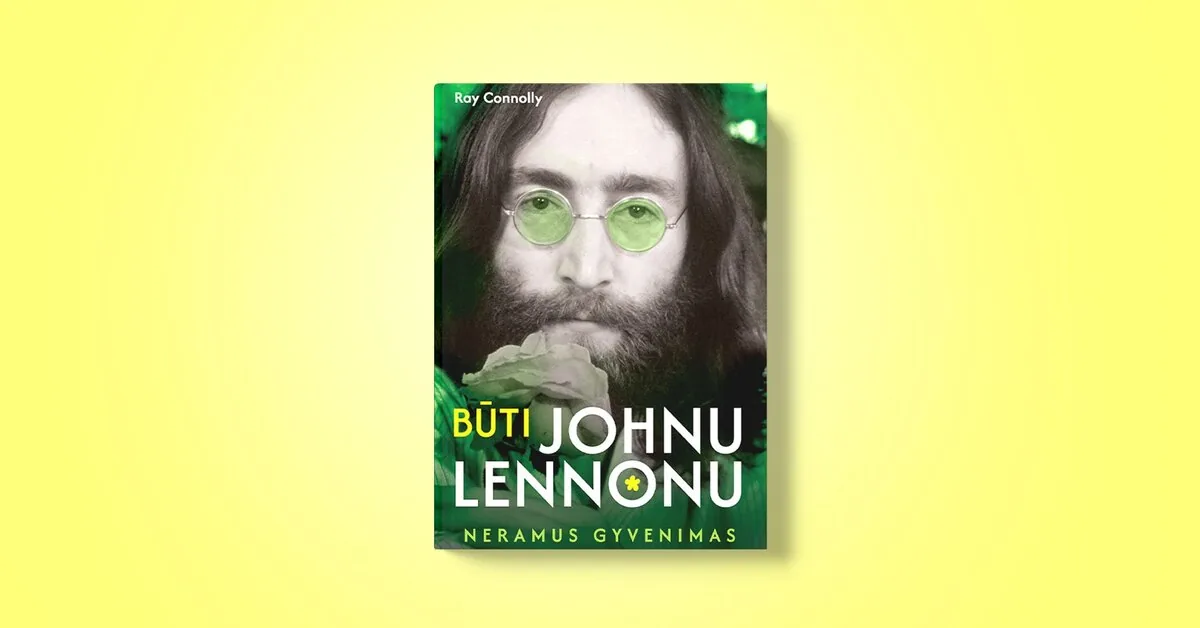
What did it truly mean to be John Lennon: an outcast child, a middle-class boy pretending to be a working-class hero, and a genius who disliked his distinctive voice so much that he constantly masked it in recordings? The book’s author, who knew Lennon personally, shatters the myth of the idealized prince of peace from the song “Imagine” and reveals the true creator – vulnerable, capricious, and torn by contradictions. In these pages, John Lennon emerges as an incredibly multifaceted personality: a mischievous Liverpool teenager, the wittiest Beatle, a psychedelia guru, an anti-war feminist, and finally, a bohemian multimillionaire who single-handedly destroyed “The Beatles.”
Read more Professional Golf Tour – Gilė Bilė Starkutė’s Career Record
R. Connolly reveals the behind-the-scenes of John Lennon’s personal life and seeks an answer to what truly shaped this complex personality. He openly describes J. Lennon’s relationship with his first wife Cynthia, the guilt over his abandoned son Julian, the life-changing connection with Yoko Ono, and the growing tension among the band members. The author also delves into the creator’s very roots: a difficult childhood, the backdrop of World War II, and the unfashionable environment of the port city of Liverpool. All of this helps to better understand what it meant to be John Lennon.
The book was translated from English by Mantas Tamulevičius.
The “Briedis” publishing house has also released another biography by Ray Connolly, “Being Elvis. A Lonely Life.”
We offer an excerpt from the book.
John withdrew. It was that simple. It was fashionable for students to drop out of college to play in a rock and roll band. But John turned everything upside down. He withdrew from rock and roll and abandoned his dozens of guitars to be more at home and dedicate himself to fatherhood. Dr. Winston O’Boogie, as he wittily called himself during the Lost Weekend, was exiled, and his place was taken by the reborn JohnandYoko duo. John was changing his life again, starting everything from scratch, and even called his life before “Dakota” his “previous incarnation.” And along with the new life, new obsessions would soon emerge.
“Dear Ray,” Yoko wrote to me on a postcard in the spring of 1975. “This news will be hard to digest – John and Yoko have not only started living together, but they are also expecting a baby – due in October!”
This was unexpected… for John too. A couple of years earlier, during one of his rare meetings with Cynthia, he told her he thought he wouldn’t be able to have more children, as such a large amount of drugs must have made him infertile. He was wrong. But for Yoko, it wasn’t so easy.
“She had too many miscarriages,” John would explain. “When she was young, there were no birth control pills, so she went through many abortions and miscarriages. Her stomach probably resembles Kew Gardens in London. <…> But a Chinese acupuncturist from San Francisco said: Be good, don’t do drugs, eat healthy, don’t drink. You will have a child.”
Yoko romanticized the conception. “When John came back, we made love wonderfully, and I got pregnant,” she told a journalist, smiling, and John felt certain it happened on February 6th, six days after his divorce from May. He, like his father, had no doubt he knew the exact moment his son’s life began.
Many years later, Yoko would admit that initially, at forty-two, she wasn’t sure if she really wanted a child and considered having another abortion – but decided not to terminate the pregnancy after seeing how much John wanted to be a father again.
Read more Litgrid begins preparations for the construction of the Harmony Link Gižai substation
And John certainly felt uplifted. He had written half the songs for a new album, but when it became clear that Yoko was pregnant, he pushed them aside. As Julian grew up, John practically didn’t enjoy fatherhood, as Julian’s birth coincided with the peak of Beatlemania. “I already lost one family to create what… Sgt Pepper?” he wrote, downplaying “The Beatles'” most famous album. This time, everything would be different. “I am blessed because I got a second chance,” he stated. And, having no external obligations, he plunged headfirst into fatherhood, driven by the same passion as at the beginning of any other new project. This meant, as Yoko indicated, cleansing his body of alcohol, switching to a macrobiotic diet, and hanging his guitar on a stand. If he ever needed a dose of rock and roll, as a reminder of his previous life, he could get it in the Black Room – as John and Yoko called it – where he kept a jukebox with mostly 1950s rock and roll records. But he hardly ever needed it. He canceled his Billboard subscription, no longer followed pop music charts, although he still watched the careers of the Bee Gees, Bowie, and Elton John, and switched the kitchen radio to a station playing light music adapted for the general public. In fact, the probability of hearing a “The Beatles” song on this station was probably even higher.
While living with May, apart from Yoko, he kept a diary describing daily life, how he “would wake up in unfamiliar places or read incredible things about myself in the newspaper, half of which I did, but the other half – no.” Now the couple ceremonially burned his diary and repeated their marriage vows to each other.
And having started a new life and awaiting the birth of his child, he began a new, morbidly intimate diary, in which he noted everything he did or thought each day. He wrote that he often wished he and Yoko weren’t celebrities and that he could “enjoy a truly private life.” But he realized that such a wish was futile – there was no doubt that he enjoyed the financial benefits brought by global fame. And Yoko even more so. However, for the next four years, he avoided giving interviews.
He had always loved writing letters, so, having no audience beyond the four walls of his home to entertain, he began writing mountains of letters (in fact, on a typewriter, as he worried his handwriting was illegible) to family and friends in the United Kingdom. Although many of them were lighthearted and humorous, some revealed a completely different side of John Lennon than we were used to seeing from his public image – a man who cared so much about his loved ones that he would ask them to send photos of themselves and their children. Mimi received a request to send an old school tie. Although he liked to say that he had left the past behind and that he only cared about the present and the future, his childhood never truly left him.
His cousin Liela had always been his favorite relative. Now she was a doctor, and when she criticized his lifestyle in a letter, he affectionately retorted to the “old boss” that she was being “naive” in judging him, and then vented his spleen on Mimi. He wrote that he was considering taking piano lessons because he could “only play with eight fingers. <…> I’m a clumsy self-taught musician. <…> Mimi never allowed me to have a piano at home, <…> saying it was ‘common’.” And then he added that his aunt still thought he was “untalented” and that he had simply “got lucky.” In truth, Mimi thought no such thing, but the wounds left by their quarrels, known to the whole family, were still bleeding. “She always wanted to castrate everyone (both men and women) and put their balls in an apple pie!” – John concluded this complaint on such a cheerful note.
One person John probably didn’t write to was Michael de Freitas. The press still called him by his “revolutionary” name Michael X. Nevertheless, John signed a petition asking for clemency for de Freitas after a Trinidadian court found him guilty of murder and sentenced him to death. John, a long-time opponent of the death penalty, did not abandon a man he had once trusted and considered reformed, but who had actually swindled thousands of pounds from him and eventually became a murderer. De Freitas did not receive clemency. On May 16, 1975, he was hanged in Port of Spain.
Yoko’s pregnancy was difficult, but during this period John revealed his caring side, as, by doctor’s orders, she had to stay in bed almost all the time. And when she was taken to a New York hospital at the end of September, two weeks before her due date, he also went with her and “slept on the floor,” as he told his stepsister Julia.
Read more „Regitra“ will reduce bureaucracy: what will change for drivers and business?