
Russian propagandists are spreading the version that German investigators suspect Ukraine of staging the so-called “false flag operation” at Leipzig/Halle airport, allegedly aimed at discrediting Russia.
Read more Galvydytė left just a moment away from another final: «It hurts, but maybe it’s enough?»
It is claimed that on August 4, a drone loaded with explosives allegedly crashed into the wing of a Ukrainian An-24 aircraft carrying military cargo, but the explosive device did not detonate.
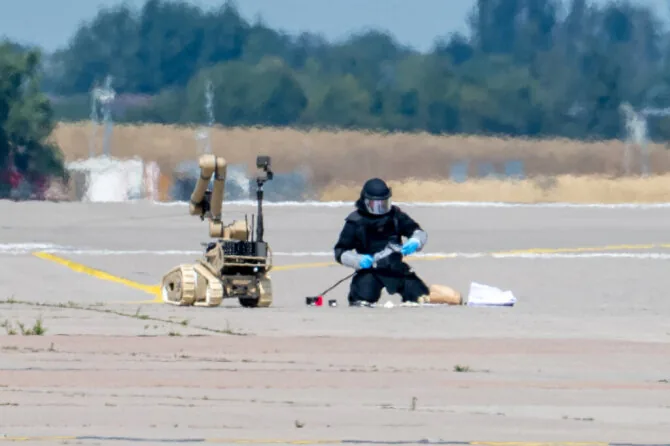
Propaganda reports also claim that DNA traces were found at the scene, and German law enforcement allegedly does not rule out the possibility that the incident could have been organized by Ukraine itself. “The Ukrainians wanted to discredit Russia in this way,” the publication states.
This claim is further developed by invoking French far-right politician Florian Philippot. He stated that Ukrainian President Volodymyr Zelensky was allegedly “caught red-handed” conducting operations that could have caused a “global catastrophe.”
The politician linked drone incidents in Germany and Bulgaria to the Ukrainian leadership and called V. Zelensky a “bloody puppet of the Eurohawks.”
Thus, Russian propagandists are shaping a narrative that Ukraine itself is staging dangerous provocations on European territory and seeks to blame Russia for them.
However, publicly available information shows that German officials have not yet determined who is responsible for the incident.
DNA puzzles
Late on the evening of August 10, a drone with explosives and a detonator was found at Leipzig/Halle airport, near Ukrainian transport aircraft. Surveillance camera footage shows the drone crashing into the wing of an Antonov plane around 7:30 p.m. Fuel tanks are usually installed in the wings.
According to Die Zeit, the footage shows the device bouncing off the wing and falling to the ground. Why the explosive device did not detonate is still unclear. It was later found not on the drone itself but at some distance from it—possibly bounced off during the impact.
Soon after the airport was closed, a plane collided with an unknown small flying object—believed to be a second drone.
Read more: DNA traces from Lithuania found on drone with explosives in Leipzig

DNA traces were found on the drone discovered at Leipzig/Halle airport. According to Die Zeit, the same DNA traces had previously been recorded in Lithuania.
As reported by Bild, this DNA has not yet been linked to a specific individual. However, it is stated that the DNA matches an older trace recorded in 2024 during an investigation of an arson at the DHL logistics center in Leipzig. However, according to Die Zeit, there is currently no evidence confirming a connection between these two cases.
Different versions raised
Die Zeit published three articles mentioning the “false flag operation” version, but none of them claim that German investigators are considering this version. Moreover, the first two articles are texts from the DPA news agency.
In the article published on August 8 “Drone with explosives at the airport – is it Russia’s work?” the focus is mainly on possible Russian responsibility.
It states that a drone with explosives and a detonator was found near Ukrainian transport aircraft at Leipzig/Halle airport. The German Federal Prosecutor’s Office has launched an investigation into the suspected attempt to cause an explosion and danger to air traffic.
The article notes that some experts immediately pointed to Russia after the incident. Russian and military affairs expert Matthias Uhlis said that “at first glance, much indicates that Russian special services could have been involved.”
The article also relies on US media reports, according to which information held by American officials and intelligence also indicated possible involvement of Russian special services.
The Die Zeit text discusses alternative versions, but claims about a possible Ukrainian provocation are not presented as conclusions of German investigators. Such accusations are spread by Russian officials and institutions. For example, the Russian Foreign Intelligence Service (SVR) previously claimed that Ukrainian special services allegedly plan anti-Russian provocations and “false flag” operations, and the Russian embassy in Berlin called the incident itself a Kyiv “provocation.”

The possibility of a “false flag” operation is also mentioned in the publication by M. Uhlis. He did not rule out the theoretical possibility that the attack could have been intended to direct suspicion towards Russia, arguing that “official German institutions have so far clearly refrained from accusing Moscow.”
Read more Seriously ill Bruce Willis attended his daughter’s wedding: see how he looks now
However, the expert did not name Ukraine as a possible organizer of such an operation. On the contrary, assessing the available information, he primarily emphasized possible traces of Russian special services.
Thus, the propaganda narrative essentially reverses the meaning of the publication: the alternative, theoretically mentioned by the expert “false flag” version is presented as a version of a Ukrainian operation considered by German investigators.
The original text does not contain such a position from German law enforcement, and Ukraine is directly linked to the alleged provocation only by statements from Russian officials and intelligence.
Only Russians see Ukrainian traces
In another publication released on August 9, there is also no information that German investigators suspect Ukraine of staging a provocation.
The text quotes a representative of BSW (“Sahra Wagenknecht’s alliance”), Saxony state parliament deputy Bernd Rudolph. The politician urged not to jump to conclusions and not to assign blame to Russia until investigation results are available.
“Speculation is not investigation results. Russia cannot be declared guilty without evidence,” he said.
B. Rudolph added that, in his opinion, another possibility should be checked—whether the incident could have been a deliberately staged provocation aimed at discrediting someone. “It is also necessary to check whether this could have been a deliberate provocation to discredit someone—the so-called false flag operation,” the politician is quoted as saying.
However, two details are important here. First, these are the politician’s considerations, not those of the German officials investigating the incident.
Second, B. Rudolph did not say that such an operation could have been organized by Ukraine—he only urged not to rule out the provocation version.
Therefore, the Russian propagandists’ claim that German investigators are considering a possible Ukrainian “false flag” operation is not supported by this article. The publication presents the opinion of one BSW politician, which in propaganda reports is turned into an alleged version of German investigators.
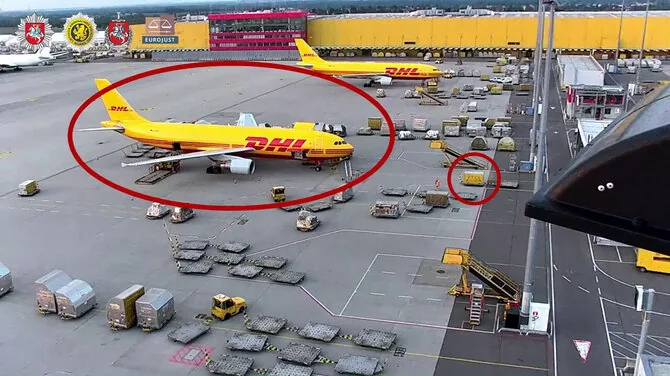
In the third publication, released on August 12, the Ukrainian trace version is indeed mentioned, but again not as a position or conclusion of German investigators, but as one of the possible hypotheses analyzed by the journalists themselves.
The article states that a state-ordered attack is considered likely, and one theory is that Ukraine could be behind it.
The authors consider that Ukraine has experience with drones and could theoretically be interested in a “false flag” operation—an attack that would appear to be carried out by Russia and thus further turn German public opinion against Moscow.
However, immediately after, the authors list the weaknesses of this version. It is emphasized that Germany is already one of the most active supporters of Ukraine, so the benefit of such a provocation would be doubtful. Moreover, Ukraine would have risked its own cargo plane in the attack, and the reaction of German society to such an incident would be unpredictable.
The article then examines a second version—that Russia could be behind the attack. The authors note that Moscow also has extensive experience with drones, is associated with hybrid operations, and, in their assessment, could have a clearer motive.
The article considers whether the attack could have been intended to create fear and political tension in Germany, especially ahead of elections in Saxony-Anhalt and with the strengthening of the pro-Russian “Alternative for Germany” (AfD).
Thus, this publication also does not support the propagandists’ claim that German investigators suspect Ukraine. The “false flag” operation version is presented only as a hypothesis analyzed by journalists, whose weaknesses they immediately highlight themselves, while the scenario of Russian involvement is assessed as much more logical.
15min verdict: lacks context. Russian propagandists distorted the content of German media publications and presented politicians’ and experts’ considerations as an alleged version of German investigators. Although the theoretical possibility of a “false flag” operation was raised in the public space, German law enforcement has not announced that it suspects Ukraine in connection with the incident at Leipzig/Halle airport. Who carried out the attack has not yet been determined.
The publication was prepared by 15min in cooperation with Meta, aiming to stop the spread of misleading news on social networks. More about the program and its rules – here.