Where you can ride
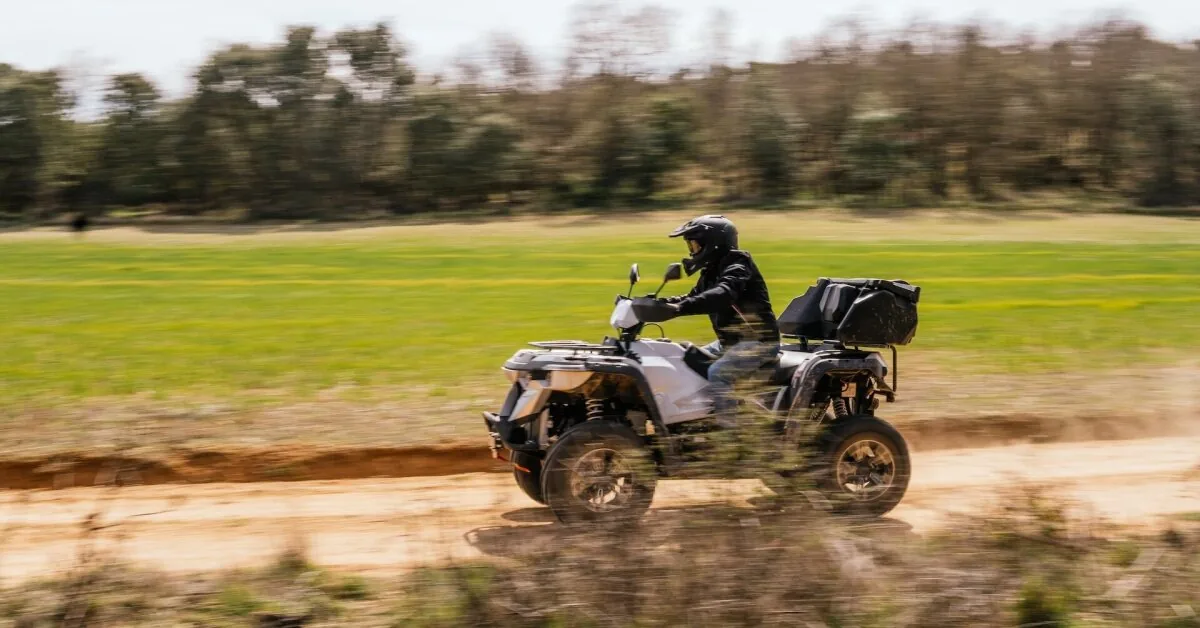
The main rule is simple: roads designated for ATVs, as for any motor vehicle. Registered and technically sound equipment is a legal participant in traffic on state and local roads, gravel roads, and public forest roads – there are thousands of kilometers of these in Lithuania. In protected areas, including national and regional parks, the same logic applies: driving is only allowed on roads, without leaving them.
Before entering the forest, it is worth visually assessing whether there really is a road ahead, for example, a gravel road, and not just a forest floor trampled by others. If in doubt, you can check public map portals kadastras.amvmt.lt and geoportal.lt or inquire at the State Forest Enterprise branch or ranger station – they provide information about forest roads in a specific area. Vehicles should be parked in designated parking areas or at the roadside without obstructing others.
“Before a trip, I plan the route so that I only drive on roads – gravel roads and public forest roads. When encountering pedestrians or cyclists, the speed is reduced to a minimum. This is basic respect, which costs nothing, and at the same time the best way to prove that an ATV in nature can be unnoticed,” says ATV racer and sales manager at the company “Motorider,” Adomas Gančierius.
Where riding is prohibited
Off-road driving is a violation even when there is no prohibition sign. It is forbidden to drive on the forest floor, meadows, swamps, marshes, streams, river or lake shores, and any other natural terrain. It is also prohibited to drive along quarter lines, power line routes, firebreaks, clearings, nature trails, and hillforts – these are not roads.
A separate rule applies near water. The Special Land Use Conditions Act stipulates that in surface water protection zones, motor vehicles are prohibited from driving and parking closer than 25 meters from the shore – exceptions apply only to roads, streets, or parking lots located there. These zones protect shores from erosion, i.e., soil degradation, and pollution.
Private land, rental, and larger dimensions
Driving on private property is only allowed with the landowner’s consent, and businesses renting ATVs are allowed to organize rides in the forest only with a written permit from the forest manager. The renter must also inform clients about the rules of visiting the forest – otherwise, the responsibility lies with them. Routes for competitions or events are coordinated with the managers of the territories they pass through, and in protected areas – also with the relevant park directorate.
Additional planning is required when transporting oversized equipment to the start of the route. Permits to use state roads when driving oversized or heavy vehicles are issued electronically by AB “Via Lietuva”: they are issued no later than three working days and can be valid for one trip, a month, or a year.
Read more Aleksandras Izgorodinas. Declining US inflation, oil price shock, and slowing Chinese growth
How much does ignoring the rules cost
Illegal driving on grassy surfaces or forest floors may result in a warning or a fine from 20 to 140 euros, and if the surface is damaged – a fine of up to 300 euros plus additional environmental damage costs. Parking a vehicle in the forest where it is prohibited carries a fine from 20 to 50 euros. Illegal driving on surface water bodies costs individuals from 300 to 560 euros, and company managers up to 1,450 euros.
It is becoming increasingly difficult to get away with it: offenders are recorded by cameras of protected area directorates and photos from conscientious visitors, and investigations are initiated based on recorded license plates. In spring and summer, environmental officers additionally conduct targeted raids in forests, regional parks, and ATV rental points.
“The biggest problem is that a few people riding off-road in protected areas, often with unregistered equipment, create an image for the entire community. Therefore, responsible drivers are interested in reporting off-road offenders by calling 112 – so they do not ruin the reputation of the whole sector,” emphasizes A. Gančierius.
How to ride so you remain unnoticed
The basis of legal ATV tourism is the “Tread Lightly” philosophy from the USA, called “Invisible Rider” in Lithuanian: no traces should remain after a trip in nature.
So the answer to the question of where you can ride an ATV fits into one sentence: everywhere there is a road, and nowhere there isn’t. Lithuania offers thousands of kilometers of legal gravel and forest roads to drivers who follow these rules, while fines, cameras, and raids remain the problem of those who choose off-road.
Read more Electricity Price Comparison Calculator: now you can also see the price of public electricity supply