From “herrings” and “little Golfs” to million-dollar cars
Yet at the end of the last decade of the previous century and the beginning of the 2000s, life was not buzzing in car dealerships, but in the car markets of Vilnius Gariūnai, Kaunas, or Marijampolė, where “goods” from second hands were transported from Germany through Poland, constantly risking being robbed by roadside bandits.
Read more Iran’s Supreme Leader calls on Muslim countries to unite against the US and Israel
Among drivers, fashion was dictated not by luxury, speed, and power, but by practicality. Especially popular were the “Audi 100”, “Audi 80”, and the German “people’s car” “Volkswagen Golf”, which fascinated Lithuanians newly freed from the Soviet bloc with their quality assembly and durability. At one point, eyes were simply dazzled by the colorful “herrings”, “buns”, and “little Golfs”.
Young people, whose pockets were empty, could afford more serious “muscle” cars – “Opel Calibra”, “Audi Quattro”, “Volkswagen Scirocco”, or “BMW M3 E30”. At that time, you could judge a person’s age and social status by the car standing in the yard: the owner of an “Opel Calibra” was a carefree young man who had just passed his driving test; an “Audi 100” was a family man earning an average income.
Today, after several decades, the state registry data testify to an almost incomprehensible evolution. While enthusiasts in one garage clean dust off a century-old interwar technical masterpiece, in another corner of Lithuania, a hypercar worth several million, with a four-digit horsepower number, sleeps under nine locks.
So how did we grow from dangerous sellers’ journeys along Polish roads to million-euro investments on wheels?
The century-old “Cadillac”: how Lithuania’s oldest car is preserved
Official “Regitra” data reveal an intriguing fact: the title of the oldest registered car in the country currently belongs to a 1923 “Cadillac”. This car is already over a hundred years old and today it is legally adorned with Lithuanian state license plates.
However, maintaining this century-old elder is a big challenge. As the president of the “Retromobile” association, Ramūnas Kardelis, states, ordinary car services are not acceptable for historic vehicle enthusiasts.
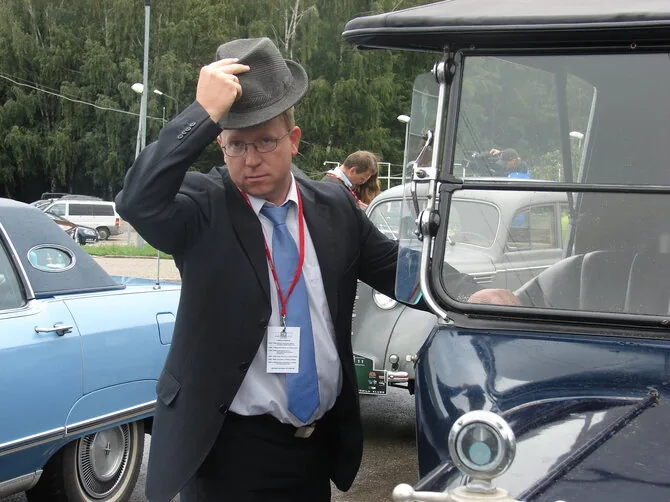
“In our case, it must not only move but also maintain ‘historical truth’, that is, be repaired using the most original parts and materials possible,” emphasizes the speaker.
Interestingly, the hunt for parts for century-old cars resembles a detective story. Authentic parts are searched for with a flashlight. However, R. Kardelis notes that the situation is somewhat easier with American classics – the US automotive industry still produces many parts needed for historic vehicles, from the simplest screws to complex engine assemblies.
“Here you only need funds, and everything else is time and patience,” he says.
While in 2016 there were only 212 vehicles registered in the country with historic “H” marked plates, today their total number in the country has already reached 3,517 units. The annual wave of historic cars – for example, 551 registered in 2020 and 423 in 2025 – shows a steadily growing respect for the history of technology and its preservation.
R. Kardelis highlights two main evaluation directions in the Lithuanian market – global and emotional. On world auctions, German “Porsche”, “Mercedes-Benz”, or “BMW” models remain valuable, treated as a safe investment. However, in Lithuania, there is also a unique phenomenon of Soviet technology, where nostalgia fiercely competes with objective value.
“Soviet technology has little engineering or historical value on the international market, as most of these cars were copies of Western solutions. However, in Lithuania, this technology is valued according to emotional memory. Nostalgia is an expensive pleasure,” explains the association leader.
“Barn finds” in Lithuania are undoubtedly running out. However, enthusiasts believe that a few hundred long deregistered and forgotten vehicles may still be hidden in remote village barns or industrial warehouses.
Lithuanian collectors are still going through a transformation phase. The occupation period pushed Lithuania many years back, also damaging the understanding of transport history. Although we have not yet reached the level of German, American, or Canadian restoration guilds, the movement is heading in the right direction.
“Lithuanians have already crossed the boundary of simple ‘repair’ and increasingly strive for 100 percent authenticity. The fact that a new transport museum opens in Lithuania every year shows that this is important to us,” summarizes the “Retromobile” leader.
Read more What not to say to a cancer patient? Specialist reveals a common mistake

When a car costs millions: what makes the “Bugatti Chiron Super Sport” special
If in the case of Lithuania’s oldest car emotional importance is dictated by time, the most expensive car in the country on the other side of the state registry – the “Bugatti Chiron Super Sport” – tells a completely different story. Here, mind-boggling numbers and engineering mystique collide. What generally turns a vehicle into an object valued at three, five, or ten million euros?
Famous car journalist and expert Vitoldas Milius emphasizes that a car’s value changes through its own life story, uniqueness, and the manufacturer’s name.
“As with every object – for example, paintings – so with cars: the rarer, the more valuable,” explains V. Milius.
“A first-generation, today perfectly restored ‘Volkswagen Golf’ costs approximately 10 thousand euros on the market. However, a limited edition, the legendary first ‘Golf Pirelli Edition’ – already 60 thousand euros,” he says.

This rule works even stronger in the duel of sports car icons, such as the “Lancia Delta” and its cult, rally-prepared “Integrale” version. When factories release a Limited edition series, such models are made to special order and their value rises immediately, even before they have driven a single kilometer.
“Only when the car rolls onto the asphalt and starts driving does its value immediately drop,” emphasizes V. Milius. The longer an item is kept completely untouched, with symbolic factory mileage, the longer its age is guaranteed and the more its value grows at future auctions.
Maintaining and caring for such cars has nothing to do with the standard Lithuanian service concept. V. Milius recounts that when visiting elite “Ferrari” and “Lamborghini” factories in Italy, he saw with his own eyes how specialized car evaluation takes place. If such a unique model needs repair or a specific part, owners do not turn to local suppliers – everything happens through closed channels. For an old retro car or a unique hypercar, parts are made by hand or cast anew at the factory according to original, decades-old drawings.
A thousand horses under the hood – but nowhere to unleash them in Lithuania
So where can you harness thousands of horses and test their power? V. Milius confirms that neither in Lithuania nor in neighboring Latvia, Estonia, or Poland are there tracks that meet the category and safety requirements of hypercars of this caliber.
The legendary “Nemuno žiedas” in Kačerginė, designed during the Soviet era, is in poor condition and does not meet requirements. To really let this engine “breathe” air, the owner has to transport the car to special Formula 1-level tracks in Central Europe – the closest being “Slovakia Ring” in Slovakia or “Hungaroring” in Hungary.
Asked to describe the typical buyer of such cars, V. Milius simply named: wealthy people with a great passion for cars.
“They are simply car lovers who can buy a luxury villa in France but instead choose a rare car,” warmly describes V. Milius the buyers’ psychology. Although resale deals are known in the market, most buyers simply have enough capital to fulfill their childhood dreams.
Since the early 1990s, when a Western car driven from Germany through dangerous Polish roads was the only and hard-to-reach proof of prosperity, Lithuania has come a remarkable way.
In Lithuania, the car has become not only a means of transport but also an investment, a status symbol, and even cultural heritage. Our country has reached a point where two wonderful extremes coexist in its space: exceptional respect for the past, restoring and preserving a century-old interwar period car, and a bold demonstration of modern luxury, presenting the latest world-class hypercars on the country’s streets.
Read more These Zodiac signs are simply made for each other: they attract each other like a magnet