- An unexpected request from Russian war generals to Putin
- Budanov issued an ultimatum to Putin: “You will feel it yourself”
- The Kremlin issued a serious threat to Lithuania: you will be in the crosshairs
All news about Russia’s invasion of Ukraine can be found HERE.
SIPRI: Russia has sharply increased the number of deployed nuclear warheads
09:48
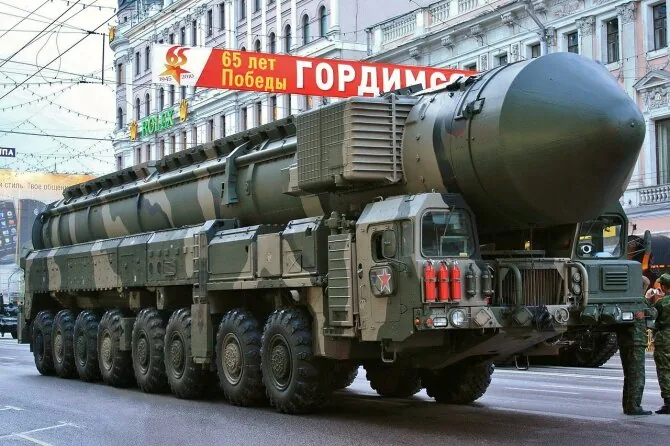
Russia continues to increase the number of deployed nuclear warheads. This is stated in the 2026 annual report “World Nuclear Forces” by the Stockholm International Peace Research Institute (SIPRI).
According to analysts, in January 2026, Russia’s entire nuclear arsenal consisted of 5,420 warheads. Of these, 2,604 were kept in central storage, 1,020 were withdrawn from service and awaiting dismantling, and 1,796 were deployed and ready for use.
Deployed arsenal grows for the fourth consecutive year
The number of deployed nuclear warheads in Russia has been increasing for the fourth year in a row. In 2022, there were 1,588; in 2023 – 1,674; in 2024 – 1,710; and in 2025 – 1,718.
Compared to 2020, Moscow has increased the number of deployed warheads by about 14%. The current figure is the highest since 2017, when Russia had about 1,950 deployed nuclear warheads.
The United States has not changed its number of deployed warheads – it has about 1,770. France and the United Kingdom have 280 and 120 such warheads respectively.
China is also increasing its deployed arsenal: over the year, the number of warheads rose from 24 to 34. According to SIPRI, Beijing’s entire nuclear arsenal consists of about 620 warheads.
What makes up Russia’s nuclear triad
According to SIPRI, Russia’s land forces’ delivery systems can potentially carry up to 1,092 nuclear warheads. About 892 of these are currently deployed on intercontinental ballistic missiles.
The Russian Navy has 13 strategic nuclear submarines with a total theoretical capacity of 928 warheads. However, two submarines are undergoing major repairs, so the actual number of deployed warheads available to the fleet is estimated at 704.
About 586 nuclear warheads could be carried by strategic bombers.
SIPRI notes that in 2025, Russia’s Aerospace Forces suffered operational losses after strikes on military airbases by Ukrainian defense forces. Following these attacks, Russian leadership dispersed part of its strategic aviation, including Tu-160M and Tu-95MS aircraft, to remote airfields.
Modernization of nuclear forces stalls
Although the deployed arsenal is growing, Russia’s nuclear forces modernization program is experiencing delays. Experts link these to Western sanctions, problems in Russian industry, and prioritization of conventional weapons production needed for the war against Ukraine.
At the same time, Moscow continues to deploy new missile systems, including the “Oreshnik” complexes, also on Belarusian territory.
The report separately highlights the increasing secrecy of nuclear arsenals. One reason is the expiration in February 2026 of the New Strategic Arms Reduction Treaty between Russia and the US, also known as “New START” or START III, which was not extended.
SIPRI experts warn that the number of deployed nuclear warheads may increase even faster in the coming years.
“While the total number of nuclear warheads worldwide continues to decline, gradually dismantling retired warheads, the number of deployed nuclear warheads ready for combat use increases annually. This trend is likely to continue and possibly accelerate in the coming years,” the report states.
Drones attacked a military airfield and industrial facilities in Russia: large fires broke out
09:24
Explosions thundered overnight into Saturday in Tolyatti, Samara region, and Taganrog, Rostov region. Fires broke out in industrial areas of both cities after drone attacks, reports UNIAN.
According to preliminary data from Russian monitoring channels, a chemical plant “KuibyshevAzot” in Tolyatti may have been hit. Videos posted by witnesses show a fire in the city’s industrial district. Samara region governor Vyacheslav Fedorchishin stated that air defense reportedly repelled a “mass drone attack” overnight.
“KuibyshevAzot” is one of the larger chemical product manufacturers in Russia. The company produces ammonia, urea, ammonium nitrate, caprolactam, and polyamide. Some of these products are used in industry, and the chemicals may also be important for Russia’s military-industrial complex.
Several explosions also thundered overnight in Taganrog. Later, fires broke out in different parts of the city. According to analysts from the ASTRA monitoring project, one smoke plume rose near the Taganrog-Central military airfield. The 708th Military Transport Aviation Regiment of Russia is deployed there.
Nearby operates the 325th Aviation Repair Plant, which repairs transport aircraft and manufactures their parts. The General Staff of the Armed Forces of Ukraine reported in the morning that one Russian combat aircraft was hit, but did not disclose further details. It is not officially confirmed whether this report is related to the Taganrog airfield attack.
Satellite data recorded another fire at the former Taganrog automobile factory “TagAZ” site. Monitoring channels suggest a tank may have caught fire there. The bankrupt factory’s territory is now used for various industrial and military purposes – it was previously reported that strike drones might be assembled there.
Fires in this area were also detected by NASA’s FIRMS satellite system. Due to the drone attack, Russia’s aviation agency “Rosaviatsiya” temporarily suspended operations at Samara’s Kurumoch airport.
Russia launched massive attacks on Ukrainian cities: casualties reported
08:43
On Saturday night and morning, Russian forces struck Odesa, Kryvyi Rih, Dnipro, and Zaporizhzhia with missiles and drones. There were casualties, injuries, and damage to residential buildings and industrial enterprises.
Odesa regional military administration head Oleh Kiper reported that Russia carried out a massive missile and drone attack on the region’s civilian infrastructure. According to the latest data, at least 12 people were affected, including a child.
In Odesa, the upper floors of an apartment building were completely destroyed. The blast wave damaged nearby residential buildings and a low-pressure gas pipeline. In another location, three more residential buildings were damaged, one of which was completely destroyed. A gas pipeline was also damaged.
Witnesses said the residential complex “Perlyna” in the resort area of Arkadia was hit. People reported significant destruction. Emergency services are working at the attack sites, and operational headquarters have been established.
One person killed in Kryvyi Rih
Russian forces attacked Kryvyi Rih overnight from several directions with ballistic missiles. One person was killed and two injured after a strike on an industrial enterprise.
“The city was attacked with ballistic missiles from different directions,” said Oleksandr Vilkul, head of Kryvyi Rih’s defense council.
Fire broke out in Dnipro
During the night attack, Dnipro was also hit. A fire broke out at an industrial enterprise. Preliminary data indicate no casualties.
Two people killed in Zaporizhzhia
Russian forces attacked Zaporizhzhia overnight with strike drones. One hit a private residential area, causing fires and completely destroying one house.
Initially, two people were pulled from the rubble, but one injured woman died. Later, rescuers found a man’s body in the debris.
According to the latest data, a 64-year-old woman and a 37-year-old man died in the Russian strike in Zaporizhzhia. Another 59-year-old woman was injured.
Read more Rented a van, left Vilnius and got a fine: what happened?