The decision was made on Friday at the Vilnius Municipality Emergency Situations Operations Center (ESOC) meeting, BNS was informed by the operations manager Dalius Krinickas.
“There were several decisions. The amount presented for August–September (VKJ – BNS) will only be enough for the incineration of the current flow of combustible waste. About 2660 tons of waste per week. This amount corresponds to the current flow of combustible waste and there is also an additional amount above this – it will also satisfy the quantities for Alytus and Utena. So there will be no accumulation (of waste – BNS),” D. Krinickas told BNS.
“For the Vilnius region, it would be 2660 tons of waste per week (incinerated – BNS), for the Utena region – 105 tons per week, for the Alytus region – 210 tons,” he added.
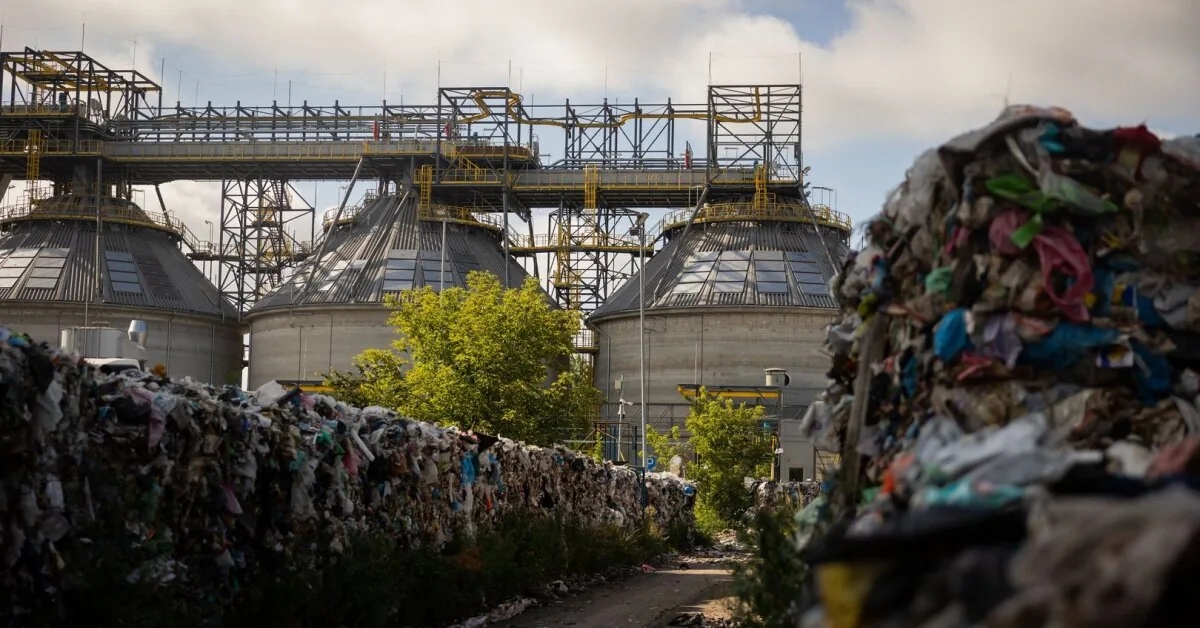
As BNS wrote, the daily waste flow – about 700 tons – in the Vilnius region is sorted by three waste management companies – “Ecoservice,” “Ekonovus,” and “Ekobazė,” which supply the combustible part to the power plant. Meanwhile, waste supplied from the MBA plant to VKJ accumulates on its territory.
D. Krinickas emphasized that the incineration quantities were discussed together with the Regional Waste Management Centers (RATC).
“We received messages from the heads of the Alytus and Utena RATCs addressed to VKJ with a request to start acceptance from Monday according to these quantities. We also know that the three RATCs have discussed these quantities among themselves so as not to cause waste accumulation in any region,” he explained.
Currently, VKJ incinerates up to 450 tons of waste per day. VKJ representative Rima Aukštuolytė previously told BNS that the plant incinerates less waste due to clogged filters, which are gradually being replaced without stopping the plant.
A representative of Vilnius Municipality explained that lower incineration capacities will avoid planned plant maintenance.
“This reduced amount for August–September provided by VKJ is motivated by the fact that in this case, it will not be necessary to stop waste incineration at the plant for planned maintenance. This is basically good because then the amount of combustible waste will not accumulate in the region,” D. Krinickas said.
D. Krinickas emphasized that the incineration quantities were set based on the schedule provided by VKJ. According to him, VKJ’s incineration capacities will increase from October.
“From October, VKJ’s capacities will increase. In October–December, it will be possible to incinerate from 500 to 550 tons of combustible waste. From October, we will also be able to incinerate combustible waste from the MBA territory,” he explained.
VAATC plan will have to change
According to D. Krinickas, with VKJ stopping waste acceptance from the MBA plant, the plan of its operator, the Vilnius County Waste Management Center (VAATC), will have to change.
“Since in August–September we will incinerate smaller amounts and it will not be possible to supply waste from the MBA territory for incineration, the long-term plan of VAATC is slightly postponed – preliminarily by two months. Today at the Emergency Situations Operations Center, we also instructed VAATC, considering VKJ’s incineration quantities, to update the plan by September 14,” the municipality representative explained.
He also said that according to the meeting decisions, orders will be signed: “These are already decisions of the operations center. Accordingly, after the protocol is signed, I will prepare the operations manager’s orders, where I will write instructions to the institutions.”
The head of VAATC said at the end of July that first, over a couple of months, the area where about 20,000 tons of waste have accumulated will be cleared, and then they will look for someone to restore the plant that burned down last year by the end of the year.
Read more Hungary may terminate the contract with «Rosatom» for nuclear construction
At the beginning of August, he said that they are looking for a territory where the combustible waste currently on the plant’s territory could be stored.
According to D. Krinickas, storage would help clean up the plant’s territory faster, but even if a suitable land plot is found, it would take time: “We cannot set it up immediately within a week. So this will not solve the problem in the short term, but it will definitely solve it in the longer term.”
Vilnius continues to look for storage space, Alytus hopes to avoid crisis
Meanwhile, VAATC states that it is currently “adjusting the deadline for the complete removal of waste accumulated in the Vilnius MBA territory according to the current situation and circumstances.”
“We expect to restore the plant’s territory by December 31. At the same time, we are looking for temporary solutions for the temporary storage of sorted waste until VKJ can increase waste incineration norms,” VAATC communications manager Germanas Kavalskis told BNS on Friday.
According to him, if the work proceeds faster, the waste may be removed sooner: “We are simply planning according to a realistic, not optimistic scenario.”
As G. Kavalskis told BNS, they are looking for opportunities to increase waste processing volumes and reduce their quantities on the territory. In addition, several options are being considered for where sorted waste could be temporarily stored.
“We are analyzing what preparatory work would be needed for specific locations to meet the requirements for waste storage. When we have a final decision, we will inform about it,” he said.
In turn, the director of the Alytus Regional Waste Management Center (ARATC), Aurimas Uldukis, told BNS that if VKJ accepts 210 tons of sorted waste for incineration each week, the threat of a waste crisis in the Alytus region will no longer arise.
“The waste started to accumulate, and we would have been in a critical situation in about 30 days. But since we managed to agree and coordinate these quantities, and with 210 tons per week we can function normally, there is no threat that a crisis will arise here,” A. Uldukis said to BNS on Friday.
According to him, ARATC will operate in “accumulation mode,” but it is expected that temporarily, until the repair at the Kaunas cogeneration plant is completed, by transporting part of the sorted waste to VKJ for incineration, the waste will decrease and the situation will normalize.
“We have now agreed that sorted waste should leave us on Monday, so let’s hope that this will happen,” A. Uldukis said.
As the Ministry of Environment announced on Monday, Vilnius ESOC was instructed to prepare an updated long-term plan within three days on how the waste flows of the Vilnius, Utena, and Alytus regions should be distributed.
Vilnius Mayor Valdas Benkunskas said on Monday that the country’s waste incineration capacities are a “bottleneck” in their management chain and that this is a matter for the central government, not municipalities.
BNS wrote that the waste crisis in the Vilnius region arose due to last year’s fire at the Vilnius waste sorting plant, which has not yet been restored, and VKJ’s reduction of waste incineration volumes.
Read more Signal also for Lithuanians – Poland cut VAT on fuel