Parliamentary elections are likely to take place in Italy in the first half of next year. “Everyone I met in Rome started discussions about them with the ‘Vannacci effect’ – an impressively rising politician who wants to change Italy’s foreign policy,” notes the analyst.
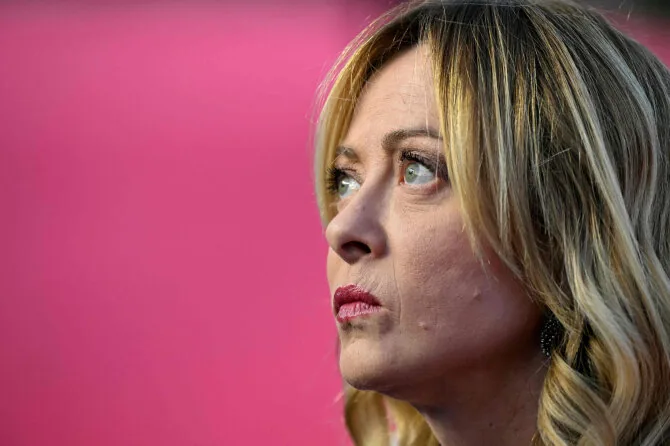
The government led by Giorgia Meloni achieved an unusual record this autumn – it became the longest continuously serving cabinet in the history of the Republic. In about 80 years of the Republic, Italy has been led by as many as 68 governments. Therefore, political stability is not a given.
Her party, Brothers of Italy, still holds a rating of about 27% – almost the same as four years ago. But G. Meloni’s partners are much weaker. Matteo Salvini, who does not hide his pro-Russian views, can criticize arms supplies to Ukraine and sanctions against Russia, while Antonio Tajani supports close ties between Italy, the EU, and NATO. G. Meloni balances the direction.
Contrary to critics’ predictions, G. Meloni chose a pragmatic stance: she maintained support for Ukraine and avoids conflict in relations with the EU. Italy’s defense spending has also increased: from 1.5% of GDP in 2022 to 2.1% this year (nominally – from €30 to nearly €50 billion). On the international stage, she was not only not isolated but earned a solid status.
Former General and Military Attaché in Moscow Roberto Vannacci

And here comes Roberto Vannacci – a former general and military attaché in Moscow, from where he was expelled in 2022 along with other diplomats. Until recently, he was almost unknown. Everything changed with his book published in 2023, which became a bestseller.
In February 2026, Vannacci, already a member of the European Parliament, after a phase of political flirtation, split from M. Salvini and founded “National Future.” Now this party polls around 7.5–8%. This is more than both smaller parties in G. Meloni’s coalition separately. His voters could become crucial in deciding whether G. Meloni will have enough votes to remain in the majority after the next elections.
Chose Putin

R. Vannacci’s program proposes “remigration” – the return of some migrants to their countries of origin, stricter family reunification and citizenship rules, greater support for large families, the abolition of civil unions, and stricter abortion policies. He calls to resist the Green Deal, stop arms supplies to Ukraine, not increase defense spending according to NATO agreements, restore dialogue with Moscow, and resume Russian gas imports (before the large-scale invasion, Russia supplied about 40% of gas; imports have almost disappeared, but in summer 2026 gas still cost on average 1/3 more than in 2021. So there is a niche for this proposal among voters).
He himself rejects the label of pro-Russian politician and says he is “for Italy and Europe.” Asked whom he would choose – Vladimir Putin or Volodymyr Zelensky, R. Vannacci chose V. Putin last year.

“The promise to change policy towards Russia has an audience. Polls show that 34% of Italians would like the West to pressure Kyiv to seek peace at the cost of territorial concessions, another 15% would like to end support. 52% would be ready to buy Russian gas again, and 58% oppose higher defense spending. So the direction chosen by G. Meloni is far from self-evident.
This does not mean that Italy will turn away from NATO or change its geopolitical direction after the next elections. However, maintaining the current line will not be easy. As the vote approaches, domestic policy will take up more space on G. Meloni’s agenda. The same applies to France, which is preparing for presidential elections. The political situation in Germany is also fragile, so the upcoming cycle for important decisions in Europe looks unfavorable,” says L. Kojala.