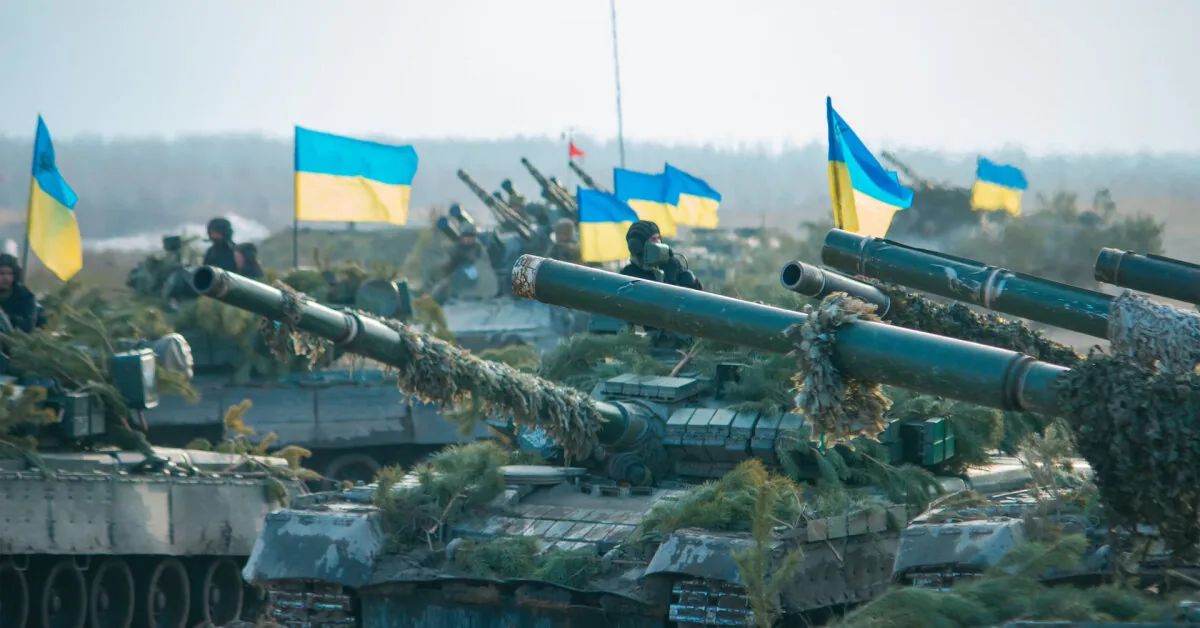
The only thing missing from this picture was the tanks that gave the 33rd Separate Mechanized Brigade battalion its name.
Read more Vilius Gaubas – one step away from the main US Open tournament
These armored vehicles, which until recently were the most coveted Western weapons, now stand almost unused, hidden somewhere in the forests and covered in cobwebs.
It turned out that these hard-won $10 million combat vehicles are no match for the cheap drones that now dominate the battlefield. Nevertheless, Ukraine still cherishes them and trains soldiers to use them, while trying to find new ways to apply them on the front line.

“We practically do not use armored vehicles,” former commander of the Ukrainian Armed Forces Oleksandr Syrskyi stated earlier. “This leads to another question: how can we give our armored vehicles a new life?”
This question also became central to a dispute over military strategy, which cost Syrskyi his post as commander of the armed forces last month.
But some of Ukraine’s best tank divisions are not waiting for an answer.
“Tank crews should not get stuck in one place,” said the commander of the 33rd Division, who, like most soldiers, gave only his call sign – “Morpheus.” He instructed his soldiers to learn something new.
“Everyone laughed at the Russians”
Requests for Western tanks from Ukraine were heard almost immediately after Russia launched a full-scale invasion in February 2022. At the time, they seemed vitally necessary.

Ukraine’s allies resisted their transfer until January 2023. However, after intense negotiations and increased public pressure, the United Kingdom, Germany, and the United States changed their stance.
Partly for this purpose, the 33rd Brigade was formed. It was supposed to receive Western tanks. However, when they appeared on the battlefield in late spring, cheap drones were able to damage their weakest points and cause irreparable harm.
Russian forces were the first to start covering their tanks with anti-drone nets and special metal cages.
“Then everyone laughed at them, saying they were making barbecues,” recalled the 33rd Brigade’s tank maintenance commander, call sign “Energetyk.” “But they were moving in the right direction.”
In an attempt to keep its tanks effective on the battlefield, Ukraine also soon followed suit: mounting protective cages and reactive armor – external plates that detonate upon impact, deflecting incoming projectiles – on heavy armored vehicles.

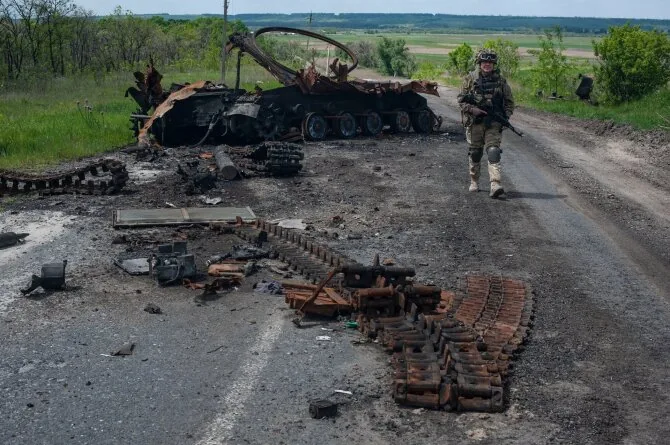
Despite the efforts, it wasn’t long before both sides completely stopped using heavy armored vehicles for direct assaults.
“No rest”
Tank crews must always be ready, stated the company commander, call sign “Fin.”
His men are constantly engaged in exercises, the intricacies of tank maintenance, and welding new protections.
“Whether there are combat operations or not – there is no rest,” said the 26-year-old soldier, playing with his fingers with his talisman – an image of the Virgin Mary, hanging on a black braided bracelet.
The 33rd Regiment conducts firing exercises every two weeks to maintain its skills. One sunny morning, soldiers brought a tank between sunflower fields and set up targets.
Meanwhile, commanders and other soldiers sat in a makeshift gazebo, shelling sunflower seeds and sipping Pepsi.
57-year-old Yuriy Kosenka had just returned after two weeks in frontline trenches, which, according to him, were damp and moldy.

There were no tank battles. But there were so many “mosquitoes,” the soldier recounted, scratching his arm and pointing to the sky, implying he meant both biting and exploding ones, that he had to take a drone detector to the toilet.
Like most other servicemen, Yuriy admitted that he didn’t mind not participating in combat, as he had already seen enough battles.
“War is war. There is nothing to like about it,” he said, as the crew loaded the tank with shells.
Soon the soldiers climbed into the tank and turned the cannon. The first few shots were inaccurate. Orders flew over the radio, demanding a course correction.
Three more shells were fired. Only half of the soldiers flinched at the roar of each shot.
“You missed,” the commander’s voice was heard again over the radio.
“We know – we can see it from here too,” replied one of the crew members.

By then, the liter bottle of Pepsi was almost empty. Tank driver “Mechan” pulled out pancakes stuffed with minced chicken, which he had brought from his recently ended vacation, and shared them with his comrades.
Read more August 27th horoscope: astrologically most significant day of the year
“I once burned inside a tank”
Today, 57-year-old fighter “Energetyk” works in the forests of the Kharkiv region, far from the front line. Birds chirp there, the smell of wood hangs in the air, and camouflage nets among the trees can only be noticed upon close inspection.
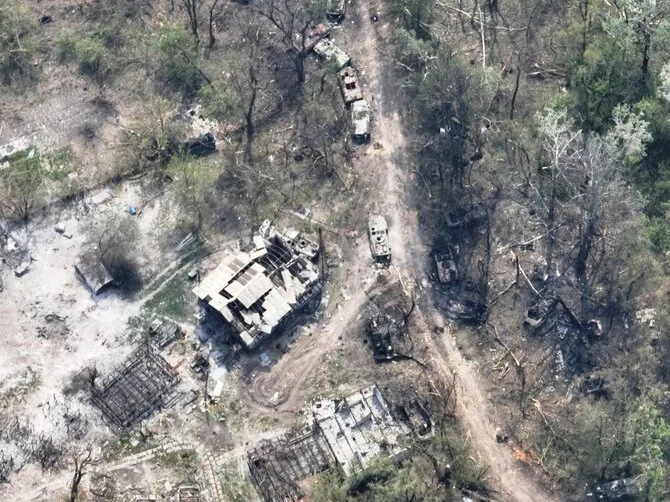
Under those nets stand German “Leopard” tanks, their turrets turned back to the “travel position.” Some armored vehicles are awaiting repair or maintenance, such as an oil change. Others, like the one covered in cobwebs, stand in reserve, ready for combat, although such orders have not been given for a long time.
The soldier, call sign “Energetyk,” supervised a team that was changing the engine of a tank that had hit a mine and caught fire. Another tank took a direct drone hit to the turret, he recounted, gesturing towards the armored vehicle’s position as he walked down a muddy forest path with ammunition slung over his shoulder.

It turns out that the damage was done not during combat, but during “evacuation,” when tanks were needed to tow damaged equipment, essentially turning them into monstrously expensive tractors.
Even then, added a Ukrainian defender smoking a cigarette nearby, nicknamed “Archie,” tanks can only go on missions in bad weather, when there are fewer drones in the sky due to wind, rain, and poor visibility.
According to the soldier, if the internet connection were more stable, he could use his free time for learning and perhaps improve his German language skills.
57-year-old “Archie” admitted that he wouldn’t mind returning to combat missions. However, a fighter 30 years younger, nicknamed “Golden,” who was waiting to drive the tank to a net-protected area, said he wanted tanks to stop being used altogether.
“I once burned inside a tank – that’s enough for me,” the soldier said with an uncomfortable laugh, recounting how he narrowly escaped with his life.
“You close the hatch, drive out, and don’t know if you’ll return”
After live-fire exercises, tank driver “Mechan” and his crew returned to the small house where they all live. Here, the refrigerator is filled with treats prepared by his wife. The soldier hung up his weapon and exchanged his sweaty overalls and dusty boots for shorts and sandals.
The man sat on his bunk and, before starting to cook his wife’s potato dumplings, said that after working with old Soviet T-64 tanks, he was very much looking forward to switching to Leopards.
“It’s like driving a Mercedes or a BMW,” he laughed, giving two thumbs up, “but now I drive rarely, mostly when something needs to be towed.”
The Ukrainian defender showed a video of his tank towing a burnt car across a field. He feared that without constant practice, he might lose his skills, so even such tasks seemed not bad to him, despite being dangerous.
Dima, sitting on the bunk opposite, questioned whether it was worth using Leopard tanks as tow vehicles, as it poses a threat to both the armored vehicles and their crews.
“And for what? To pull out a burnt car?” he fumed.
It’s better to retrain and learn to operate drones, the soldier added – which is exactly what fighter “Mechan” did at night, practicing with a control panel by his bed.
Piloting drones seemed strange and unusual to him, but the man admitted that the era of tanks was over.
Ironically, some newcomers to the 33rd Brigade have never even touched a tank. Among them is a 33-year-old soldier, call sign “Koržyk,” who joined the brigade in 2025. Now he spends his days in dark workshops, repairing ground drones.
Working alongside him, 37-year-old squad leader “Johnny” also used to drive tanks, but when he received an offer to transfer to the ground drone unit, he didn’t hesitate for a moment.
He noted that when driving a tank, “you close the hatch, drive out, and have no idea if you’ll return.”
End of an era?
Squad leader “Fin” asserted that tanks would not be pushed aside, as new technologies would help them adapt. He speculated that perhaps they would be equipped with artificial intelligence to create protective domes, or drone interceptors.
Back at the command post, fighter “Morpheus” said that about half of his battalion’s soldiers had retrained as drone operators.
“It’s important to find ways to utilize our personnel,” he noted, looking at numerous screens.
The soldier added that a major technological breakthrough would be needed to bring tanks back into battle.
“I am convinced that tanks still have a future, but there is one caveat,” he emphasized, adding: “I think they will be unmanned.”
This article was published in „The New York Times“.
© 2026 The New York Times Company